+33-9-7266-3068
 contact@gdm-pixel.fr








The question makes you uncomfortable. Because the answer, most of the time, is “I’m not really sure” or worse, “not much”. And yet, you paid someone to create it. You approved the design, reviewed the copy, chose the colors. The site is there. It’s running. It costs hosting fees every year.
But it’s not working for you.
It’s not a matter of luck. It’s not fate either. It’s a visibility problem — and visibility on the web is called search engine optimization. Not magic, not jargon: precise rules that Google applies mechanically, and that most SME websites in Normandy don’t follow.
Here’s what we actually see at our clients when we conduct an audit.
What Google Really Looks For (And What Your Service Provider Didn’t Tell You)
Everyone has heard of “keywords”. Fewer people understand how Google actually decides which website deserves to appear on the first page.
The reality is simpler than people think, and more demanding than they hope.
Google is trying to answer a user’s question. Its algorithm evaluates whether your page is the best available answer to that specific question. Not the best site in your industry. Not the most beautiful. The best answer to that particular question, on that particular day, for that particular user.
In practical terms, that means three things.
Your content must address the topic in depth. A 150-word page that says “We are a plumber in Caen, contact us” doesn’t answer anything. It exists, that’s all. By contrast, a page that explains when to call an emergency plumber, average rates in the region, questions to ask before signing a quote — that page answers something concrete.
Your site must be technically sound. Loading time, mobile compatibility, page structure, internal links: Google analyzes all of this before it even reads your content. A slow site on mobile is penalized, period.
Your site must build trust with Google. This is what we call domain authority: do other reputable sites mention you? Do you have Google reviews, mentions in local press, partners who cite you? Without that, even excellent content struggles to rank.
“SEO isn’t a button you press. It’s a reputation you build, online, over time.” — What we repeat at every first client meeting.
The 4 Errors Sinking SEO for 90% of SME Websites
After hundreds of audits conducted at our agency, the same problems come up. Consistently.
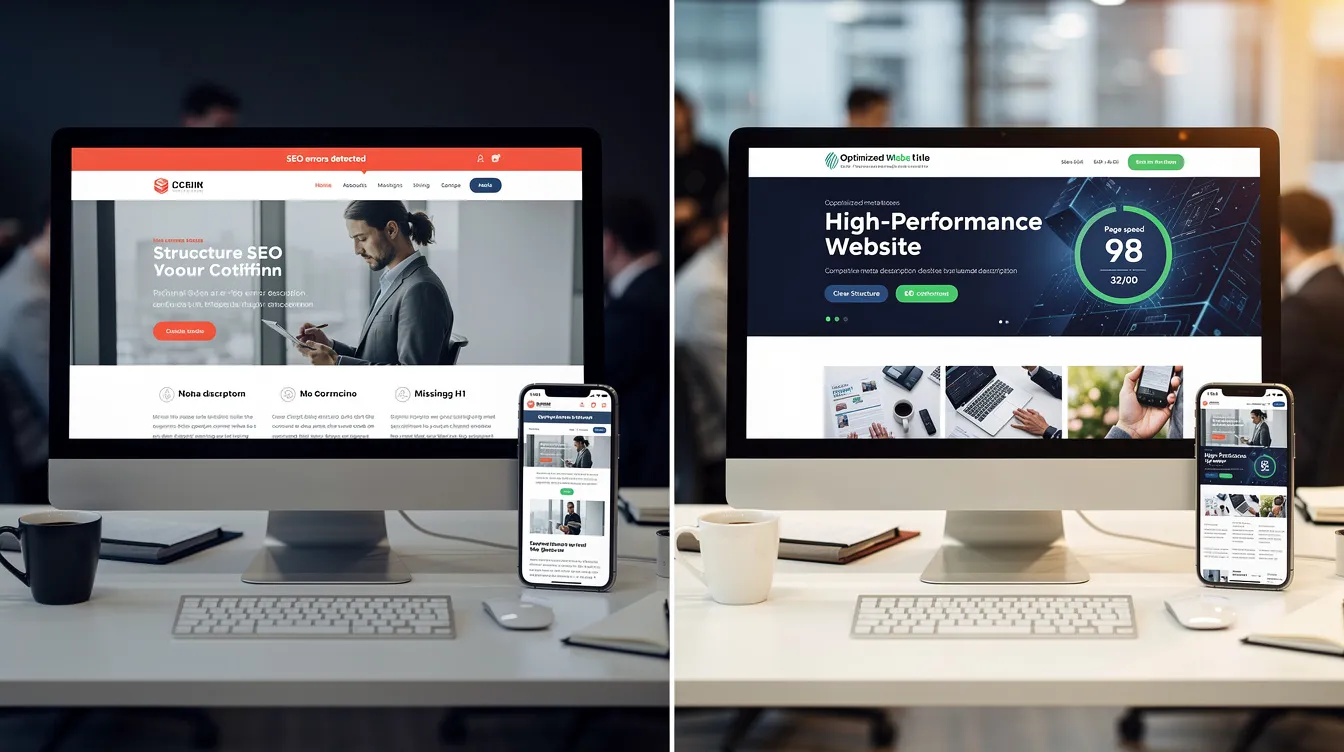
Error #1 — Pages Without Identified Search Intent
Your “Our Services” page lists what you do. It’s useful for a client who already knows you. But someone searching “air conditioning installation Caen” or “accountant for sole proprietors Normandy” won’t type “our services” into Google.
Each page must answer one specific search query. Not multiple. One.
If you’re an electrician offering code compliance work, emergency repairs, and electric vehicle charging station installation, each of these activities deserves its own page, with its own content, targeting its own keywords. Grouping everything on a single page dilutes your relevance on each topic.
Error #2 — Texts Written for the Imaginary Client, Not for Google
“Family-owned business since 1987, we put our passion at the service of your project.” It’s human. It’s sincere. It generates zero traffic.
Nobody types “family-owned passionate business” into Google. People type concrete problems, specific needs, practical questions. Your content must answer those searches, with the words your customers actually use — not your industry’s vocabulary.
Error #3 — A Website Invisible on Mobile
Since 2019, Google indexes websites primarily in their mobile version. This is called “mobile-first indexing”. If your site is difficult to use on a phone, Google knows it, and it penalizes your ranking accordingly.
Yet in our region, over 65% of local searches happen on smartphones. A craftsperson looking for new clients in Caen or Rouen must have a site that’s perfectly readable on mobile. Not “acceptable”. Perfect.
Error #4 — Zero Content Produced After Launch
The site is created. It’s “finished”. And you don’t touch it for three years.
This is the most common trap. Google values active sites that publish regularly, that show signs of life. A blog with 4 articles from 2021 sends a negative signal. A site that publishes useful content regularly — even once a month — gradually climbs in results.
It’s no accident that sites dominating their category locally are also those with fresh content, recent news, and regularly updated pages.
What “Well-Ranked” Actually Means
Let’s be precise, because the phrase is overused.
A “well-ranked” site for a Normandy SME doesn’t mean appearing on the first page for “web agency” or “plumber”. These generic searches are saturated, ultra-competitive, and bring poorly qualified traffic.
What generates clients is appearing on long-tail, local searches with high purchase intent.
“Emergency roof repair Calvados” rather than “roofer”. “CPA for LLC creation Caen” rather than “accountant”. “Fire safety training for businesses Normandy” rather than “training”.
These searches have less volume. But the people typing them have an immediate need and a budget. They convert.
This is what well-done local SEO is: capturing the right people, at the right time, when they’re searching for exactly what you offer.
“Better 50 qualified visitors per month than 2,000 visitors who bounce in 10 seconds.”
Google Business Profile, Content, Links: Three Pillars to Build in Order
If you’re starting from scratch or your site is stagnating, here’s the order to tackle things. This isn’t theory — it’s what we apply to the projects we work on.
Pillar 1 — Google Business Profile
This is the starting point for any local business. Free, quick to set up, with visible impact in a few weeks. Your profile must be complete: hours, photos, well-chosen categories, description with your keywords naturally integrated, and most importantly regular customer reviews.
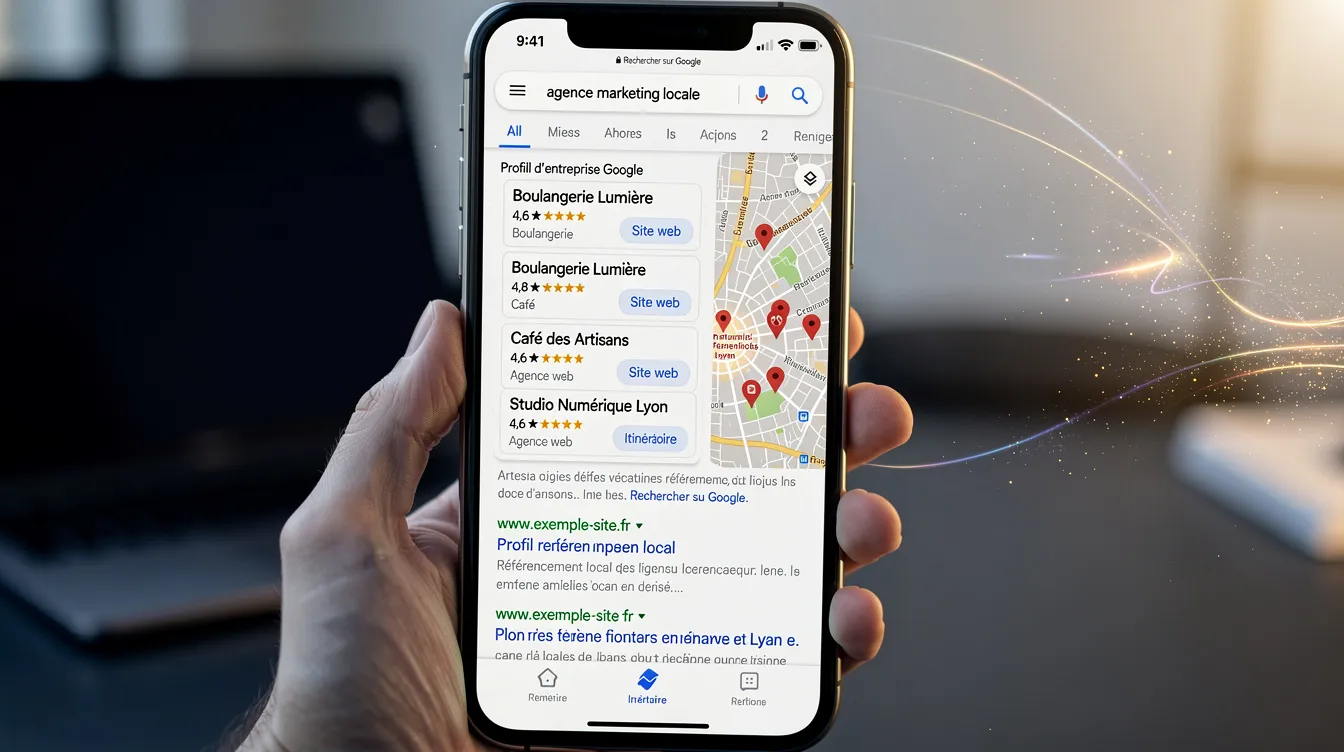
A well-optimized Google Business Profile can place you in the “local pack” — those three results with a map that appear at the top of the page for location-based searches. For a local SME, this is often more profitable than any advertising campaign.
Pillar 2 — Your Page Content
Before thinking about a blog or social media, optimize your existing pages. Each service page must answer a specific search query, with text of at least 400-600 words, structured with clear headings, answering the real questions your potential customers have.
If I were in your position with a limited budget, I’d start with the page for my main service. Not the blog. Not the “About” page. The page that has to sell.
Pillar 3 — Backlinks
This is the longest to build, but it’s what makes the difference long-term. Local partners who mention you on their site, reputable business directories, local press coverage of your activity, industry associations — each link from a credible site strengthens your authority in Google’s eyes.
This isn’t something that happens in a week. It’s a 6 to 18-month strategy. But without it, even the best content plateaus.
How Long Before You See Results?
That’s the question we get at every kickoff meeting. And the honest answer is this.
Initial technical improvements (speed, mobile, structure) have an effect in 4 to 8 weeks. Not dramatic, but measurable in Google Search Console.
Optimized content starts generating traffic between 3 and 6 months, depending on competition for your target keywords.
Domain authority, built through backlinks, develops over 12 to 24 months.
Anyone promising you the first page in 30 days without paid ads is lying to you. Natural SEO is an investment, not a one-time expense. The good news: once you’re well-ranked, traffic continues even when you stop paying.
That’s the whole difference from paid advertising: Google Ads stops the day you cut the budget. Natural SEO keeps working.
What We Actually Do at GDM-Pixel
When we work on a site’s SEO, we always start with a complete technical audit. Not to sell a redesign — to identify what’s really blocking progress.
On recent projects, we’ve seen sites lose 40% of their traffic after a poorly managed migration. Entire pages deindexed because of a “noindex” tag left by mistake. Loading times exceeding 8 seconds on mobile. Content duplicates that cannibalize keywords across pages.
These problems are invisible to the site owner. They’re catastrophic for SEO.
Our approach: honest diagnosis, priority fixes, then a content strategy suited to your industry and geographic area. We don’t sell a 12-month SEO package if three days of audit and a few technical fixes are enough to unlock the situation.
According to resources from the National Agency for Territorial Cohesion, over 60% of French microenterprises have a website — but fewer than a third of them generate qualified leads through their online presence. The gap between “having a site” and “having a site that works” is real, measurable, and often fixable without starting from scratch.
Three Things to Do This Week
No need to wait for a full audit to start. Here’s what you can check today.
1. Test your site on mobile. Open it on your phone. Are the texts readable without zooming? Are buttons clickable easily? Does the menu work correctly? If you hesitate, it’s already a problem.
2. Search for your activity + your city on Google. Type what a customer who doesn’t know you would type. Do you appear in the results? If not, you’re invisible to people who need exactly what you offer.
3. Check your Google Business Profile. Is it claimed? Is the information current? Do you have recent reviews? An incomplete or abandoned profile hurts your local credibility.
Your Website Can Become Your Best Salesperson
It doesn’t take vacations. It doesn’t ask for a raise. It works at 3 a.m. when a business owner urgently needs a service provider.
But for that to happen, it must be visible. And visibility is built methodically, with the right tools, the right content, and a strategy suited to your local reality.
At GDM-Pixel, we’ve been helping Normandy SMEs with these issues for 15 years. Not with promises of first-page rankings in 30 days. With honest audits, concrete fixes, and a strategy that lasts.
Want to know why your site isn’t generating qualified traffic? We’ll diagnose it. We’ll tell you what’s blocking progress, what fixes easily, and what requires more structured investment. No commitment, no hard selling.
Contact us for an SEO audit — and start finding out what your site is really worth.