+33-9-7266-3068
 contact@gdm-pixel.fr








A plumber in Paris called us last year. Tight budget, no website, but a full order book. His number one source of clients? A Google Business Profile he’d created in twenty minutes three years earlier, without ever updating it.
Meanwhile, his competitor had just spent 4,000 euros on a complete website redesign. Six months later: still fewer inquiries than the plumber with the basic profile.
This isn’t luck. The numbers confirm it.
What Google Business Profile does that your website can’t
Here’s where it gets interesting: when a customer searches “plumber Paris” or “restaurant open now Lyon,” they don’t see websites first. They see the Local Pack—those three Google Business profiles with stars, hours, phone number, and reviews.
Your website, even if perfectly optimized, comes after.
According to data from BrightLocal, 87% of consumers read reviews online before choosing a local service provider. Not “About” pages. Not portfolios. Reviews, hours, and the five-star rating.
What we see consistently with our clients is that the Google Business Profile generates two to three times more direct calls than the website. Because it immediately answers the customer’s question: Is this provider available, well-reviewed, and near me?
Your website, meanwhile, has to first be found. Then load. Then be browsed. Then convince.
The Google Business Profile cuts the line.
The mistakes sabotaging your local visibility without you knowing it
The majority of Google Business Profiles we audit for local SMEs suffer from the same issues. Not from lack of effort—just blind spots nobody points out.
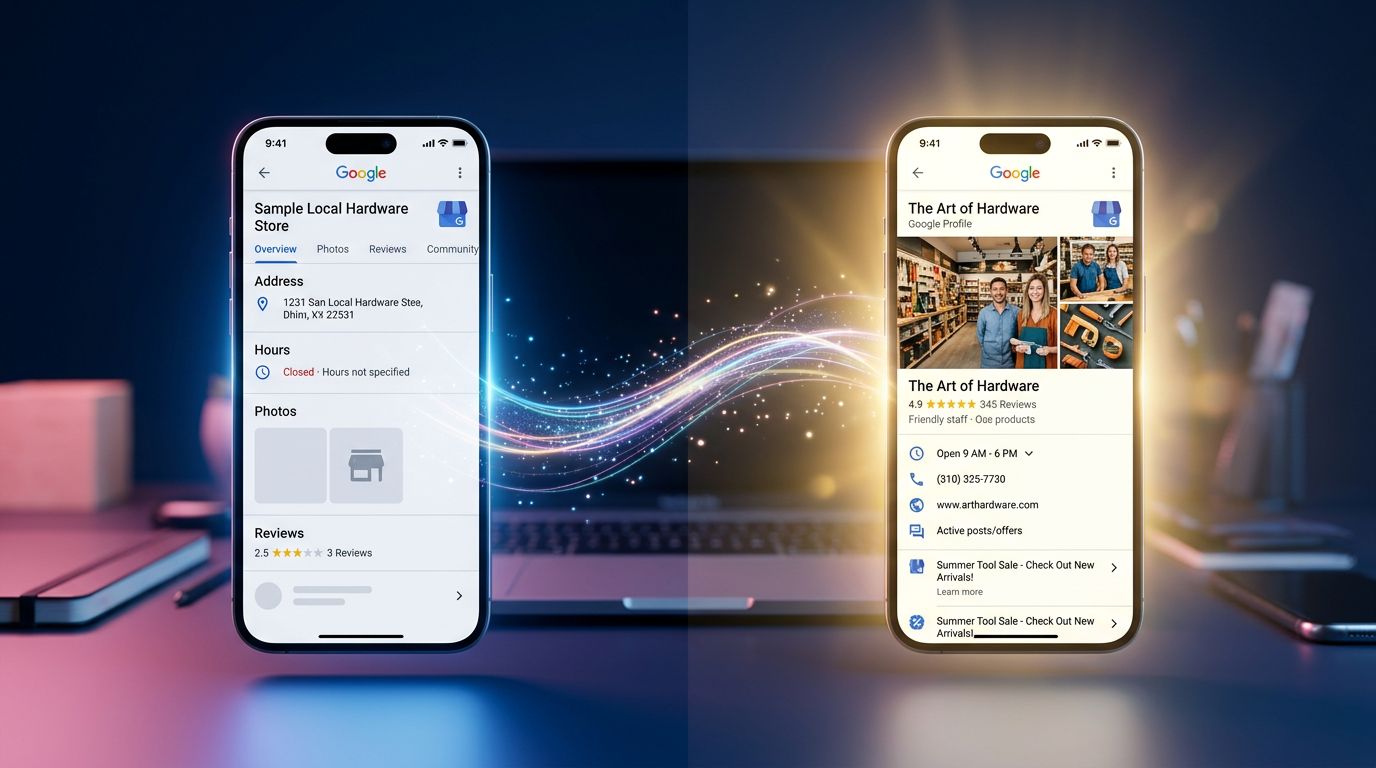
Hours never updated
Your shop closes at 6 PM except Thursdays when you stay open until 8 PM. Your profile says 6 PM every day. A customer arrives at 7 PM on Thursday. Closed. They leave a negative review. And Google penalizes profiles with incorrect hours in its local algorithm.
This isn’t trivial. It’s one of the first things we check during audits.
Zero recent photos
Google favors active profiles. A profile without photos, or with photos from 2019, sends a negative signal to the algorithm. And for customers, the absence of visuals creates distrust. Why isn’t this restaurant showing its dining room? Why doesn’t this office have team photos?
The absence of images is a signal, and not a good one.
Wrong primary category
This is the costliest mistake. A carpenter who lists themselves as “General Contractor” loses visibility on all searches specific to their trade. The primary category determines which keywords Google indexes you under locally.
After years of helping local SMEs, I can tell you that fixing the primary category alone can double a profile’s local visibility in weeks.
What customer reviews do to your revenue (the good and the bad)
Let’s talk concrete numbers.
A study by Harvard Business School showed that one extra star on a Google rating can increase a restaurant’s revenue by 5 to 9%. For a local SME, that’s potentially tens of thousands of euros a year.
The reverse is equally true.
“A single unhandled negative experience outweighs ten good reviews in a potential customer’s mind.”
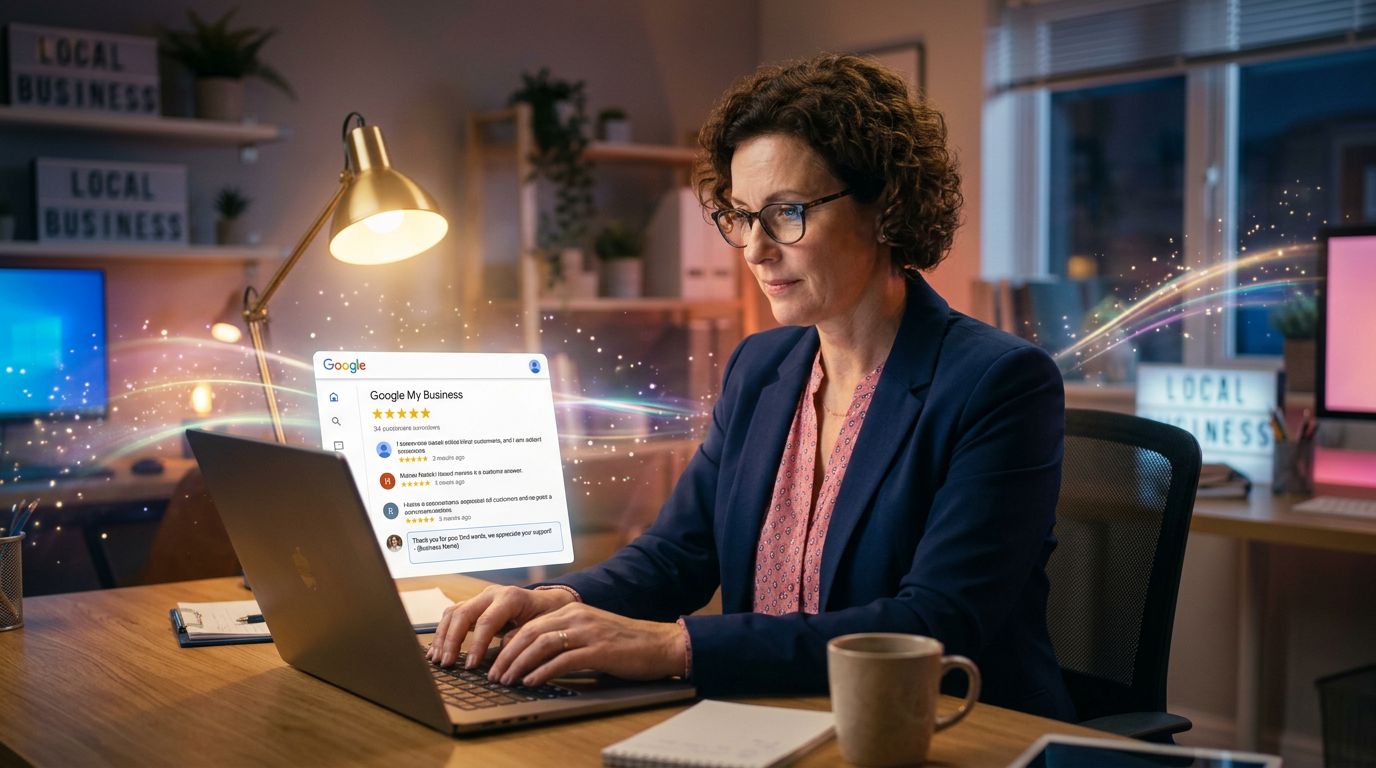
What agencies never tell you is that managing negative reviews is often more important than collecting positive ones. An unanswered negative review says to future customers: “This business doesn’t care.” A professional response, even to an unfair critique, says: “This business takes its customers seriously.”
How to collect reviews without being intrusive
The method that works in our agency’s daily practice is maximum simplicity. A QR code on the invoice, a link in the follow-up email, a WhatsApp message after successful service.
No aggressive automated reminders. No five-step forms.
One click, one review. That’s it.
Google provides a direct link to your review form. If you don’t have it yet, go to your Business Profile dashboard, section “Get more reviews.” Copy the link. Put it everywhere.
The local content strategy nobody’s using
Your Google Business Profile isn’t a static business card. It’s a publishing channel.
“Google Posts” let you publish news, offers, and events directly on your profile. These posts appear in local search results. And 99% of local SMEs never publish a single one.
Why does this matter? Because Google interprets an active profile as a trust signal. A profile that publishes regularly, receives reviews, updates photos—that’s a profile Google will prioritize in the Local Pack.
Flip it: if you were Google, between a profile last updated three years ago and a profile with a post from last week, which would seem more relevant to a user searching for a service right now?
What we publish for our clients (and what generates clicks)
No need for elaborate content. Posts that perform locally are often the simplest:
- A seasonal promotion with an end date
- A product or service featured this month
- A recent project with photos (before/after if relevant)
- A reminder of exceptional hours (bank holidays, local celebrations)
Twenty minutes a month. Measurable impact on visibility.
Questions & Answers: the hidden feature you’re missing
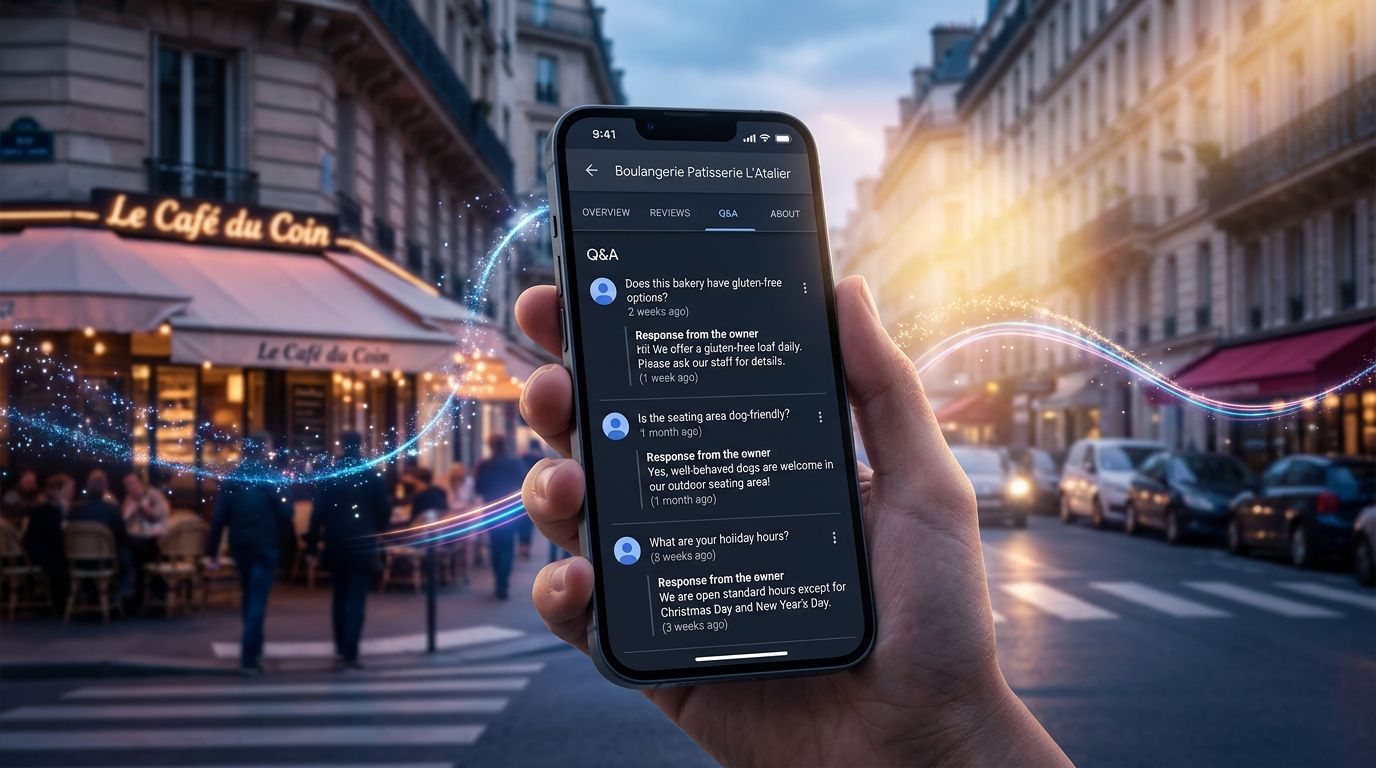
There’s a section of your Google Business Profile you’ve probably never looked at: Questions & Answers.
Anyone can ask a question on your profile. Anyone can answer—including competitors, or an unhappy customer. If you don’t answer your own questions, someone else does it for you.
What we systematically do for our clients: pre-populate this section with frequently asked questions. “Do you offer weekend service?” “Do you provide free quotes?” “Do you deliver outside Paris?”
You ask the question. You answer it. It appears on your profile. The customer has their answer before they even call.
It’s automated customer service, free, and visible to Google.
Google Business Profile vs website: it’s not a battle
Here’s what I sometimes hear: “If the Google Business Profile is enough, why invest in a website?”
That’s the wrong question.
The Google Business Profile captures existing demand—people already searching for what you do. Your website builds your credibility, differentiates you from competitors, and converts the undecided.
One without the other is limping.
A perfect profile without a website is a convinced customer arriving at your profile, wanting to learn more, clicking your website link… and landing on a 2017 page, or worse, a 404 error.
A perfect website without an optimized profile is a magnificent storefront on a street nobody knows.
“The Google Business Profile is your first appointment with the customer. The website is the handshake that confirms it.”
After years of helping local SMEs, the formula that works is always the same: a flawless Google Business Profile + a clean, fast website + an active review strategy. No need for more to dominate local search in your sector.
What to do this week (not in three months)
Priority tasks, in order of impact:
1. Verify your basic information. Exact name, address, phone number, website, hours—including any exceptional hours. Wrong information costs you calls every day without you knowing it.
2. Audit your categories. Primary category first. It must match your main activity exactly, not your broadest activity. Then add up to nine relevant secondary categories.
3. Upload at least ten photos. Storefront, interior, team, projects, products. Recent photos, natural light if possible. No stock photos—Google detects and values them less.
4. Create your review link and start distributing it. Your last five satisfied clients—send them the link today. Not tomorrow.
5. Publish your first Google Post. A news item, an offer, a project. Two hundred words maximum. One photo. That’s enough to signal to Google that your profile is alive.
The perfect profile isn’t built in a day. But the first improvements are.
Going further
To measure the real impact of your local presence, Google Search Console and your Business Profile dashboard give you valuable data: number of searches that displayed your profile, clicks to your website, calls generated, direction requests.
Look at these numbers each month. Not for reporting—to understand what works and adjust.
According to Moz research on local ranking factors, the Google Business Profile is the top ranking factor in the Local Pack. Ahead of backlinks. Ahead of your website content.
It’s the most underused lever in local SEO. And it’s free.
Your Google Business Profile deserves more than five minutes of attention
We’ve helped local SMEs triple their incoming inquiries in six months—no website redesign, no advertising campaign, just serious optimization of their Google Business Profile.
This isn’t magic. It’s method.
If you’d like us to audit your Google Business Profile and local presence, contact us. We look at what’s blocking you, tell you what deserves priority fixes, and don’t sell a complete overhaul when two hours of auditing is enough.
Your next customer is searching for your service on Google right now. The question is: are they finding you?