+33-9-7266-3068
 contact@gdm-pixel.fr








Why 80% of Norman Websites Are Never Found on Google (and How to Fix It Without Starting Over)
A restaurant owner in Bayeux contacted us a few months ago. His website had been up for two years. He had paid someone to build it. It was “on Google”, technically. But when you typed “restaurant Bayeux” or “gastronomic restaurant Bayeux”, it appeared nowhere in the first ten pages. Result: zero online reservations, zero incoming calls from the website. Two years of digital rent paid for nothing.
This is not an isolated case. It is the norm.
So let’s ask the real question: is your website visible or simply existing?
The Difference Between “Having a Website” and “Being Found”
This is the fundamental misunderstanding of most small businesses. People think that creating a website automatically means being present on Google. As if publishing a book were enough to get it into the bookshop window.
No. Google doesn’t work that way.
A website without SEO work is a shop front in an alley with no passers-by, no directional sign, no known address. It exists. Nobody finds it.
Search engine optimisation — what we call SEO — is precisely the work of telling Google: “My site exists, it talks about this, it targets these people, and it deserves to appear when they search for these terms.”
This work, the majority of website builders don’t do. Or they do it poorly. Or they do it once and never touch it again.

The Three Technical Reasons Your Website Is Invisible
Here is what we find systematically during our audits. Not theories — repeated observations on dozens of Norman SME websites.
No Work on Local Keywords
This is the first problem. The website talks about the business in generic terms, but not in the terms your customers use when searching.
An electrician in Caen shouldn’t just appear for “electrician”. He should appear for “emergency electrician Caen”, “electrical repair Caen north”, “consumer unit installation Calvados”. These precise so-called “long-tail” queries are what generate calls. And they don’t happen by accident.
In practice, with our clients: when we restructure pages by naturally integrating these expressions into titles, text and tags, qualified traffic increases by an average of 40 to 70% within three months. Without redesign. Without a new design.
Title Tags and Meta Descriptions Missing or Poorly Written
Open your website. Look at what appears in the browser tab. If you see “Home” or the name of your CMS, you have a problem.
These tags are what Google reads first to understand what your page is about. They are also what potential customers see in search results before deciding to click — or not. A vague title tag is a missed opportunity with every Google impression.
What no agency ever tells you: some providers deliver websites with the same tags on every page. Or automatically generated tags that mean nothing. This is 30 minutes of work per page that can radically change your visibility.
Content Too Thin to Convince Google
Google evaluates the expertise, authority and trustworthiness of a website. It does this by analysing the depth of content, among other things. A service page with three sentences and a photo isn’t enough.
The minimum threshold for a page to have a chance of ranking for a competitive query? Around 400 to 600 words of useful, structured content that answers the real questions your customers are asking.
It’s not about padding. It’s about the signal sent to Google: “This page deserves to be shown because it genuinely adds value.”
What Google Is Really Looking For in 2025
Google’s algorithm has evolved. A lot. But its objective has remained the same since the beginning: show internet users the most useful and reliable result for their search.
In 2025, three signals dominate:
Real user experience. Google measures whether people who click on your site stay or leave immediately. A slow, poorly structured, unreadable site on mobile — visitors flee within seconds. Google interprets this as a negative signal and demotes you. We published a complete article on loading speed if you want to explore this specific point.
Local relevance. For small businesses, the challenge is not to compete with large national chains. It’s to be the first result when someone searches for your activity in your town or region. And that is achievable — provided you work on the right local signals on your website AND outside it (Google Business Profile, local citations, NAP consistency).
Domain authority. Websites that link to you, that cite you, that recommend you — these are what we call backlinks. Each quality incoming link is a vote of confidence in Google’s eyes. An isolated website with no external links starts with a structural handicap.
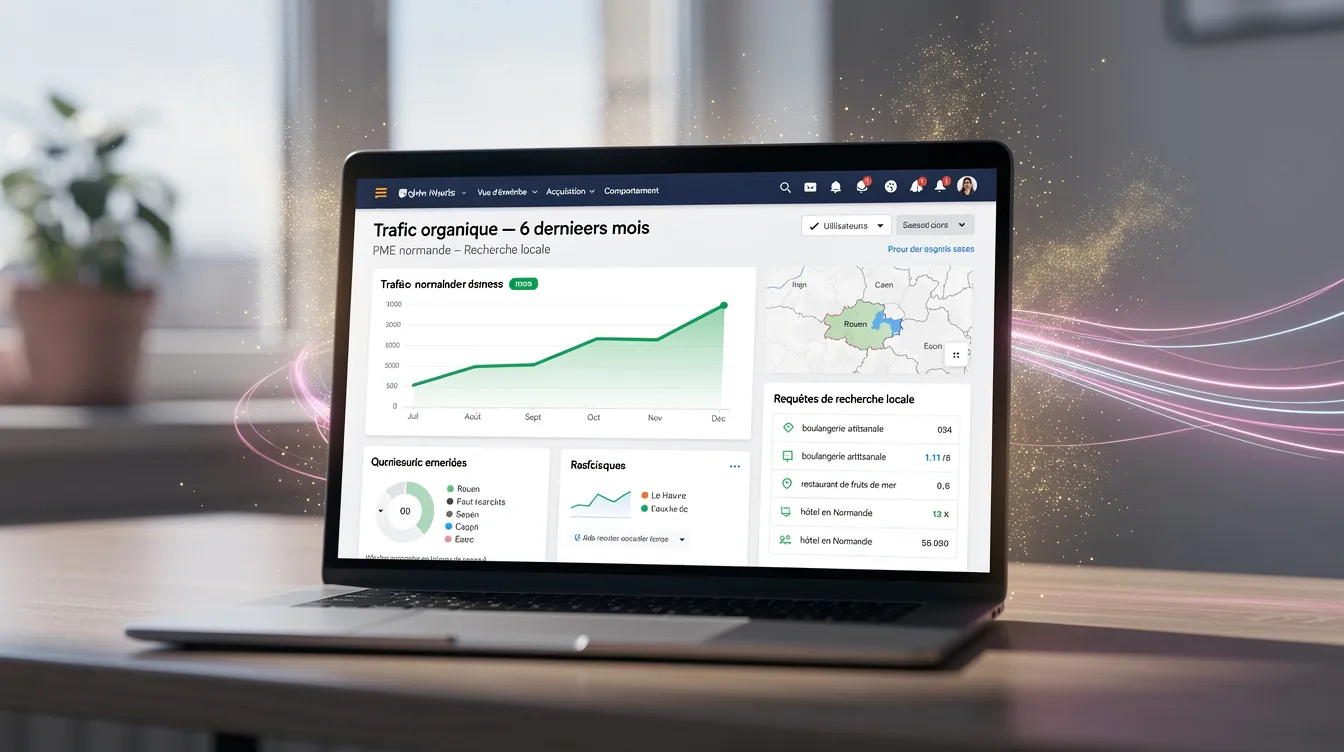
The SEO Audit: What We Always Find (and What It Costs to Do Nothing)
When we audit a Norman SME website for the first time, here is what we find in 80% of cases:
- Pages with identical or generic titles
- A site structure that mixes everything without a clear hierarchy
- Zero content optimised for local queries
- Uncompressed images slowing down loading
- A website not adapted for mobile (or minimally adapted)
- No internal linking between pages
This is not a judgement. It is an observation. Most website builders are not SEO experts. And most SEO experts don’t build websites. The result is that the two subjects are rarely treated together, from the start.
What does it actually cost? If your website should be bringing you 3 to 5 new clients per month and it hasn’t generated any for two years, do the maths with your average transaction value. For the Bayeux restaurant owner, it was between 8,000 and 15,000 euros in lost revenue per year. For a correction cost that would have been ten times less.
“The best time to optimise your SEO was when the site was created. The second best time is now.” — Adapted from a principle every entrepreneur should keep in mind.
What We Can Fix Without Starting Over
Good news: in the majority of cases, a complete redesign is not necessary.
What we can do on an existing website, without rebuilding everything:
Restructuring Tags and Titles
Technical intervention, no visible changes for your visitors. We rewrite the title and meta description tags for each page, restructure H1/H2 headings to incorporate the right keywords. Visible results in Google Search Console within 4 to 8 weeks.
Enriching Existing Content
We take your service pages, develop them, integrate the questions your clients actually ask, and structure the information for Google and your readers. Not a total rewrite — targeted enrichment.
Creating Local Pages
If you operate across several towns or areas, a dedicated page per geographical zone multiplies your chances of appearing in local searches. This is a lever that is underused by virtually all tradespeople and self-employed professionals.
Basic Technical Optimisation
Image compression, fixing 404 errors, improving loading speed, checking indexation. One-off interventions that can unblock positions Google was refusing to grant due to negative technical signals.
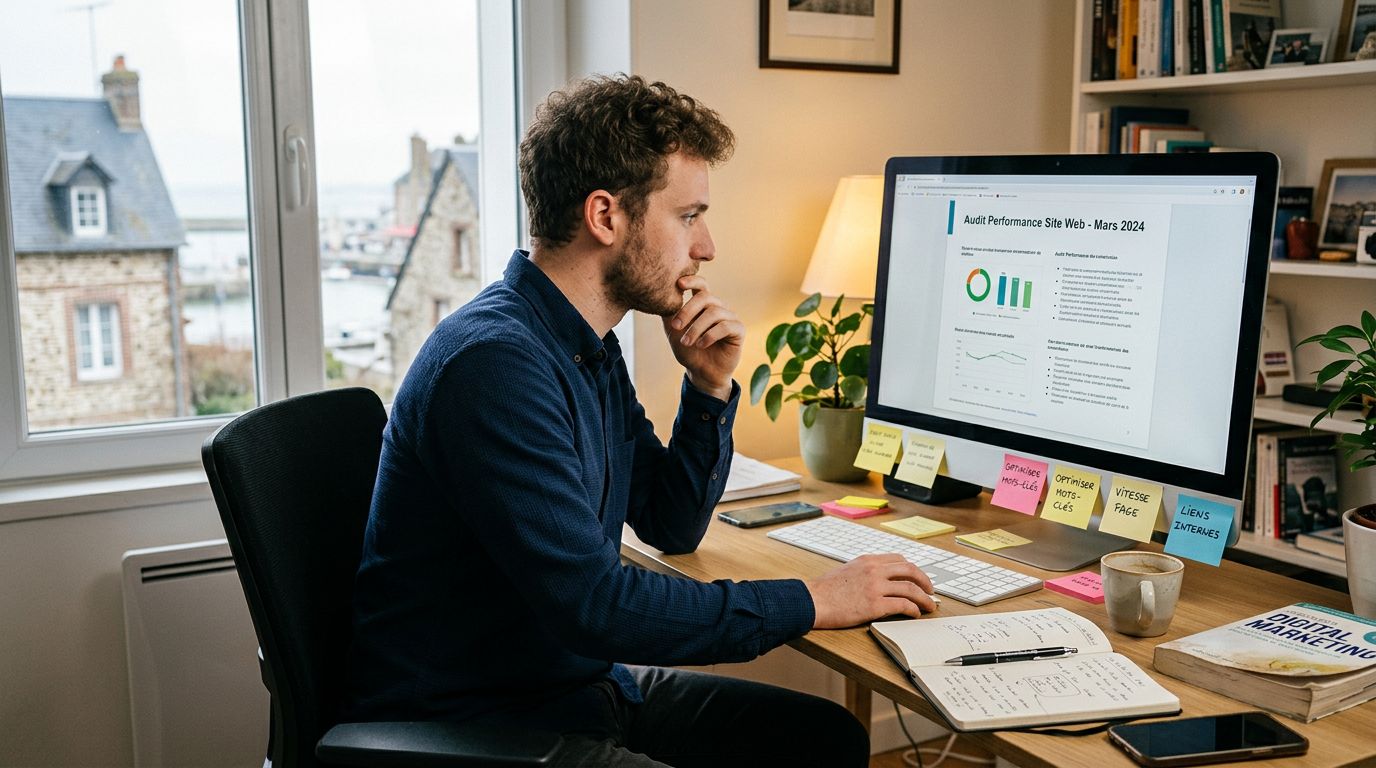
What This Looks Like in Practice
After 15 years working with Norman businesses, here is what we have learned to measure.
An SEO audit followed by optimisation on 3 to 5 strategic pages represents between 8 and 20 hours of work depending on the complexity of the site. Average result observed with our clients: a 2 to 4-fold increase in qualified organic traffic within 3 to 6 months. Not random traffic — people actively searching for exactly what you offer, in your geographical area.
For the Bayeux restaurant owner? We reworked 6 pages, restructured his tags, created two local pages (one for Bayeux, one for the Bessin area), and integrated content answering the real questions of people searching “where to eat in Bayeux”. Three months later: 12 bookings per month through the website. Zero redesign. Total budget for the work: less than 1,500 euros.
My advice for a small business with a limited budget: don’t start with a new website. Start by understanding why the current one isn’t working. Audit first. Decision second.
Three Concrete Actions to Take This Week
If you want to quickly test the state of your online visibility, here are three checks accessible without technical skills:
Type your activity + your town into Google. In private browsing. If you don’t appear in the top 5 organic results (excluding ads), you have work to do.
Open a tab on your website. Look at what appears in the browser tab. If it says “Home” or generic text, your title tags are not optimised.
Check your website on mobile. Not just “it displays” — is it really readable, fast, usable with a thumb? Google offers a free testing tool that gives a score and precise recommendations.
These three checks take ten minutes. They give you a clear picture of where you stand.
Conclusion: Visibility Is Built, Not Installed
Having a website in 2025 is necessary. But it is not enough.
Visibility on Google is ongoing, methodical, measurable work. It is not magic, it is not an advertising budget, it is not a supplier’s promise. It is a series of technical and editorial actions that, stacked in the right order, move your site up to where your customers are looking for you.
Existing does not mean visible. Visible does not mean profitable.
If you want to know exactly why your website is not being found — and what should be corrected first — we offer a diagnostic SEO audit. Not a 40-page indigestible report. A clear, prioritised assessment with concrete actions and honest pricing. Contact GDM-Pixel to discuss it.
Because a website that is not found is money left on the table. Every month.