+33-9-7266-3068
 contact@gdm-pixel.fr








A prospect lands on your website. They read. They scroll. They check your portfolio. Then they leave — without leaving their name, email, or phone number. Nothing.
This scenario plays out dozens of times every day on most SME websites. Not because the offer is bad. Not because the design is flawed. Because the path between “I’m interested” and “I’ll contact you” is too long, too unclear, or simply broken.
How many visitors have you lost this month before they even clicked your contact form?
What “conversion funnel” actually means
The term sounds intimidating. It conjures images of Excel spreadsheets, marketing funnels, and tools costing 500 euros per month. Forget all that.
For a French SME, a conversion funnel is simply the answer to this question: what path must my visitor take to become a customer?
This path has stages. They arrive on your homepage. They understand what you do. They see you’re credible. They spot an offer that suits them. They click. They fill out a form. They send you a message.
Each stage is a door. If a door is poorly marked, too heavy to open, or missing entirely — the visitor gives up. Not because they didn’t want to buy. Because you didn’t make it easy.
What we see with our clients: websites with excellent local SEO, dozens of visits per week, and zero quote requests. The traffic is there. The conversion is broken.
The three places where the funnel breaks most often
In the audits we conduct, conversion problems always cluster in the same places. No magic, no mystery — just friction points nobody has fixed.
The homepage that doesn’t say who it’s for
Your homepage must answer one question in under five seconds: “Am I in the right place?”
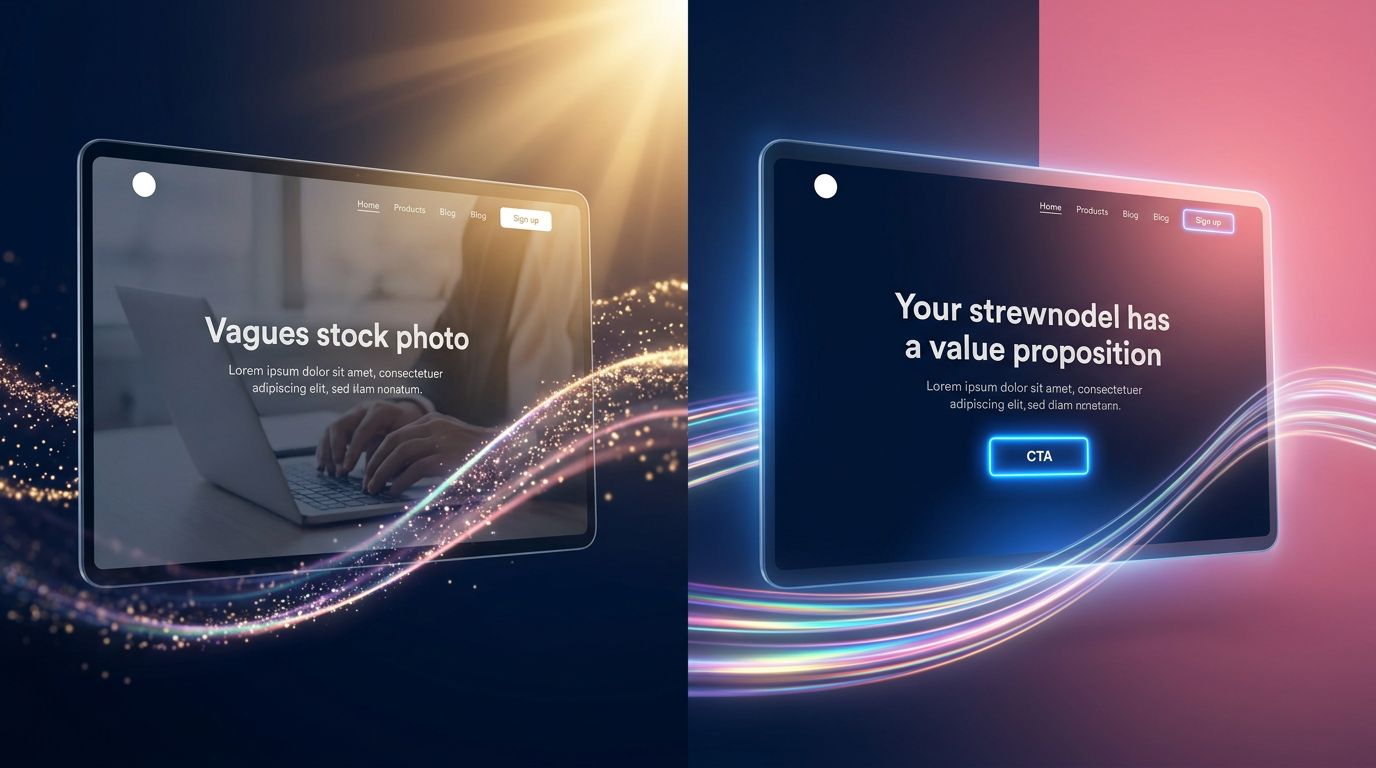
A plumber doing emergency repair in Caen has different visitors than an architecture firm in Rouen. Yet the majority of homepages we audit use the same vague language: “Welcome to our site,” “We’ve been serving you for X years,” “Feel free to contact us.”
This tells nobody anything. It reassures nobody. It gives no reason to stay.
The rule is simple: in the first five seconds, your visitor must understand who you help, what problem you solve, and why you over everyone else. If these three elements aren’t immediately visible, you lose part of your prospects before they’ve read your first sentence.
The contact form buried on page 7
It’s the classic trap. The manager spent time on content, service pages, an “About” page. The contact form? It’s accessible from the menu, top right, in a tab labeled “Contact.”
The problem: your visitor isn’t looking for your contact page. They expect you to invite them to take action when their interest is at its peak.
That moment often comes right after reading a service description that fits their needs. Or after seeing a portfolio piece similar to their project. Or after reading a client testimonial that reassured them.
If there’s no visible button at that exact moment, no invitation to move forward — the momentum dies. They tell themselves “I’ll check later.” And later never comes.
Our experience confirms it: adding a contextual call-to-action directly in service pages — not just in the menu — can double contact requests on an existing site without changing a word of content.
Absent or poorly placed social proof
You trust a tradesperson you’ve never met. On what basis? Other clients’ reviews. Photos of completed projects. A testimonial from someone in your industry.
Social proof is what transforms a curious visitor into a convinced prospect. Yet on most sites we audit, it’s either missing or hidden on a dedicated page nobody visits.
“Consumers trust online reviews as much as personal recommendations.” — BrightLocal, Local Consumer Review Survey
Your credibility isn’t declared. It’s demonstrated. And it must be visible where your visitor needs it — not on a separate page they might never find.
What you can fix this week without redoing your site
Here’s where it gets interesting: most conversion problems can be fixed without a redesign, without significant budget, without a full-time developer.
If I were in your position with an existing site that generates traffic but few contacts, here are the three actions I’d prioritize.
Rewrite your homepage headline. Take your current title. Ask yourself whether a stranger landing on your site immediately understands what you do and who you help. If not, rewrite it in one sentence: “[What you do] for [who you help] to [concrete result].” Example: “Plumbing services in Caen — emergency response within 2 hours, 7 days a week.” That’s direct. That’s useful. That sticks.
Add a call-to-action button after each service page. Not just in the top menu. At the bottom of each service description, add a simple sentence: “Do you have a similar project? Request a free quote in 2 minutes.” With a direct link to your form or phone number.
Move your best client reviews to your homepage. Not all of them. Just the two or three that are most specific, most concrete, closest to your ideal customer profile. A review saying “Great work, I recommend” helps nobody. A review saying “Fast emergency response for an under-sink leak, fixed in 45 minutes, fair pricing” — that convinces.

Measure to avoid working blind
Fixing a conversion funnel without measuring is like repainting a car without knowing what color it was. You intervene, but you don’t know if it changed anything.
The basic tool is Google Analytics 4. Free, already installed on most sites, and vastly underutilized. What you must monitor first:
Bounce rate by page tells you which pages visitors leave immediately. If your quote request page shows an 80% bounce rate, something’s wrong — either the content doesn’t match what people searched for, the page is too slow, or there’s no call-to-action.
Navigation flow shows you how visitors move around your site. Do they arrive on your homepage and then go to your services? Or do they arrive and leave immediately? This data shows you where the funnel breaks.
Conversion events let you know how many people click your contact button, fill your form, or call your number. If you haven’t set up these events, you’re blind to what actually generates leads.
In practice, setting up basic tracking with our clients takes half a day. And it often reveals surprises: pages you thought were secondary that generate lots of interest, key pages with abnormally high abandonment rates. Without this data, you optimize by feel. With it, you intervene where it matters.
The question nobody asks before launching a site
Before publishing a page, writing copy, or choosing a photo — ask yourself this: what action do I want my visitor to take after reading this?
Not “I want them to be impressed.” Not “I want them to understand my expertise.” One concrete action: call, fill out a form, download a document, sign up for a newsletter.
If you can’t answer this question for a given page, your visitor won’t either. And they’ll do nothing.
That’s as simple — and as brutal — as it gets.
In France, SMEs and tradespeople invest in their websites thinking the work ends at launch. The truth is launch is the beginning. The conversion funnel is what you build afterward. And it’s what determines whether your site brings you clients or just appears as a line item in your budget.
Key takeaways
Three actionable points to apply right now:
Your homepage must answer in five seconds “Am I in the right place?” — if not, rewrite your headline before anything else.
Every service page must end with an explicit invitation to move forward — a visible button, direct language, a link to your form or number.
Without measurement, no optimization is possible — configure at minimum conversion event tracking for your contact form in Google Analytics 4. It’s free and it changes everything.
Your site generates traffic but no contacts?
That’s exactly the kind of problem we diagnose in just a few hours with our conversion audits. We review your funnel from start to finish: page structure, calls-to-action, tracking, user journey. And we tell you what’s blocking — without selling you an expensive redesign if you don’t need one.
Get in touch with GDM-Pixel for an honest assessment of your site. We tell you what works, what doesn’t, and what to prioritize.