+33-9-7266-3068
 contact@gdm-pixel.fr







 TL;DR - Key Takeaways at a Glance
What Nobody Tells You About the Real AI Revolution
You’ve heard of ChatGPT. Maybe Midjourney. Maybe you even tried a music generator out of curiosity one evening. And you thought: “Nice, but it’s for tech people.”
Wrong category.
What you’re seeing on the surface — these small creative tools that appear without fanfare, without press conferences — is the vanguard of a much deeper movement. AI doesn’t arrive at businesses with trumpets. It infiltrates. Quietly. Through the side door of daily workflows, before reshaping the entire architecture of production.
Here’s what we’re observing concretely in our agency, and what it means for you.
Creative AI Tools: The Iceberg Where You Only See the Tip
An AI music generator launches this week. Nobody organizes an official launch event. No keynote. Just a link, a few social posts, and suddenly thousands of creators are using it.
This is the recurring pattern of mainstream AI in 2024-2025.
These tools arrive stealthily, embed themselves in usage patterns, and create dependency before we’ve even had time to seriously evaluate them. Image generation, automated writing, voice synthesis, music composition — every week, new capabilities become accessible to anyone with a credit card and ten minutes to spare.

What’s interesting isn’t the tool itself. It’s the speed of adoption and what it reveals about our relationship with technology.
Why does this matter for a Norman SME selling windows or running an accounting firm? Because your competitors aren’t philosophizing. They’re experimenting. They’re adopting. And while you’re waiting to “see how it plays out”, the productivity gap widens.
“The question is no longer ‘will AI change my sector?’ — it’s ‘how fast, and will I be ahead or behind?’”
From Creative Tool to Operational Transformation: The Real Leap
This is where the distinction becomes critical.
There’s AI-as-gadget — the kind that generates a funny image or composes a melody in thirty seconds. And there’s AI-as-lever — the kind that fundamentally reorganizes how a company produces, communicates, sells, and serves its customers.
Confusing the two is expensive. We regularly see executives who “tried AI” by asking ChatGPT to write an email, concluded that “it’s nice but not revolutionary”, and moved on. Meanwhile, their competitors are automating their prospecting, customer service, content production, and reporting.
It’s not the same thing.
In our agency, industrialization through AI isn’t an experiment. It’s our daily production mode. 21 pages delivered in 10 hours on a recent project. Client specs generated automatically. Blog articles written, illustrated, and published overnight. It’s not magic — it’s architecture.
Creative AI saves you time on a task. Strategic AI changes your scale.
The Three Levels of AI Integration in Business
To clarify where you stand and where you could go, here’s how we structure the thinking with our clients:
Level 1 — Occasional AI Use
You use AI tools for isolated tasks: write some text, fix a translation, generate an image for a presentation. It’s useful. It saves 20 to 30 minutes here and there. But it’s cosmetic — you haven’t changed your workflow, you’ve just added a tool.
Most French SMEs are at this stage today, according to Bpifrance data on digital maturity of SMEs.
Level 2 — AI Integrated Into Processes
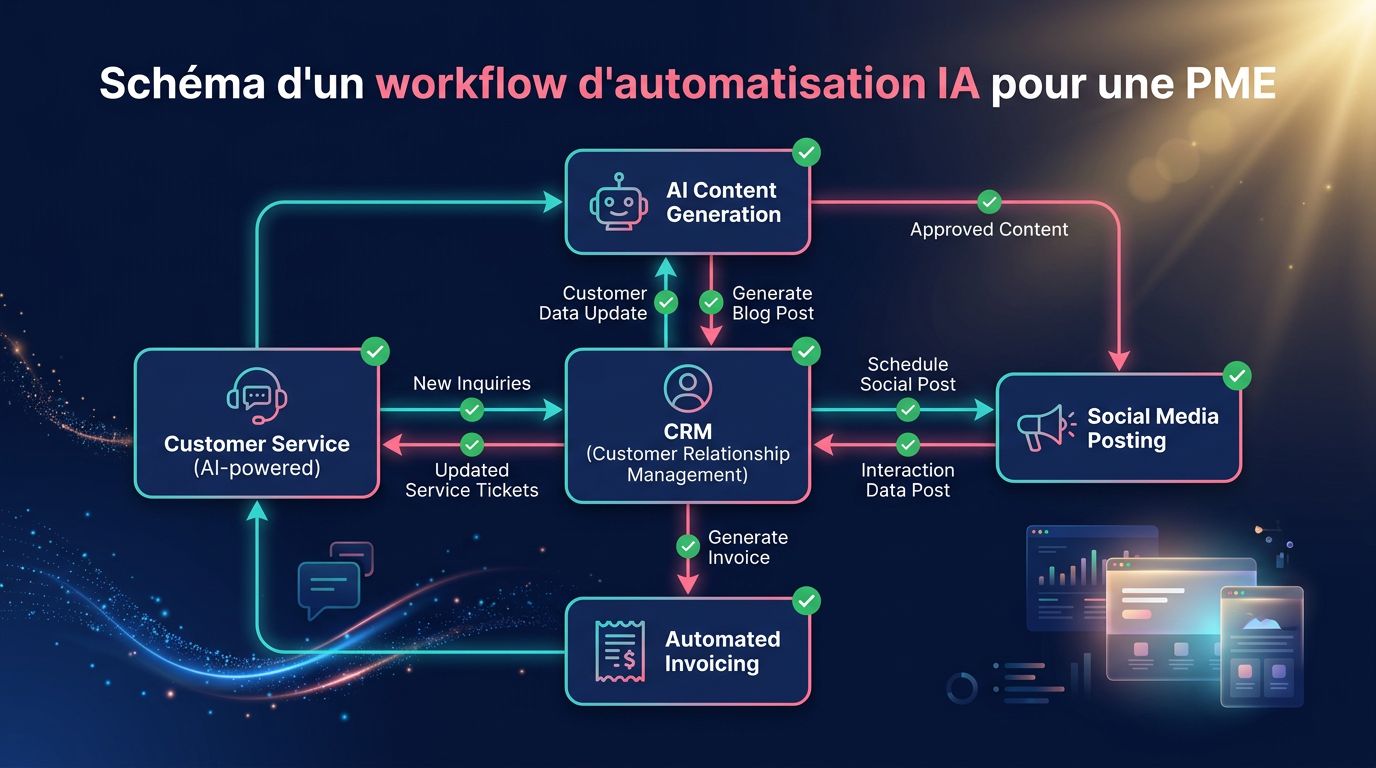
Here, AI is no longer a tool you consult occasionally — it’s wired into your processes. Your CRM automatically suggests follow-ups. Your website produces SEO content autonomously. Your quotes generate from an intelligent form. You’ve started measuring time savings in hours per week, not minutes per task.
This is the level where ROI becomes visible and measurable.
Level 3 — AI as Structural Competitive Advantage
This is where companies that started early dig a moat that’s hard to cross. AI is no longer a department or a project — it’s an organizational capability. Production speed, personalization at scale, market responsiveness become real differentiators.
A few web agencies are there. A few e-commerce businesses too. Most traditional SMEs, no.
What AI Transformation Actually Requires (And They Often Hide This)
Here’s the part that AI solution vendors carefully omit.
AI integration doesn’t happen on its own. It requires three things that nobody mentions in enthusiastic demos:
Clean data. AI is only as good as what you feed it. If your customer data is scattered between a 2018 Excel file, a paper notebook, and your sales rep’s memory, AI can’t create real structure. Before you automate, you have to organize.
A clear vision of which processes to automate. You can’t automate what you haven’t first documented. Companies that successfully transform through AI usually spend time mapping their workflows — often with outside help — before touching any tool.
A shift in human mindset. AI doesn’t replace decisions. It accelerates execution. Teams that resist adoption slow everything down. The human dimension of transformation is consistently underestimated.
“You don’t automate chaos — you automate a controlled process. The difference is fundamental.”
What we see in our daily agency work: clients who get the most value from automation are those who arrive with a clear understanding of what they do today, not those hoping AI will “sort out the mess”.
Creative AI and Strategic AI Are Converging — And It’s Happening Now
Let’s come back to these stealthy creative tools that launch every week.
They’re not trivial. They’re the nerve endings of a larger system. Today’s music generator will be integrated tomorrow into a marketing platform that automatically personalizes your ad jingles based on audience profile. This week’s image generation tool will be wired into your online store to create product visuals on demand.
The convergence between creative AI and operational AI is already underway. Companies that have experimented with both will have an edge when integrated platforms reach maturity — and they’re coming fast.

For an SME in Normandy or anywhere else, the concrete question is simple: are you experimenting now, when tools are still accessible and adoption costs reasonable? Or are you waiting for it to be “more mature”, risking costly catch-up in two years?
Three Concrete Actions to Not Miss the Shift
No grand theory. Here’s what I’d do if I were managing a 5-to-50-person SME today:
Identify one high-volume repetitive task. Not the most complex, not the most strategic — the most repetitive. Report writing, quote request responses, social media publishing. Just one. Automate it. Measure the gain. This creates the internal “aha moment” and confidence in the approach.
Audit your content presence. Does your website produce content regularly? If not, this is the first measurable loss AI can fix quickly. An automated content pipeline — monitoring, writing, publishing — is accessible today for less than €200 per month in tools. The SEO that results is worth far more.
Don’t confuse speed with rushing. Successful AI integration takes 3 to 6 months minimum to show real ROI. “Transformation in 48 hours” promises are marketing. Real transformation is methodical, measurable, and starts with an honest assessment of where you stand.
What We Take From AI’s Dual Nature
AI has two faces, and they complement each other.
The first is creative, accessible, almost playful — it democratizes capabilities that were reserved for large organizations five years ago. The second is strategic, structuring, and creates lasting competitive advantage for those who integrate it seriously.
Ignore the first and you miss quick wins and the experience needed for the second. Stick only to the first and you’re playing with gadgets while others reorganize their production.
The real question for your business isn’t “does AI concern us?” It’s: what level of integration do you want to be at in 18 months, and what concrete steps are you taking this week to get there?
At GDM-Pixel, we industrialized our own production with AI before bringing these approaches to our clients. We don’t sell theory — we document what we’ve built, what works, and what failed. If you want an honest perspective on what automation can bring to your business, or simply where to start without getting lost in marketing hype, let’s talk about it. A 30-minute assessment can clarify more than a year of tech news scanning.
 Social networks
  Analyze with AI