+33-9-7266-3068
 contact@gdm-pixel.fr








 TL;DR - Key Takeaways at a Glance
The ground is shifting beneath your feet — and most businesses don’t see it coming
A client called us last week. Their organic traffic had dropped 22% in three months. Good SEO, good content, no visible penalty. The answer wasn’t in Google Search Console.
It was somewhere else.
This case is not isolated. In 2025, marketing managers and SME leaders are facing dual pressure unlike anything we’ve seen since the mobile shift in 2015. On one side, Google continues to refine its technical crawling rules — silent evolutions that can destabilise a well-ranked site overnight. On the other, ChatGPT and its competitors are building a new discovery channel, with a cost-per-click advertising model that looks remarkably like what Google AdWords was in 2003.
Two simultaneous fronts. Two different logics. One budget.
Here’s how to read the situation — and what to do concretely.
What Google is changing in technical crawling
Let’s start with the fundamentals. Before thinking about ChatGPT, you need to ensure the foundation is solid.
The robots.txt file has existed since 1994. Most webmasters configured it once, years ago, and never touched it again. That’s a mistake that costs dearly in 2025.
Google has been working for several months on a finer and stricter interpretation of crawling directives. Concretely, this means that rules that were once “tolerated” or interpreted loosely may now be applied to the letter. Entire sections of a site — category pages, navigation filters, duplicate content — can end up excluded from crawling without the site owner being immediately informed.
What we concretely see when auditing clients: Disallow directives that are too broad, written by a developer in 2019, that are now blocking strategic URLs. Or, conversely, no restrictions on thousands of internal search result pages that dilute the crawl budget and drown out important pages.
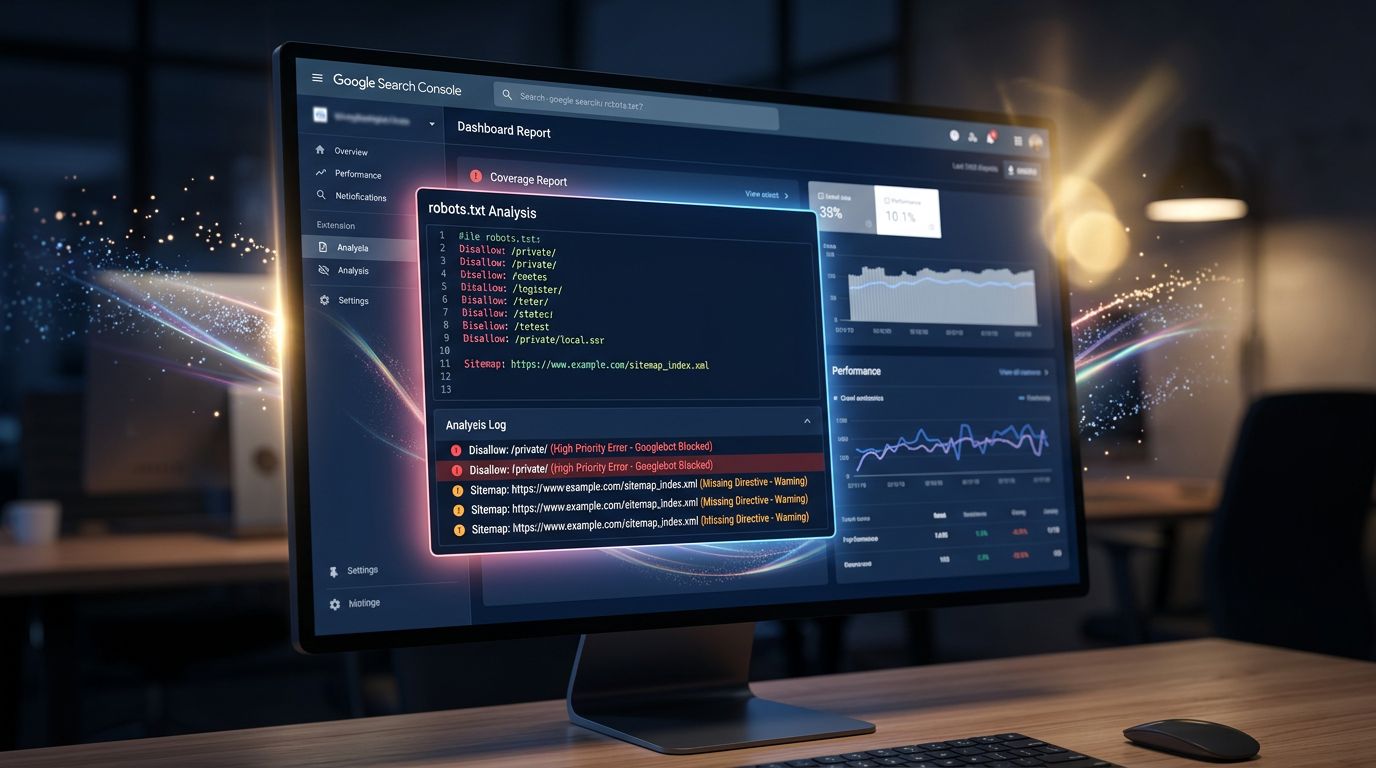
The crawl budget, specifically. That’s the real topic for sites with more than 500 pages. If you want to understand precisely how Googlebot reads your site, our article on what Google really sees during its exploration will give you a concrete framework. Google doesn’t crawl your entire site on every visit. It allocates a quota per domain, based on perceived authority and server response speed. If that budget is wasted on low-value pages, your strategic content is crawled less often — and indexed more slowly.
Three immediate vigilance points:
- Check your server logs to identify which URLs Googlebot actually visits
- Audit your
robots.txtby testing each rule in Google Search Console - Identify low-value pages (filters, URL parameters, duplicates) and explicitly decide to exclude or canonicalise them
It’s not glamorous. It doesn’t make for good LinkedIn posts. But it’s what separates a site that grows from a site that stagnates.
ChatGPT with advertising: understanding what’s really happening
Let’s move to the second front — the one that worries leaders most, often for the wrong reasons.
OpenAI has confirmed the deployment of a CPC (cost-per-click) advertising model in ChatGPT. For many observers, it’s simply a question of monetising a high-traffic platform. That’s true. But it’s not the only issue at stake.
“Conversational search engines don’t replace Google — they create a new search behaviour that coexists with it, and that captures a portion of purchase intent.” — analysis shared by several SEO experts at BrightonSEO 2024.
Here’s what fundamentally changes: when a user types “best accounting software for tradespeople” into Google, they see results, click, compare, come back. The journey is non-linear, but traffic arrives at websites.
When that same user asks the same question to ChatGPT, they receive a synthesised answer. With the new advertising model, that answer can include sponsored links integrated into the conversation. The user gets a contextualised recommendation — and can click directly on a product or service without ever going through a classic results page.
Referral traffic changes in nature. It becomes conversational, intentional, and potentially more qualified — but it escapes the logic of traditional SEO.
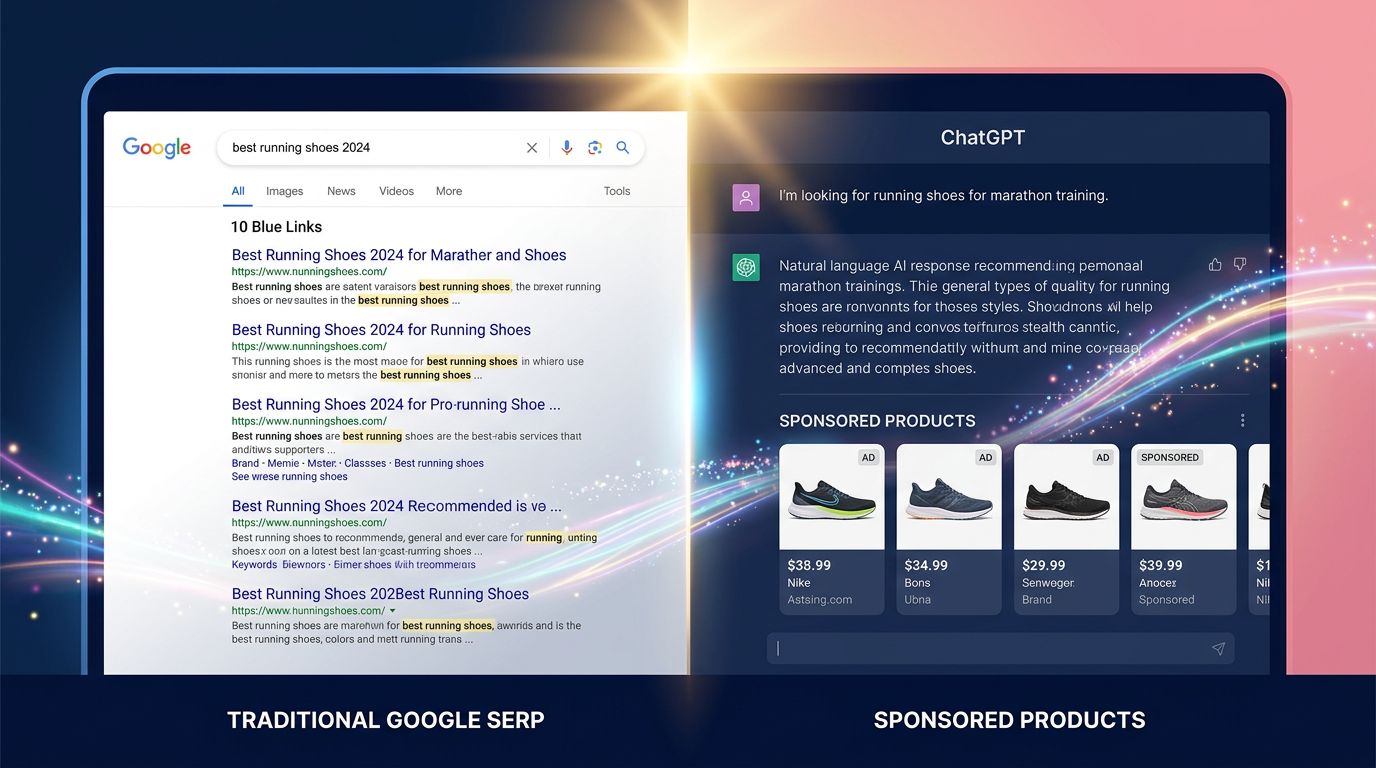
For an SME selling products or services online, the concrete question is this: is your content structured to be cited by an AI, not just indexed by a search engine?
It’s not the same thing.
Visibility in AI: it’s not SEO, but it looks like it
Here’s where it gets interesting — and where many agencies will tell you anything.
There is no codified and validated “SEO for ChatGPT” yet. Anyone selling you an “LLM optimisation” service with guaranteed results is telling you a story. We’ve actually analysed this topic in depth in our article on the future of SEO in the face of AI. Language models don’t work like search indexes. They have no crawl file, no meta tags, no PageRank.
What they do have, however, is a representation of the world built from billions of texts. And this representation favours sources that:
Are cited by other reliable sources. Domain authority remains relevant, not because Google measures it, but because authoritative sites are over-represented in training data and in real-time search results that some models consult.
Answer specific questions directly. Content structured in Q&A format, with clear definitions and concrete examples, is more easily extractable by a model.
Are recent and regularly updated. Models with real-time web access (like ChatGPT with browsing enabled) favour fresh content.
What we currently recommend to our clients: don’t abandon their Google SEO strategy to chase AI platforms. But adapt their editorial format so that their expertise is extractable. That means: direct answers, clear structure, verifiable data, no vague and generic content.
What this changes for your budget and strategy
Let’s be direct about the practical implications.
If you’re an SME with a limited digital budget — let’s say between €500 and €2,000 per month — you can’t fight on all fronts simultaneously. You have to choose.
Our advice for a small business with a limited budget: secure the Google technical foundation first before investing in AI visibility. A site poorly crawled by Googlebot won’t be treated better by ChatGPT. The foundation is the same.
Then, if you have an e-commerce site or a local business with a strong “product discovery” component, start monitoring your analytics to identify if you’re already receiving traffic from ChatGPT or other AI platforms. Google Analytics 4 and some third-party tools now allow you to identify these sources. It’s probably not yet significant for the majority of French SMEs — but it will become so.
For companies with an existing advertising budget, CPC on ChatGPT is worth testing as soon as it launches in France. Acquisition costs on an emerging platform are historically lower than on a mature platform. Google Ads in 2003 cost a fraction of what it costs today. The window of opportunity exists — it won’t last.

Three concrete actions to implement now
No theory. What we’d do if we were in your position, with an existing site and a reasonable budget.
1. Audit your robots.txt and your indexing coverage this week. Open Google Search Console, go to “URL Inspection” and test your 10 most important pages. Check that they are indexed, that the robot isn’t blocking them, and that the date of last crawl is recent. If that’s not the case, you have a technical problem that takes priority — no content strategy will compensate for that.
2. Restructure your best content in “direct answer” format. Take your 5 most visited articles or pages. Add an introduction that answers the main question in 2-3 sentences. Structure the content with sub-headings that are themselves questions. This work serves both Google featured snippets and extractability by AI models. Double benefit, single effort.
3. Create a tracking dashboard for emerging traffic sources. In Google Analytics 4, create a custom segment to identify traffic from chat.openai.com, perplexity.ai, claude.ai and other AI platforms. Even if volumes are marginal today, having the historical data when these sources become significant will be valuable for justifying your future investments.
The real question for 2025
How many of your potential clients have already asked ChatGPT a question before searching on Google? You don’t know. Neither do I. Nobody knows precisely.
But we know that search behaviour is fragmenting. We know that Google is no longer the only entry point to your expertise. And we know that the companies that will have structured their digital presence to respond to this fragmentation will have an advantage over those that waited for definitive numbers.
On the projects we’re currently running at GDM-Pixel, we systematically integrate these two dimensions into our SEO audits and services: technical health for Google, and content structuring for readability by AI. It’s not two separate budgets — it’s a single coherent strategy.
Want to know where your site stands on these two axes? We offer a complete technical audit in 3 days, with an actionable report and prioritised recommendations by impact. No 80-page report that ends up in a drawer — an action plan you can start executing the following week.
Contact GDM-Pixel for an audit — we’ll tell you what’s really blocking your visibility, without detour.
Sources consulted: Google Search Central Documentation, BrightonSEO 2024 analyses, FEVAD data on e-commerce search behaviour in France, OpenAI reports on ChatGPT monetisation features.
 Social networks
  Analyze with AI