+33-9-7266-3068
 contact@gdm-pixel.fr







 TL;DR - Key Takeaways at a Glance
Google Answers for Your Users. And They Don’t Click Anymore.
A client called us a few weeks ago. Their organic traffic had dropped 34% in three months. Their website hadn’t changed. Their SEO hadn’t changed. Their Google rankings? Stable.
The culprit: AI Overviews.
Google now answers directly in search results, before users even need to click. Result: your content is used, your expertise is mined, and your site remains invisible. This phenomenon — called “zero-click” — is no longer a theoretical projection. It’s the reality of thousands of SMBs across the US, Europe, and beyond, watching their traffic evaporate without understanding why.
Here’s what’s actually happening, and what you can concretely do about it.
What AI Overviews Really Are (And Why They Change Everything)
AI Overviews is Google’s feature launched in 2024 that automatically generates a synthetic answer at the top of search results. The AI aggregates sources, reformulates, and delivers a ready-made answer to the user. Without them needing to click further.
For informational queries — “how to,” “what is,” “which is best” — it’s devastating. These queries made up the bulk of content traffic for most websites.
Here’s where it gets interesting: according to early analysis conducted in the United States, where AI Overviews are deployed at scale, click-through rates on organic results can drop by 15 to 25% on affected queries. In Europe, rollout is more gradual, but the underlying trend is identical.
This isn’t a bug. It’s Google’s business model evolving.
Google’s goal has never been to send you traffic. It was to answer its users’ questions. For a long time, it needed you for that. Now, increasingly, it doesn’t.

The Problem Nobody Mentions: AI Gets It Wrong, And Your Reputation Pays the Price
Traffic reduction is one thing. But there’s a second, more insidious risk.
Generative AI systems — Google, ChatGPT, Perplexity — are increasingly used by consumers to discover brands, compare service providers, find local recommendations. What’s called “AI-driven brand discovery” is replacing part of the traditional customer journey.
The problem: these AIs hallucinate. They invent information. They associate brands with services they don’t provide. They cite outdated pricing. They confuse companies with namesakes.
What we’re seeing with our clients: prospects arriving with incorrect information about pricing, timelines, or services, because an AI provided them with an approximate synthesis gleaned from outdated or misinterpreted sources.
“The problem isn’t that AI talks about you. It’s that it talks about you without asking your permission, and sometimes it gets it wrong.”
For a small business whose reputation rests on local trust, repeated errors in AI answers can cost you customers without ever knowing why they didn’t call. It’s the new invisible risk of digital marketing.
Three Concrete Strategies to Protect Your Traffic
Let’s get to the point. What should you do in this reality?
Focus on High-Commercial-Intent Queries
AI Overviews primarily target informational queries. “How does SEO work” — the AI answers directly. “SEO agency near me for small business” — much less so. Queries with clear purchase intent, localized, specific to a business need, resist zero-click much better than generic informational content.
If I were in your position with a limited SEO budget, I’d immediately refocus my efforts on service pages and local pages rather than generic blog articles. Not because content is dead — but because ROI has shifted.
Build a Brand Presence Beyond Google
It’s advice everyone gives and nobody really follows: diversify traffic sources. But today, it’s no longer optional.
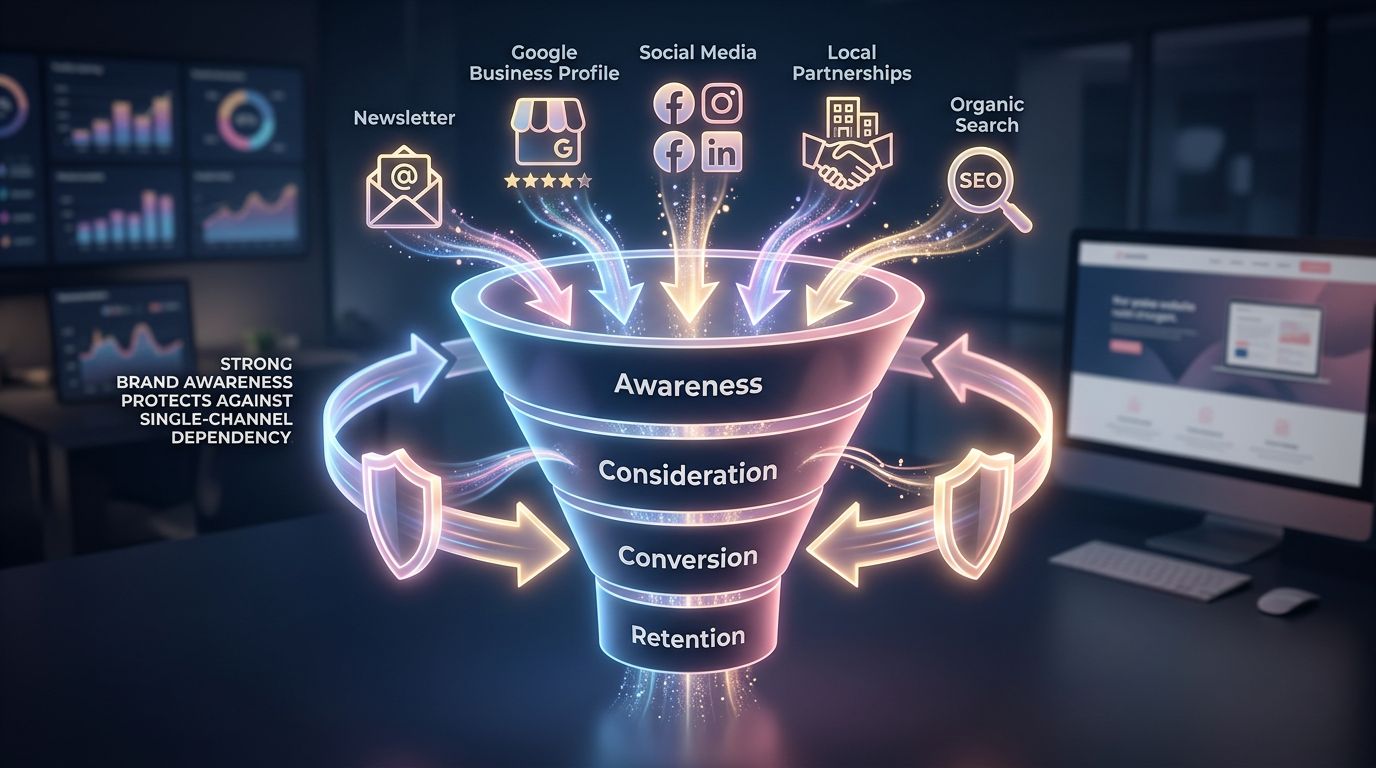
Channels that resist AI Overviews: direct email newsletters, social media with engaged communities, trust platforms like Google Business Profile (reviews aren’t being “synthesized” by AI yet), local partnerships, specialized industry directories.
Across the US and Europe, the SMBs doing best are those with multi-channel presence, even if modest. A customer who knows you through your newsletter won’t go through Google to find you again.
Optimize to Be Cited by AI, Not Just Ranked by Google
This is the strategic pivot that few agencies have integrated into their offering yet. The goal isn’t just to rank on page one of Google — it’s to be the source that AI cites when answering.
How do you get there? Several concrete levers:
Structured content with clear factual data, direct answers to common questions, verifiable numeric data. AIs love content that precisely answers a question with logical structure.
Correct schema.org markup. Structured data helps AI crawlers identify and cite your information with precision. FAQ schema, LocalBusiness schema, Review schema — these are signals that AI crawlers read first.
Domain authority built over time, with quality backlinks from recognized sources in your industry. AIs tend to cite sources that already have established credibility.
How to Control What AI Says About Your Brand
It’s a question nobody’s asking yet, but everyone should be asking now.
Your Google Business Profile is your first line of defense. It’s a source Google uses directly to feed its local answers. It must be complete, up-to-date, with precise service descriptions, hours, and indicative pricing if relevant.
Regularly verify what AI says about you. Search your company name in ChatGPT, Perplexity, Google with AI Overview enabled. If you find errors — and there often are — you can act on the sources these AIs use: update your website, correct outdated directory listings, publish content that corrects misinformation with sufficient authority to be recrawled.
“Your online reputation is no longer decided only by customer reviews. It’s also decided by the data that AIs ingest about you.”
What agencies never tell you: incorrect information about your business often comes from obsolete directories nobody thought to update since 2019. A wrong address, a dead phone number, an outdated service description — it all ends up in training corpora and AI answers.
An audit of your online presence — not just your website, but your entire digital footprint — has become a concrete priority, not a luxury.

What This Changes for Your Marketing Budget
Let’s be direct about the numbers.
If you’re investing today in purely informational SEO content — generic blog articles, generic “how-to” guides without differentiation — your ROI will continue to degrade. This isn’t opinion, it’s documented trend.
Conversely, investments that remain relevant, even gaining value:
Differentiated expertise content holds up well. An article documenting your real-world experience, with proprietary data, real client cases, an angle only you can have — no AI can synthesize it for you. That’s exactly the philosophy applied here: I talk about what I’ve done, not what could be done in theory.
Local reputation and customer reviews become strategic. Google continues to prioritize local results with reviews for commercial-intent queries. A portfolio of recent, authentic reviews is an asset AI cannot replace.
Technical SEO remains fundamental. A slow site, poorly structured, without structured data, will be ignored by AI crawlers before being evaluated on content. Technical basics are the prerequisite for everything else.
Our experience confirms it: clients hit hardest by rising AI Overviews are those who bet exclusively on content volume without differentiation strategy. Those doing best have coherent multi-channel presence and content reflecting real expertise.
Three Things to Do This Week
Not in six months. This week.
Audit what AI says about you. Search your company name on ChatGPT and Perplexity. Note any errors. Identify sources you can correct.
Check your Google Business Profile. Up-to-date description, correct categories, accurate hours, recent photos. It’s your most directly ingested data source by Google AI.
Identify your three most important pages — not most visited, most important for business — and verify they have correct schema.org markup, clear question/answer structure, and accurate factual data.
These are two to four hour actions. Not a redesign project. Not significant budget. Just rigor on fundamentals that search engine evolution makes urgent.
The era of answer engines is here. It’s not going away. But it doesn’t mean the death of SEO or digital marketing — it means the rules have changed, and companies adapting now will have an edge over those waiting to see.
Want to know exactly where you stand? At GDM-Pixel, we conduct online presence audits covering precisely these issues: what Google sees, what AI says about you, what you can correct quickly. Contact us — honest diagnosis, no redesign commitment unless necessary.
 Social networks
  Analyze with AI