+33-9-7266-3068
 contact@gdm-pixel.fr







 TL;DR - Key Takeaways at a Glance
Likes don’t pay your bills
A LinkedIn post with 15,000 impressions. Dozens of comments. Notifications all day long.
And at the end of the month? Zero new clients.
How many hours a week do you spend crafting short posts to collect likes that don’t convert? That is the reality nobody wants to hear in those £997 LinkedIn training courses: surface engagement does not build deep credibility.
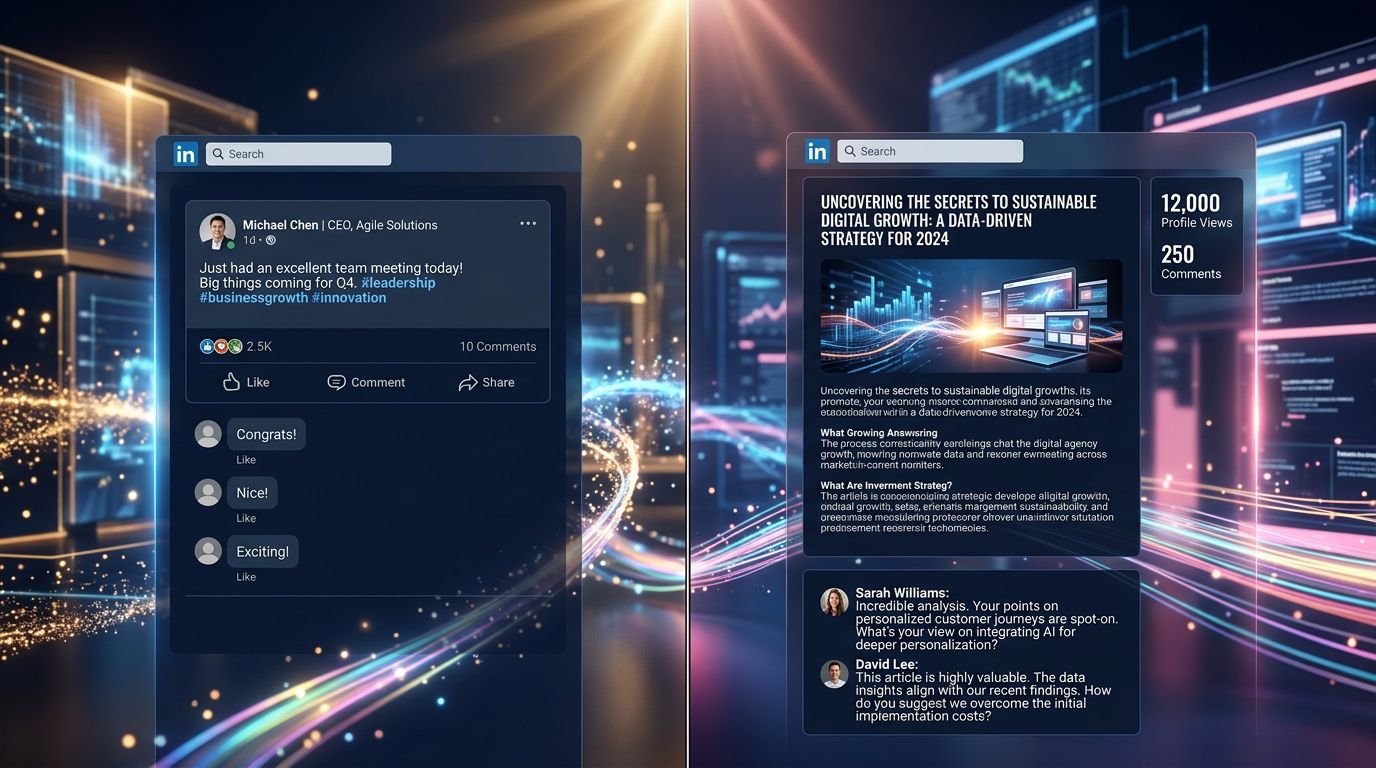
There is a distinction that “LinkedIn experts” carefully avoid making. On one side, short posts — optimised for the feed, for the algorithm, for dopamine. On the other, long articles — structured, argued, accessible months after publication. These two formats do not compete in the same category. One gives you visibility. The other gives you authority. It is one of the most common symptoms we describe in our analysis on why 90% of small businesses under-exploit their website: plenty of online presence, little content that proves expertise.
And if your goal is to find clients, partners or serious opportunities, it is the second category that matters.
What LinkedIn’s algorithm has changed (and most people missed)
For years, the universal advice was: “Keep it short, keep it simple, do volume.” Three to five lines, a catchy hook, a call to engage at the end of the post. Repeat. Scale.
That worked. Until it stopped working so well.
LinkedIn progressively evolved its algorithm to favour what it calls “lasting value content”. Concretely, this means long articles — published via LinkedIn’s native Articles tool or via LinkedIn newsletters — now benefit from different distribution. They appear in LinkedIn search results. They are indexed by Google. They continue generating traffic weeks after publication.
A short post has a half-life of 24 to 48 hours. A well-crafted article can bring you readers for 18 months.
What we see concretely with our clients who have adopted this approach: their LinkedIn profile begins to look like a consultable window of expertise, not a stream of current thoughts. When a prospect lands on their profile, they don’t just see posts — they see a library of proof.

The difference between being visible and being credible
Here is the trap most professionals fall into on LinkedIn.
Visible: your content appears in the feed of your connections. They see you. Maybe they like it. Maybe not. They move on.
Credible: a prospect searches for an expert in your field. They land on your profile. They read a 1,500-word article where you dissect a problem they are facing exactly. They understand your method, your way of reasoning, your level of expertise. They contact you.
It is not the same mechanism. It is not the same result.
Short posts build a presence. Long articles build a reputation.
“People don’t buy what you do, they buy why you do it — and above all, they buy the proof that you know how to do it.”
A well-written LinkedIn article is a public demonstration of how you think. You don’t say “I am an expert in X” — you prove it by treating X with depth, raising the right questions, providing actionable answers. That is the difference between a claim and a demonstration.
How to structure a LinkedIn article that truly converts
It is not a matter of length for length’s sake. A 2,000-word article full of generalities is no better than an empty 300-word post. What matters is structure and intention.
After having supported dozens of SMEs and professionals in their content strategy, here is what actually works:
Start with the problem, not with yourself
Your reader does not open your article to read about you. They open it because they have a problem and your title suggested you had an answer. Start there. Describe the problem precisely — enough for your reader to recognise themselves in the first three lines.
Develop your unique angle
Do not write what everyone else is already writing. If your article on “how to improve your SEO” looks like the other 500 articles on the same subject, you are adding nothing. Your added value is your field experience, your concrete cases, your instructive failures. What you have seen and done that others have not seen and done.
Conclude with a clear action
Not a vague conclusion like “I hope this article was useful”. A conclusion that clearly states: here is what you can do now, here is what it will change, here is how to contact me if you want to go further. This principle ties directly into the logic of a well-constructed inbound marketing strategy: every piece of content should guide the reader towards a clear next step.
The real question: how much does the lack of online authority cost you?
Let us be concrete.
You are a consultant, service provider, or head of an SME. A potential prospect has been referred to you by a mutual contact. Before calling you, what do they do? They search your name on Google. They look at your LinkedIn profile.
What they find on your profile will either confirm they were right to seek you out, or create doubt.
A profile with two or three generic posts and no substantial content creates doubt. A profile with a dozen articles demonstrating your mastery of your subject confirms and reassures.
What nobody in agencies ever tells you: LinkedIn content is not an optional “personal branding” tool for people with spare time. It is a direct commercial tool. Every article you do not publish is a validation opportunity you are not giving your prospects.
“Your LinkedIn profile is your second website. Except most people treat it like an abandoned CV.”
The figures from our audits show that professionals who regularly publish in-depth articles on LinkedIn generate on average two to three times more inbound contact requests than those who stick to short posts. It is not magic — it is mechanical. More visible expertise surface, more chances of being found at the right time by the right person.
Frequency and regularity: the discipline that makes the difference
Let us be brutally honest here.
Most people publish a LinkedIn article once, reap few immediate results, and give up. That is precisely why those who persist stand out.
Authority is not built in one article. It is built over time, by accumulation. One article per month for 12 months is a library of 12 demonstrations of expertise. It is 12 potential entry points for your prospects. It is 12 pieces of proof that you are serious, consistent, and that you master your subject.
The question is not “do I have time to write an article this month?” The question is: “can I afford not to?” If you wish to go further with your digital content strategy, our digital marketing offer can support you in structuring a coherent editorial plan that generates real commercial opportunities.
If I were in your position with limited time, here is what I would do: one in-depth article per month, built around a real client problem. Not perfect. Not exhaustive. But useful, honest, and published. Regularity beats perfection, always.
Three concrete actions to start this week
No more theory. Here is what you can do now:
First action. List the three questions your clients ask you most often. Each one is a potential article topic. You already know the answers — it is simply a matter of writing them down with structure.
Second action. Audit your LinkedIn profile today. Count the number of published articles. If the answer is zero or one, you have your priority for the next 30 days.
Third action. Choose a format and stick to it. A monthly article of 1,000 to 1,500 words, on a topic from your expertise, with a concrete angle and an actionable conclusion. That is all. You do not need a complex content strategy to get started.
“The best LinkedIn article is the one you publish, not the one you have been planning for six months.”
Building a presence that lasts
Likes pass. Authority remains.
That is the summary of everything we have just covered. Short posts have their uses — they maintain a presence in the feed, they show you are active. But if you want LinkedIn to work for you over the long term, if you want to be found, consulted, contacted by qualified prospects, you need to build something more solid.
In-depth articles are that foundation. They index in search engines. They remain accessible on your profile. They demonstrate your expertise rather than merely asserting it. And in an increasingly saturated LinkedIn environment full of formatted and interchangeable content, depth becomes a real differentiator.
In Normandy as everywhere in France, the professionals who truly benefit from LinkedIn are not necessarily those who post most often — they are those who have built a coherent and lasting editorial presence.
Want to go further with your digital content strategy? At GDM-Pixel, we help SMEs and independent professionals set up content creation workflows that work — without spending your nights writing. Contact us for an initial no-commitment conversation. We tell you what works, and what doesn’t.
 Social networks
 Analyze with AI