+33-9-7266-3068
 contact@gdm-pixel.fr








 TL;DR - Key Takeaways at a Glance
When numbers mislead you
One of our clients contacted us a few months ago, feeling pretty pleased with himself. His marketing agency had just sent him a monthly report: +34% organic traffic, engagement up, 1,200 new sessions. Impressive. Except his sales had stalled for six months. And his phone wasn’t ringing anymore.
That’s what we call the marketing mirage. Numbers going up. Business going nowhere.
Here’s the fundamental problem: most dashboards measure what’s easy to measure, not what actually matters. Meanwhile, the real question goes unanswered—does my offer make sense to the right people?
The usual suspect: an offer clear to you, blurry to them
Here’s a truth we see constantly with our clients, and it’s hard to hear.
You’ve spent weeks crafting your offer. You know every detail of your service, every argument, every use case. Result: you’re too close to see what a prospect sees arriving on your site for the first time.
What we observe in agency audits: the homepage answers “what do we do?” but never “why does this matter to me, right now?” Those are two radically different questions.
A carpenter who writes “handcrafted custom furniture since 1998” describes his activity. He doesn’t address his prospect’s actual problem: “I have a 190 sq ft living room and can’t find anything that fits my angles.” Offer clarity isn’t description—it’s resonance.
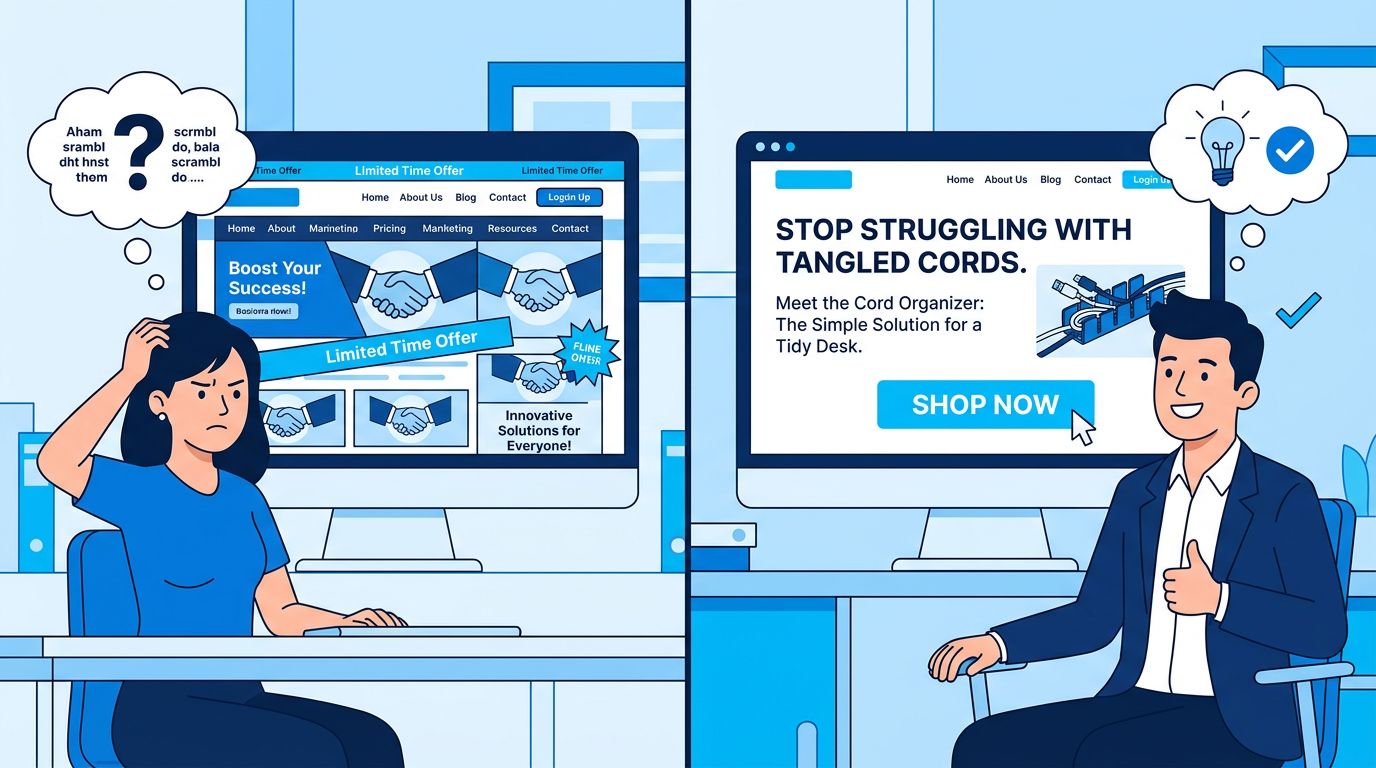
And traffic? It doesn’t fix this problem. It amplifies it. The more visitors you drive to a poorly articulated offer, the more you confirm that visibility isn’t the issue—your message is.
What your metrics don’t measure (and what it costs you)
Let’s flip the situation. Imagine your numbers are good. Really good.
- Bounce rate under 50%
- Average session duration: 2 minutes 40 seconds
- Pages per session: 3.2
Impressive. But here are the questions nobody asks in that monthly report:
Did these visitors have the budget to buy? Were they in your service area? Were they decision-makers or just curious? Did your content attract them because it solved their problem or because it ranked well on a keyword you shouldn’t be targeting?
What agencies never tell you: strong engagement can signal bad targeting. People genuinely interested in your content but who will never buy.
“Vanity metrics make you feel good. Traction metrics make you move forward.” — This distinction, popularized in startup culture, applies exactly to a mid-market business investing in digital presence.
Real diagnostic of effective marketing strategy involves at least nine dimensions: offer clarity, target relevance, message consistency across channels, traffic quality (not volume), real conversion rate, customer lifetime value, acquisition cost, perceived reputation, and alignment between promise and delivery.
Most reports cover two or three. The rest stays hidden.
The nine-dimension diagnostic: why your monthly report is incomplete
What we’ve implemented in our client tracking at GDM-Pixel is an analysis framework that refuses to stop at surface metrics. Here’s how it translates in practice.
Offer clarity is tested, not felt
You cannot judge your own offer’s clarity. You’re too embedded in it. Minimal test: show someone outside your industry your homepage for 5 seconds, then ask what you do and for whom. If the answer is vague, your offer is unclear—no matter how it reads to you.
Target relevance is measured by lead quality, not volume
A hundred inquiries where ninety don’t match your ideal customer profile isn’t success—it’s noise. The real indicator: what percentage of your leads move to proposal stage? With our clients, when this drops below 30%, it’s consistently a targeting or messaging problem, not a traffic volume issue.
Message consistency across channels is often the missing link
Your site says one thing. Your Google Business Profile says another. Your social media talks about something else entirely. A prospect discovering you through three different channels doesn’t get reinforced messaging—they get three conflicting messages. And they leave.

The real cost of unqualified traffic
Here’s a calculation most business leaders never do. If you’re paying an SEO agency 800€/month and it generates 400 extra visits, the cost per visit is 2€. But if only 10% of those visitors are qualified, the cost per relevant visitor jumps to 20€. And if your conversion rate among those qualified visitors is 5%, the real cost per lead exceeds 400€.
This isn’t a critique of SEO. It’s a reminder that intermediate metrics only matter if you trace them back to final business impact.
Offer as infrastructure, not marketing argument
If I were in your position, here’s what I’d do before spending another euro on customer acquisition.
I’d treat my offer like technical infrastructure—something you audit, test, optimize, and never consider “done.” Exactly like you’d never freeze a website in stone.
Concretely, that means:
Testing your core promise with people outside your industry. Measuring how long a new visitor takes to understand what you do, for whom, and why it costs what it does. Verifying your contact or proposal form doesn’t ask for information that turns prospects cold before they’ve even decided to reach out.
Our experience confirms: in most SME site redesigns we’ve done, the problem wasn’t technical. Sites were slow sometimes. Designs were dated occasionally. But the real friction was upstream: a value proposition that spoke to the business owner, not their customer.
“A website isn’t an online brochure. It’s a salesperson available 24/7—and like any salesperson, it needs to handle objections before they’re raised.”
What does a site cost you when it generates zero leads? The answer isn’t nothing. It includes the opportunity cost of every prospect who landed, looked, didn’t understand, and went to a competitor instead.
Three concrete actions to escape the mirage
No exhaustive checklist. Three points you can act on this week.
Audit your offer before your metrics. Before opening Google Analytics, ask five people outside your industry to read your homepage and explain what you do. Note their words—not yours. That vocabulary is your raw material for repositioning.
Isolate your qualified leads in your CRM. Not all contacts, not all inquiries—prospects who genuinely match your ideal customer profile. Calculate their percentage over the last three months. If it’s under 30%, you have a targeting problem, not a volume problem.
Ask your agency for a business-oriented report, not a traffic report. Sessions, page views, bounce rate—that’s context. What matters: how many qualified leads, at what cost, with what conversion rate to proposal then to client. If your agency can’t answer these questions, it’s a conversation to have now.

What we do at GDM-Pixel when a client arrives with this problem
We always start with the offer, not the site.
Because building a fast site around a blurry offer ships quick but doesn’t convert. Our Astro + Tailwind + Claude Code workflow can deliver a site in three days—but if the value proposition isn’t clear before we start, we ship a fast, beautiful site that still doesn’t convert.
Pre-diagnosis is part of our process. Not as a separate billable service—as a prerequisite for the rest of the work to matter. We’ve declined projects because the client didn’t yet know who they really served. Not from principle. From pragmatism: you can’t build a conversion tool on unstable ground.
If you see yourself in this—decent traffic, insufficient leads, metrics that reassure but results that plateau—it’s probably time to ask the right question, not order more content or boost your Google Ads budget.
The right question: is my offer actually clear to someone who doesn’t know me yet?
Contact us for an audit of your value proposition and conversion funnel. We look at what’s blocking, we tell you what we find—even if the answer isn’t “rebuild your site.”
 Social networks
  Analyze with AI