+33-9-7266-3068
 contact@gdm-pixel.fr








 TL;DR - Key Takeaways at a Glance
The real cost of customs duties that nobody calculates
An importing client called us last March. His problem wasn’t his site. It was his cash flow. He had been waiting for 4 months for a US Customs refund (CBP). €40,000 locked up. Meanwhile, he had to restock his inventory.
We’re seeing this scenario more and more often with e-commerce merchants who import.
Customs agency reimbursement delays are stretching out. Procedures are getting more complex. And while the money sleeps in administrative channels, your working capital needs don’t wait.
E-commerce isn’t just about traffic and conversion. It’s also about financial flows.
How many online stores have real visibility into the customs impact of their sourcing? In our experience, very few. Most optimize their sales funnel while their cash flow weakens upstream.

What customs duties really do to your business model
Let’s talk concrete numbers. No theory.
When you import from Asia or the United States, you pay duties at entry. Everyone knows that. What many underestimate is the delay between payment and potential reimbursement — especially on drawback procedures (duty reimbursement on re-exported goods) or tariff disputes.
In the United States, the CBP (Customs and Border Protection) can take 6 to 12 months to process certain reimbursement cases. In Europe, delays vary by member state, but procedures remain heavy.
Concrete impact on your business:
Your capital gets locked up. You paid the duties, you sold the goods, but the money you’ll get back in 8 months doesn’t exist to finance your next purchase.
This treasury mismatch forces painful trade-offs: reduce order volumes, negotiate shorter supplier terms, or worse — resort to short-term credit to fix a structural problem.
“Cash flow is a company’s oxygen. You can survive without profit for a time. You don’t survive without cash.” — Axiom of every accountant who has seen profitable companies fail.
The question you need to ask yourself: does your pricing really account for the cost of the time between paying duties and their potential reimbursement?
In most cases we audit, no.
The silent revolution: Shopify erases the B2B/DTC boundary
While e-commerce merchants manage their cash flow troubles, something structurally important is happening on the platform side.
Shopify, WooCommerce, and to a lesser extent PrestaShop, are democratizing B2B features that were reserved for big players just 3 years ago.
Concretely, what changes?
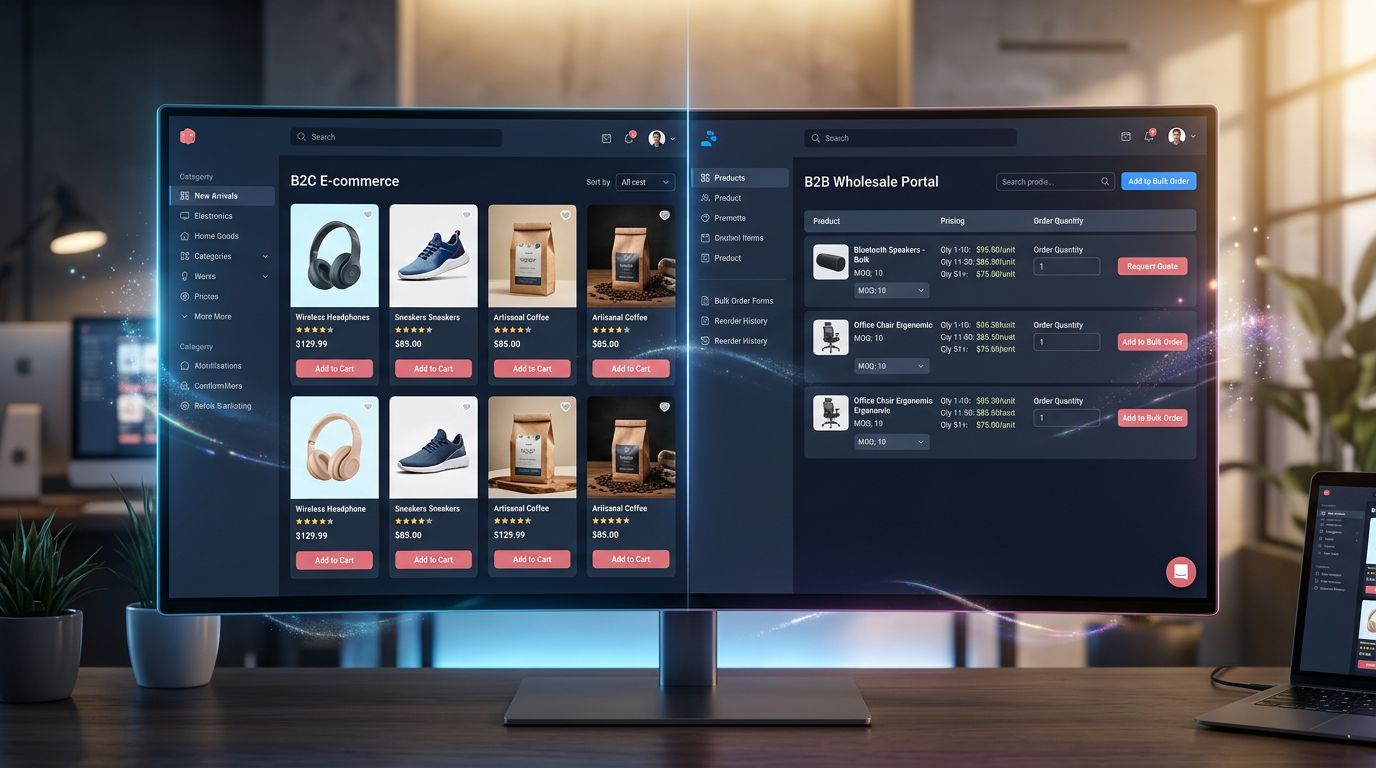
Before, if you wanted to sell both directly to consumers (DTC) and wholesale to resellers (B2B), you needed two separate environments. Two sites, two back-offices, two pricing systems, two order workflows. Cost: between €15,000 and €50,000 in custom development, depending on complexity.
Today, Shopify B2B integrated into Shopify Plus plans allows you to manage both from a single instance. Differentiated price catalogs by customer, personalized payment terms (30 days, 60 days), order validation by purchase order, dedicated customer portal.
What cost €30,000 in development 3 years ago now configures in a few days.
Why this B2B/DTC convergence is a concrete opportunity for SMEs
Here’s where it gets interesting for e-commerce merchants not yet in B2B.
You have an online store that works. You have loyal customers. You have optimized sourcing. You have decent margins.
Have you thought about selling wholesale to local resellers?
It’s no longer a size question. It’s a configuration question.
A Norman artisan selling his products online can now open a wholesale channel to supply gourmet shops, gift stores, hotels — without technical overhaul. Without massive development budget. With tools already on his platform.
The impact on cash flow is immediate and positive: B2B orders are generally larger, more predictable, and allow you to smooth seasonal variations that kill DTC margins.
On the projects we’ve run, adding a B2B channel represents on average +20 to +35% of revenue in the first year — with nearly zero customer acquisition cost if you already have contacts in your network.
PrestaShop vs Shopify: the B2B choice in 2026 for a French SME
We get this question often. Here’s our on-the-ground reading, no bullshit.
Shopify Plus: powerful but expensive at scale
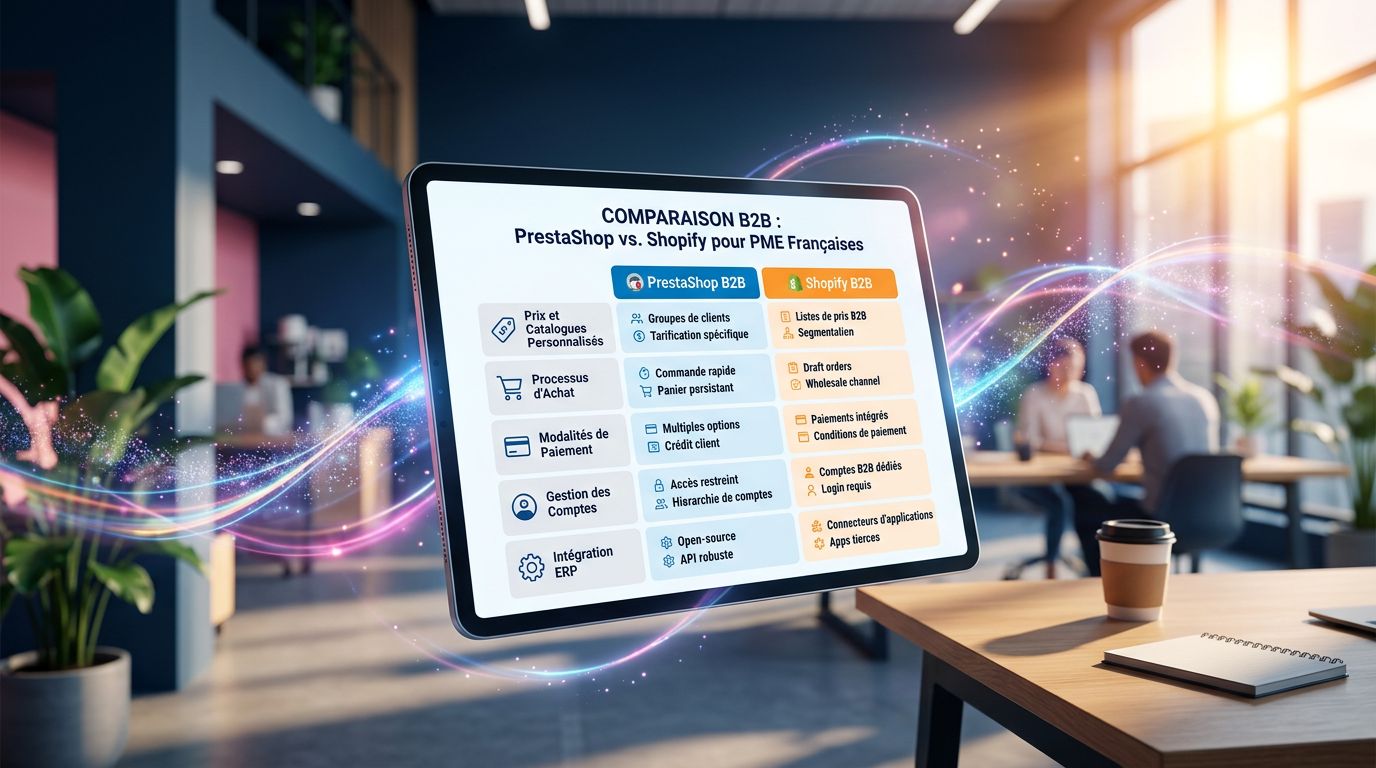
Shopify’s native B2B features are impressive. But Shopify Plus starts at roughly €2,300/month. For a French SME with average order volume, it’s often hard to justify for B2B alone.
On lower plans, B2B features remain limited and require third-party apps (Handshake, Wholesale Club) that add recurring monthly costs.
PrestaShop: technical flexibility at the service of customized B2B
PrestaShop remains our recommendation for French SMEs wanting truly customized B2B without exploding their monthly budget. The licensing model is more predictable. The B2B module ecosystem is mature. And the French-speaking community makes finding competent developers easier.
We’ve delivered complex B2B configurations on PrestaShop — differentiated catalogs, online quote management, ERP integration — for budgets between €4,000 and €12,000 in one-time development, with no platform subscription that explodes with growth.
The rule we apply at GDM-Pixel: if your GMV (merchandise volume sold) exceeds €500,000/year and you’re targeting rapid international growth, seriously look at Shopify Plus. Below that, well-configured PrestaShop will give you more flexibility for less money.
Three concrete actions to secure your e-commerce against these challenges
Not an exhaustive list. Three actionable points, in order of priority.
1. Audit your customs exposure before optimizing it.
If you import, precisely map: which products, which countries of origin, which rates applied, and what’s your average recovery time on reimbursements. This work takes a day with your freight forwarder. It will save you cash flow surprises in 6 months.
2. Evaluate the B2B potential of your existing catalog.
You don’t need to rebuild everything. Start by identifying 5 to 10 potential customers in your network who could order in volume. Test with a PDF catalog and manually negotiated terms. Only invest in technical configuration if demand exists.
3. Choose your platform based on your trajectory, not trends.
Shopify makes noise. It’s an excellent platform. But “excellent” means nothing if it doesn’t match your business model, your volume, your customization needs. Do the cold analysis before migrating.
“The best tool is the one you actually use, not the one everyone’s talking about.” — Principle we apply to our own stack choices too.
E-commerce in 2026 rewards operators, not optimizers
What we see concretely with our clients: the online stores that perform aren’t necessarily those with the best design or highest conversion rate. They’re the ones with solid operational fundamentals.
Controlled cash flow. Documented sourcing. Diversified sales channel. Platform chosen for the right reasons.
E-commerce is becoming increasingly an operator’s job — like a physical distributor, but with digital tools. The “make a nice site” part has been solved for a long time. The “build a sustainable e-commerce business” part is what differentiates survivors from victims of the next crisis.
Current customs turbulence isn’t an anomaly. It’s the new normal of globally tense commerce. Your e-commerce must be built to absorb these shocks, not to work only when everything’s fine.
The good news: the tools to do it have never been more accessible. The bad news: they don’t use themselves.
What we can concretely do for you
At GDM-Pixel, we support e-commerce merchants on both dimensions — technical and strategic.
Audit of your current e-commerce architecture (platform, integrations, performance). B2B configuration on PrestaShop or WooCommerce if your model suits it. And if you’re deciding between migrating or optimizing, we’ll tell you straight what makes sense — even if the answer is “don’t touch anything right now.”
Want an honest diagnosis of your online store? Contact us — we respond within 24 hours and don’t sell a rebuild when a 2-day audit is enough.
Sources: U.S. Customs and Border Protection (CBP), Shopify B2B documentation 2024, FEVAD E-commerce Report for France 2024.
 Social networks
 Analyze with AI