+33-9-7266-3068
 contact@gdm-pixel.fr







 TL;DR - Key Takeaways at a Glance
What nobody tells you about LinkedIn visibility
One in two executives you read regularly on LinkedIn doesn’t write their own posts.
This isn’t a shameful secret. It’s a strategy. And it’s probably one of the most effective approaches for turning a professional network into a machine for generating business opportunities — without spending three hours a week staring at a blank screen.
Ghostwriting has existed as long as CEOs have had assistants. On LinkedIn, it takes a particular form: discreet, measurable, and devastatingly effective when executed well. Here is what it really looks like in practice, without the marketing gloss.
What is LinkedIn ghostwriting, exactly?
We are talking about entrusting the writing of your LinkedIn publications to someone else — a copywriter, an agency, a freelancer — who will write with your voice, your ideas, your expertise. You validate, you publish. The content remains yours in substance. The execution is delegated.
This is not deception. It is the industrialisation of your public speech.
The difference from a classic community manager? The ghostwriter does not manage your “brand image” in the abstract sense. They help you articulate what you already think, but don’t have the time or the words to formalise. A good LinkedIn ghostwriter is someone who interviews you for 30 minutes and produces three posts that sound exactly like you.
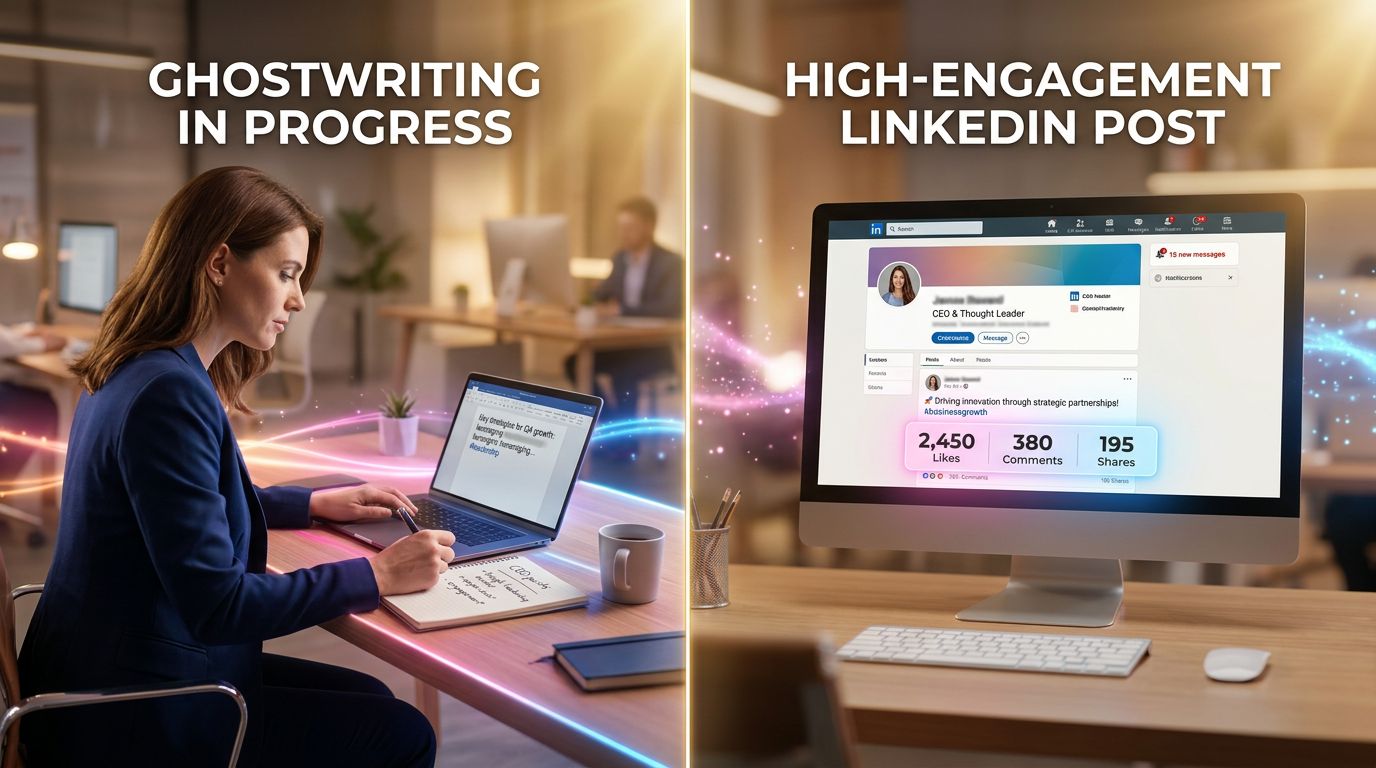
What we concretely observe with clients who delegate their content: consistency sets in, the audience grows, and inbound messages start arriving. Not because the content is “viral”. Because it is consistent and well-positioned — exactly the logic we apply in our digital marketing services, where regularity trumps the one-off stroke of genius.
Why consistency beats talent on LinkedIn
Here is the brutal truth about the LinkedIn algorithm: it rewards consistency over quality.
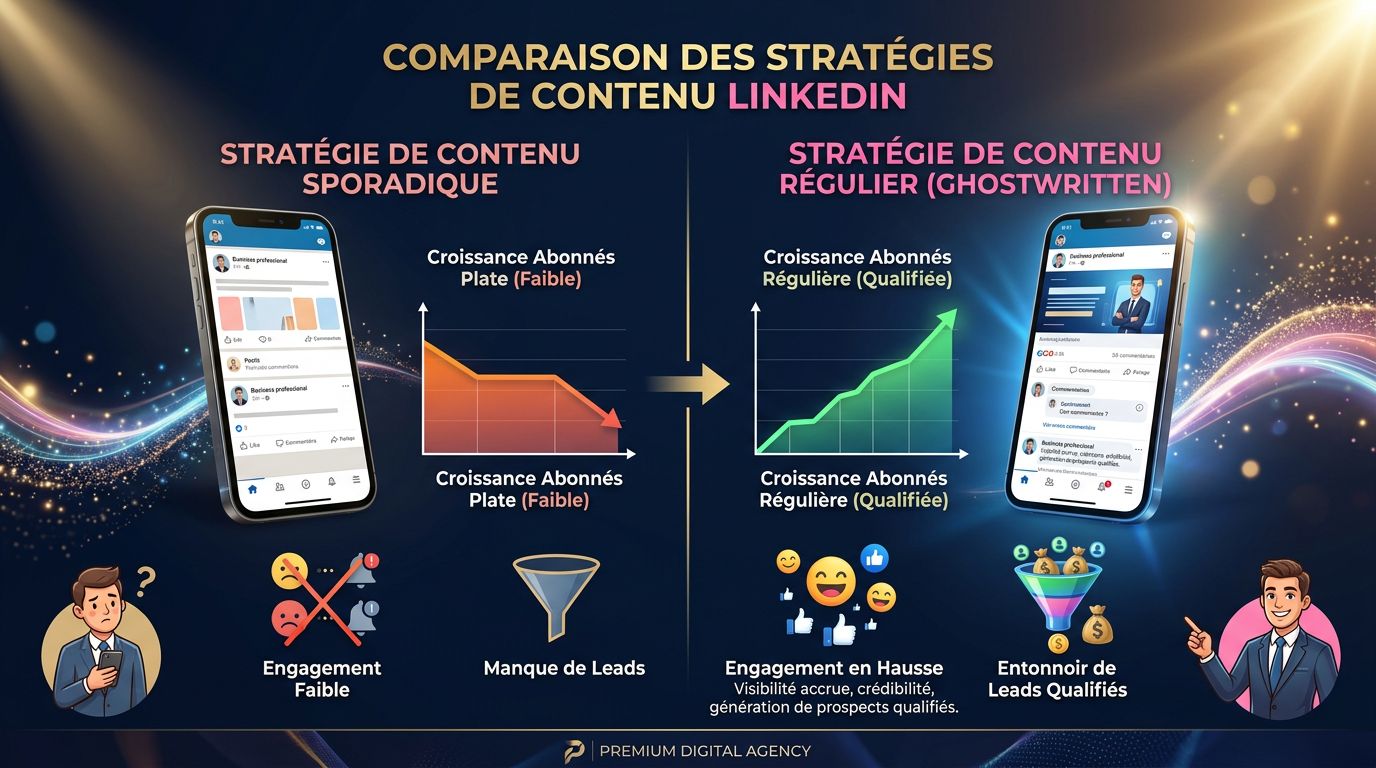
An average post published every week for six months systematically outperforms a brilliant post published once a quarter. This is not an opinion — it is the observable behaviour of the platform over many years.
The problem for the executive who wants to “be present on LinkedIn”? They publish in a flurry for two weeks after an inspiring conference, then disappear for three months. Their audience forgets them. Their profile stagnates. They conclude that “LinkedIn doesn’t work for them”.
What doesn’t work is irregularity.
Ghostwriting solves exactly this problem. You define a cadence — one post per week, two posts — and the ghostwriter maintains it, even when you are travelling, closing a project, or on forced leave. The machine keeps running. Your visibility accumulates.
“Consistency is the most underestimated form of content strategy.” — This is what I observe after 15 years building the digital presence of SMEs in Normandy.
Converting, not just existing: the difference between visibility and results
Having 5,000 LinkedIn followers is pointless if none of them ever become clients.
This is where many content strategies fail. They optimise for likes, not leads. They chase reach, not conversion. And they end up with an “influential” profile that generates no revenue — the same trap we dissect in our article on why your traffic doesn’t translate into revenue.
Conversion-oriented ghostwriting is a different discipline. Here is how it actually works:
Content must qualify, not please everyone. A post that speaks to 200 perfectly targeted people is infinitely more valuable than a post seen by 10,000 indifferent ones. The experienced ghostwriter writes for your ideal client, not for the algorithm.
Calls to action must be invisible. Nobody clicks “contact us for a quote” at the end of a LinkedIn post. However, a question posed at the end of a post — “Have you been in this situation?” — generates comments that start conversations. And conversations convert.
Social proof is built in the comments. A good ghostwriter doesn’t only write posts. They also prepare your replies to comments, your follow-up messages, your re-engagement sequences. This is the invisible work that turns a passive reader into a warm prospect.

What LinkedIn ghostwriting really costs — and what it brings in
Let’s be direct about the numbers, because that is the question everyone has in mind.
A competent freelance LinkedIn ghostwriter charges between 300€ and 800€ per month for 4 to 8 monthly posts. A specialist agency can go up to 1,500€ — 2,500€ depending on the level of strategy included. That is not trivial for a micro-business.
But ask yourself the right question: what does your absence from LinkedIn cost you?
If a single client converted via LinkedIn is worth 3,000€ — 5,000€ to your business, the ROI is obvious from the second month. The problem is that most executives don’t track this channel. They don’t know where their clients come from. So they can’t measure what their silence costs them.
Our advice for a small business with a limited budget: start with a lightweight service — 4 posts per month, positioning audit included — before scaling up. Test over three months. Measure inbound messages, qualified connection requests, and mentions of your profile in sales meetings. These signals are your real KPIs.
How to choose (or become) a good LinkedIn ghostwriter
Whether you are looking to delegate or to offer this service, the criteria are the same.
What makes an effective LinkedIn ghostwriter
A good ghostwriter starts by listening to you, not by showing you their templates. The first working session looks like a journalistic interview: they ask you about your clients, your frustrations, your recent wins, your professional convictions. They are looking for your voice, not a generic style.
They know the structure of posts that perform on LinkedIn — the hook in the first two lines, the short/long rhythm, the closing question. But they don’t sacrifice your authenticity on the altar of the “LinkedIn recipe”. Profiles that sound like clones of formulas don’t convert.
They measure. Engagement rate, growth in qualified followers, inbound messages — a serious ghostwriter tracks these metrics and adjusts. This is not copywriting; it is editorial strategy, executed.
Warning signs
Be wary of anyone who offers you content without ever having spoken to you. Be wary of “LinkedIn packs” with generic posts about “leadership” and “innovation”. And above all, be wary of those who promise thousands of followers in 30 days — LinkedIn penalises artificial behaviour, and your professional reputation is priceless.
The angle nobody takes: LinkedIn as a long-term nurturing tool
Most people think of LinkedIn in “immediate acquisition” mode. Publish a post, get clients within the week. That’s not how it works.
LinkedIn is a nurturing tool. Your prospects read you for months before reaching out. They remember your post about project management when they have a project management problem. They think of you when they need a website because you shared three concrete redesign case studies over six months.
This long cycle is a strength, not a weakness. It means every post published today works for you six months from now. It is investment, not expense.
Ghostwriting fits perfectly into this logic: you build a coherent presence over time, without the mental exhaustion of having to “find ideas” every week. The ghostwriter becomes your editorial memory — tracking your themes, avoiding repetition, planning content sequences.
After several years accompanying Normandy SMEs in their digital presence, the observation is always the same: executives with a consistent LinkedIn presence close their quotes more easily. Not because prospects stop negotiating — but because they arrive at the meeting already convinced of your expertise. Of course, the website that receives these prospects must also be up to the task: we explain the common pitfalls in why your website doesn’t convert and five concrete solutions.
Three things to remember before you start
Consistency trumps perfection. An imperfect post published every week builds more visibility than a brilliant post published once a month. Delegating consistency means delegating growth.
ROI is measured in pipeline, not likes. Set up a simple tracking system: how many qualified inbound messages per month? How many prospects mention LinkedIn in meetings? These numbers are worth more than your follower count.
The ghostwriter must disappear into your voice. If your readers sense it isn’t you, you have the wrong provider. The test: read the post aloud. Would you have said it that way in a client meeting? If yes, it works.
Do you want a LinkedIn presence that works for you?
At GDM-Pixel, we have automated web content production — blog articles, social media posts, SEO content — for our clients and for ourselves. We know what the absence of regular content costs, and we know how to measure what a well-executed strategy brings in.
If you are an SME (in Normandy or elsewhere) that wants to build a serious LinkedIn presence without spending three hours a week on it, let’s talk concretely. No 45-minute pitch — a direct conversation about your situation, your objectives, and what is realistic for your budget.
Your next business opportunity may already be reading you on LinkedIn. The question is: are you there to be found?
 Social networks
 Analyze with AI