+33-9-7266-3068
 contact@gdm-pixel.fr







 TL;DR - Key Takeaways at a Glance
Google has spoken — and it changes everything for your strategy
One of our clients called us last week, in a panic. He had read an article advising him to restructure his entire website for “Google’s AI”, add llms.txt files, and “chunk” his content into digestible blocks for robots. Estimated cost of the operation: €4,000 and three months of work.
We told him to wait.
It was the right call. Google has just published an official guide on its AI-based search features — and the clarity of this document is almost brutal. No jargon, no vague promises about “the future of SEO”. Direct answers on what matters, what serves no purpose, and what you should concretely do.
Here is our field analysis, without the usual bullshit.
What Google confirms: the fundamentals are not dead
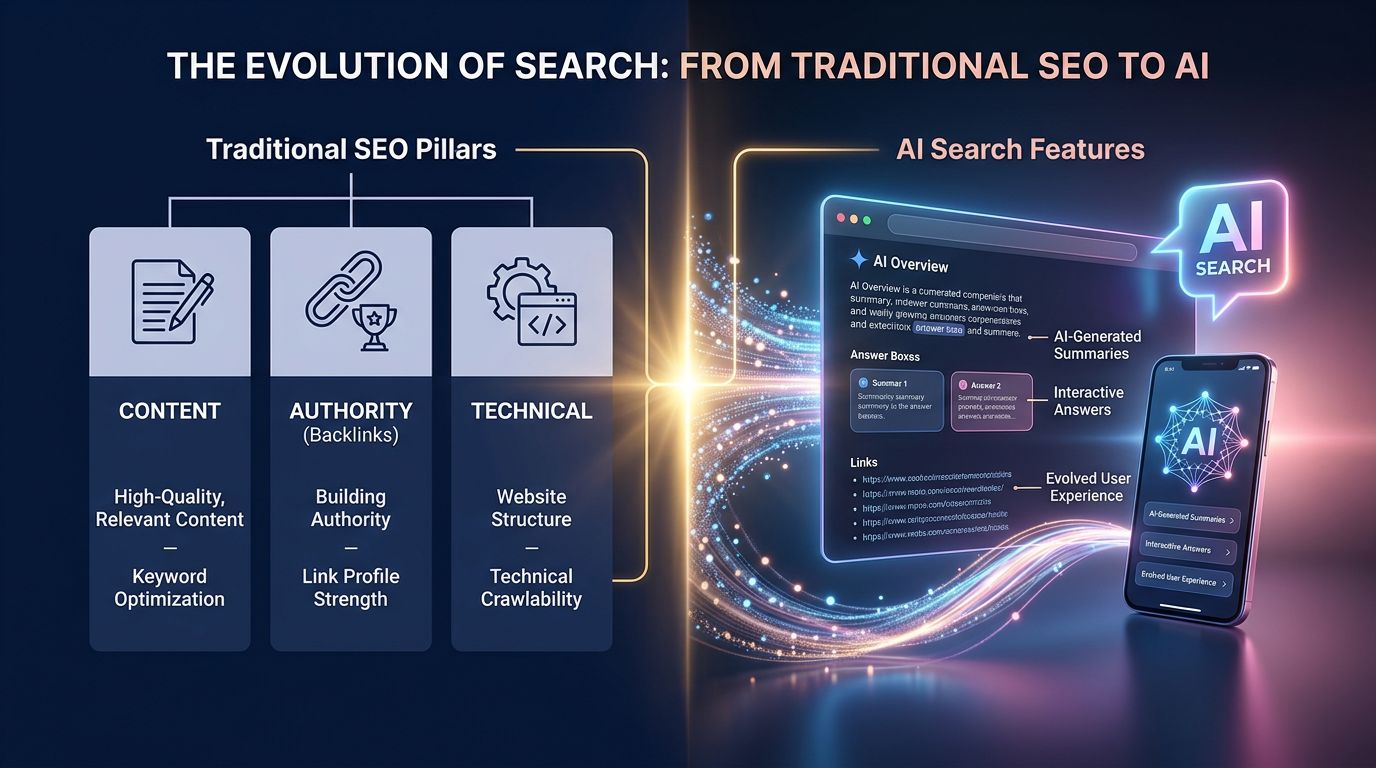
The first thing to remember, and it is the most important: Google explicitly confirms that fundamental SEO principles remain valid for AI.
AEO (Answer Engine Optimization) and GEO (Generative Engine Optimization) are not hollow buzzwords. They describe a concrete reality: optimising your content so that it is understood, extracted, and cited by Google’s AI systems — particularly AI Overviews, the generative summary that now appears at the top of certain searches.
But here is what the guide clearly states: to achieve this, you do not need a new esoteric technical stack. You need to do good SEO.
What we see concretely with our clients: those who have solid foundations — structured content, topical authority, clean technical data — are already well-positioned for AI. This is exactly the foundation on which our SEO services work rests: building lasting authority rather than chasing hacks. Those who built on sand (dubious backlinks, thin content, sloppy technical work) are suffering, and no llms.txt file will save them.
“Google’s AI does not reinvent the rules of the game. It makes them more unforgiving.”
What Google invalidates: stop wasting your time (and money)
This is where the guide becomes truly valuable. Google explicitly states that certain practices presented as “essential for AI” are useless. Three in particular.
The llms.txt file: a false good idea
Popularised in early 2025, the llms.txt file was supposed to tell AI systems how to crawl and interpret your site — similar to robots.txt for classic search engines. Some agencies were selling it as an absolute priority.
Google says it plainly: this file has zero impact on its system. Zero. It does not use it to index, rank, or feed its AI responses. If you paid for this, you paid for nothing.
Content “chunking”: a ghost optimisation
The idea: break your content into small thematic blocks “so that AI understands them better”. In theory, it seems logical. In practice, Google confirms that its systems are perfectly capable of understanding well-structured content without you needing to pre-digest it artificially.
What matters is natural editorial clarity — not mechanical fragmentation that distorts your text.
AI-specific data schemas: not necessary
Consultants were proposing to add “AI-ready” schema.org markers, proprietary metadata to “signal” your content to generative robots. Google confirms that its systems do not need these additional signals to function.
Standard Schema.org, well implemented, remains relevant. But there is no need to invent new ones.
Net result: save that money. Invest it in what actually works.
The real technical roadmap according to Google
Now that we have eliminated the noise, here is what the guide concretely recommends. These are measurable actions, not abstract concepts.
Topical authority: go deep, not broad
Google’s AI Overviews preferentially cite sources that are authoritative on a given subject. Not generalists who skim everything. Specialists who cover a domain in depth.
For a small business, this translates as follows: if you are a plumber in a mid-size city, it is better to have 20 ultra-detailed articles on plumbing (regulations, techniques, local practical cases) than a catch-all blog that talks about everything and nothing.
Our experience confirms this: the sites we have supported with a coherent thematic content strategy see their presence in AI Overviews increase naturally — with no technical manipulation whatsoever. We explore this logic further in our guide SEO 2026: mastering Google’s technical rules while ChatGPT reinvents search.
Factual, sourced, verifiable content
Google’s AI favours content it can verify. Dated figures, cited sources, concrete and localised information. Vague, generic content with no factual grounding slips under the radar.
This is not new — it is what Google Panda was already requiring back in 2011. AI simply applies it with much greater precision.
Technical performance: always non-negotiable
Core Web Vitals, loading speed, mobile compatibility. The guide does not revolutionise this point — it confirms it. A slow, poorly structured website will always be penalised, with or without AI.

Semantic HTML structure: the foundation that pays off
H1, H2, H3 tags used correctly. Clear paragraphs. Explicit questions and answers within the content. No chaotic layout where information drowns in design.
Google’s AI systems extract information from your HTML. If your structure is clean, the extraction is clean. If it is a mess, you miss out.
What this concretely changes for an SME in 2026
How much qualified content can your current workflow produce per month? And is that content truly grounded in your professional expertise, or is it generic filler?
That is the real question this Google guide poses, between the lines.
For the businesses we work with, we draw three operational conclusions.
First conclusion: audit your foundations before innovating.
Before thinking “AI-ready”, check that your site is already “SEO-ready” in the classic sense. Clean technical setup, quality content, topical authority built up. If these three pillars are solid, you are already well-positioned for Google’s AI.
Second conclusion: invest in editorial depth, not quantity.
A 2,000-word article that genuinely answers a specific professional question is worth ten 500-word articles generated on a production line. Google knows it. Its AI knows it even better.
Third conclusion: be wary of “AI optimisations” that have no official validation.
If a provider sells you an SEO technique “for AI” that you cannot find in Google’s official documentation, ask questions. This guide is public and freely accessible. It is your best filter against bullshit.
“The best signal for Google’s AI remains the same as in 2015: genuinely useful content, on a technically sound site, with real topical authority.”
Our field reading: what is really going to change
After 15 years of building websites and following Google’s evolutions, here is what we actually observe on current projects.
The introduction of AI Overviews changes the form of visibility, not the logic that leads to it. Before, you wanted to be in position 1 on Google. Now, you also want to be cited in the AI summary. But both objectives are fed by the same actions: expert content, clean technical setup, authority built over time.
What will change, however, is the pressure on editorial quality. Average content, which was content to be “good enough to rank”, will suffer. Google’s AI is far more selective about what it cites than the classic algorithm is about what it places on page 1. On the technical side, other changes are being prepared in parallel: we analyse one of them in our article on Web Bot Auth and cryptographic authentication of bots.
Across France and beyond, the SMEs that will come out on top are those that have invested in content that truly reflects their expertise — not those that have chased the latest technical trends without solid foundations.

Three concrete actions to launch this week
No more theory. Here is what you can do right now, with measurable results.
1. Audit your thematic coverage. List the 10 questions your clients ask most often. Check whether your site answers them fully and expertly. If not, that is your editorial roadmap for the next 6 months.
2. Validate your basic technical setup. Run a PageSpeed Insights test on your site (pagespeed.web.dev). If you are below 70 on mobile, that is your number one priority before any “AI” optimisation.
3. Check your existing Schema.org markup. Use Google’s Rich Results Test to validate your current structured data. Fix existing errors before adding new ones.
Conclusion: the guide you needed without knowing it
This official Google guide is good news for agencies and businesses that have done serious work. It invalidates the charlatans who were selling fanciful AI optimisations, and it confirms that the fundamentals — expert content, clean technical setup, topical authority — remain the foundation of everything.
This is exactly what we have been applying on our projects for years. Not because we had anticipated AI, but because it is what works, full stop.
If you want to know where your site stands against these criteria — and what should be done as a priority — we carry out honest technical audits. Not to sell you a rebuild if it is not necessary. To tell you exactly what is blocking and what can be improved quickly.
Request an audit of your site → — we reply within 48 hours with a clear diagnosis.
 Social networks
 Analyze with AI