+33-9-7266-3068
 contact@gdm-pixel.fr







 TL;DR - Key Takeaways at a Glance
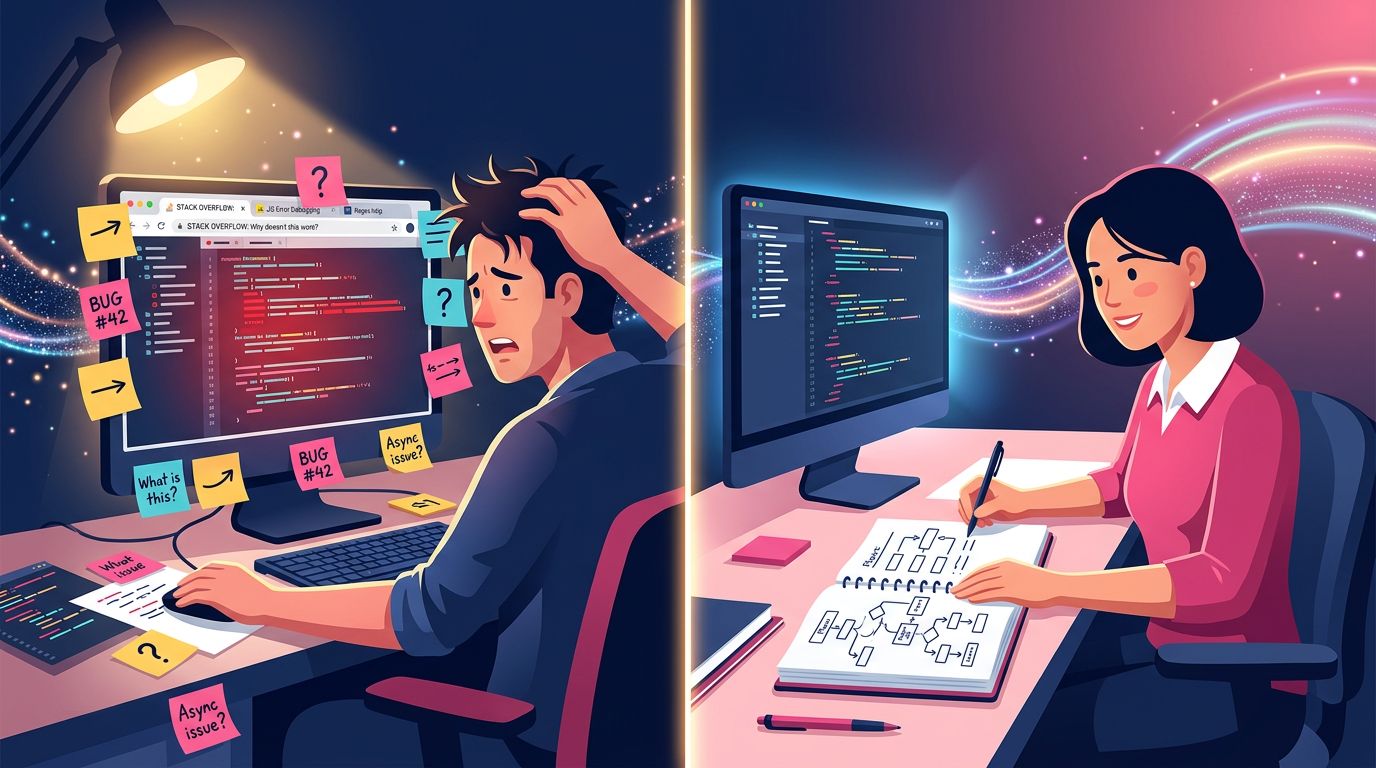
The assembly-line developer syndrome
A client calls us. Their site is broken. The developer who built it copy-pasted a component from Stack Overflow — it worked on delivery day, and six months later, you can’t touch anything without blowing everything up.
Sound familiar?
This isn’t a competence problem. It’s an ownership problem. The developer shipped code they didn’t truly own. They assembled it. They didn’t build it.
After 15 years auditing web projects in Normandy and beyond, I see this pattern everywhere. Entire stacks built on foundations nobody really understands. Tutorials followed to the letter, copy-pasted, deployed to production — without ever asking the question that matters: why does this actually work?
That’s where what I call the Ownership Framework comes in. Not a tool. Not a methodology with slides and a certificate. A mindset that transforms how you absorb a tutorial, a function, an architecture.
What “owning your code” actually means
Owning your code doesn’t mean writing it from scratch. It means being able to answer these three questions without looking anything up:
Why does it work? Not “how does it work” — why. What underlying logic makes this approach valid in this specific context?
Where does it break? All code has limits. Knowing them means anticipating them before they become production bugs at 11 PM on a Friday.
How do I adapt it? If the context changes — different browser, different data, new business constraint — do I know how to evolve the solution without starting over from scratch?
If you answer “I don’t know” to any of these three questions about code you’ve shipped, you assembled it. You didn’t build it.
The difference might seem philosophical. In reality it’s economic. Code you own, you maintain, evolve, and document. Assembled code, you endure. This is exactly the link between code quality and business performance that explains why some sites sell and others don’t.
The Ownership Framework in practice: four steps
I formalized this framework after observing how the best developers I’ve hired or worked alongside approached new concepts. Not the fastest — the most solid.
1. Read the tutorial without touching the keyboard
Counter-intuitive. But fundamental.
The first read is about understanding the narrative logic of the tutorial. Where are we going? What problem are we solving? What constraint motivates this technical choice over another? Until you’ve figured that out, you’re not ready to code.
2. Restate the problem in your own words
Before writing a single line, explain the problem to solve — out loud, in a text file, whatever. If you can’t explain it simply, you haven’t understood it.
This is the Feynman Technique applied to web development. And it’s brutally honest.
3. Implement with intention
Now you code. But every line you write must be deliberate. No mechanical copy-paste. If you’re copying a block, it’s because you understand what it does and have decided it’s the right approach for your context.
4. Deliberately break the solution
The step nobody does. Which is exactly why it’s the most valuable.
Change a parameter. Delete a line. Alter a value. Watch what happens. The errors you provoke deliberately in a test environment are the same ones you won’t suffer in production.
A concrete example: the CSS contrast() function
Theory is good. Demonstration is better.
Take the CSS contrast() function. It’s an image filter that most developers copy from examples without truly understanding what it does mathematically — and therefore without knowing why their visual result sometimes goes in an unexpected direction.
The basic syntax:
img {
  filter: contrast(150%);
}
Most developers stop there. It works, they move on. Let’s apply the Ownership Framework.
Why does it work? The contrast() function adjusts the gap between the brightness values of pixels. A value of 100% = original image. Below 100%, we reduce the gap (the image approaches a uniform grey). Above, we amplify the differences — light areas get lighter, dark areas get darker. It’s not just a visual “contrast boost” — it’s a mathematical transformation applied to every single pixel.
Where does it break? Beyond 200–300%, pixels at the extremes (very light or very dark) saturate. You lose visual information irreversibly at the rendering level. On e-commerce product images where details matter, this is problematic. On a stylised graphic effect, it might be exactly what you’re after.
How do I adapt it? By combining contrast() with brightness() or saturate(), you get precise, controlled visual effects. But more importantly, you know why you’re combining them — not because the tutorial said so, but because you understand the effect of each parameter.
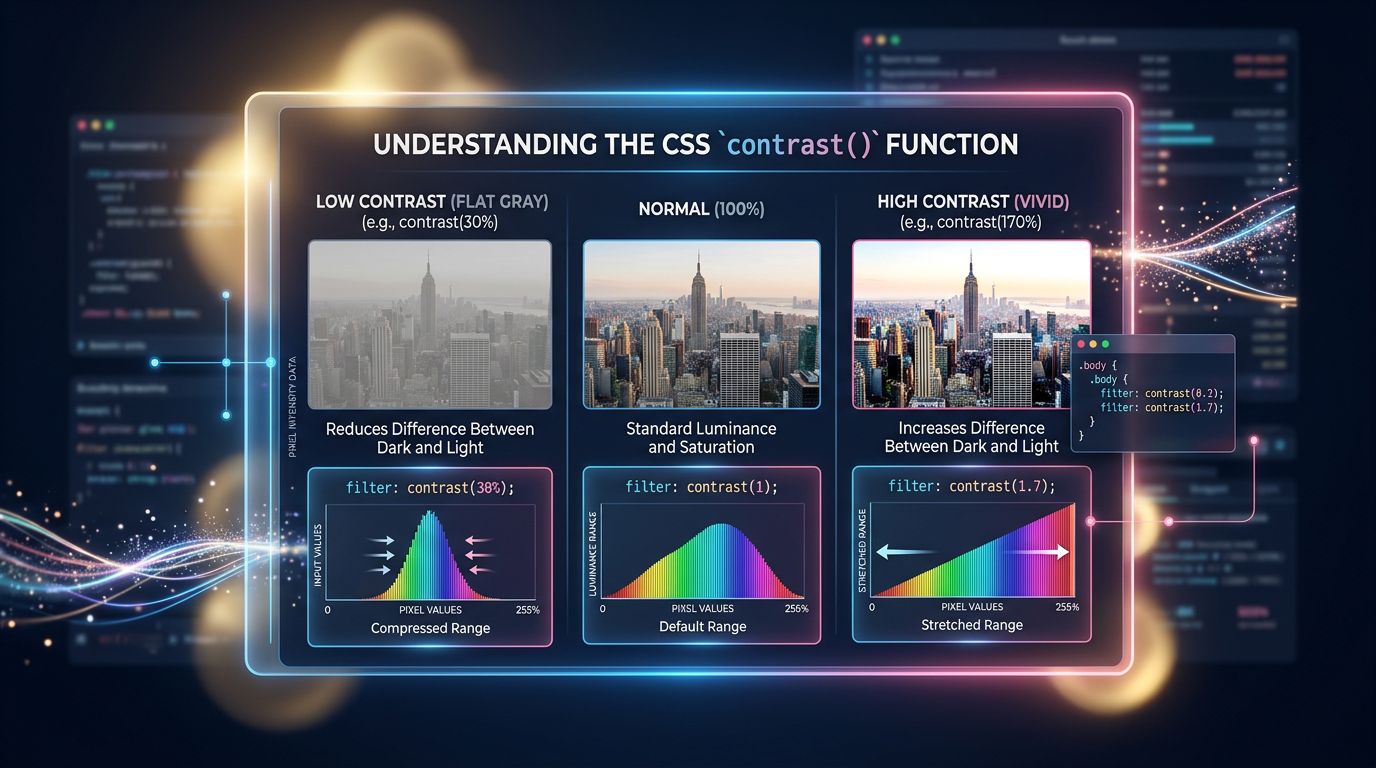
Now, if someone asks you to implement a hover effect on a photo gallery with a dramatic look, you don’t go searching for a tutorial. You know that contrast(180%) brightness(90%) will amplify shadows while avoiding overexposure. You have mastery.
That’s what owning your code looks like.
Why tutorials are a double-edged sword
Tutorials are excellent. I’m not saying otherwise — I still consume them regularly to explore stacks I don’t know.
But they have a structural flaw: they’re written to work, not to be understood. It’s the same issue with visual builders — and if you’re wondering whether using a WordPress builder is really a good idea, the answer depends entirely on whether you understand what it generates.
The author of a good tutorial wants you to reach the result. That’s their KPI. They simplify, abbreviate, choose the most direct path. Which is perfect for getting started. Which is dangerous if you stop there.
“A tutorial teaches you to reproduce. The Ownership Framework teaches you to understand. These are not the same thing.”
The difference shows up six months later, when the context has changed and the code needs to evolve. The person who reproduced goes looking for a new tutorial. The person who understood adapts.
At our agency, we’ve industrialised production using Claude Code and automated workflows. But that industrialisation was only possible because the team understands what it’s automating. Automating code that nobody understands is a ticking time bomb.
What this changes in your daily work as a developer
Concretely, the Ownership Framework changes three things about how you work.
Your relationship with estimates. When you understand what you’re building, you estimate better. Not perfectly — nobody estimates perfectly. But you anticipate friction points, hidden dependencies, edge cases that will cost you time.
Your ability to debug. Most debugging time isn’t spent fixing — it’s spent understanding. If you’ve done that work upfront, you can easily halve your debugging time. On our projects, this is a measurable reality.
Your perceived value to clients. A developer who explains what they’re doing and why inspires confidence. A developer who says “I found this on Stack Overflow, it should work” — less so. Technical mastery shows in how you talk about your work, not just in the code you ship.
Three actionable principles to start right now
No need to change everything at once. Here’s what you can apply on your next project.
Principle 1: The “I can explain it in 2 minutes” rule. Before committing code, ask yourself: can I explain this block in two minutes to a colleague who hasn’t followed the context? If not, you haven’t finished understanding it yet.
Principle 2: The “why” file. For every project, keep a technical notes file — not formal documentation, just your raw notes. Why you chose this approach over another. What you tried that didn’t work. Six months from now, it’s gold.
Principle 3: Break before you deploy. In your dev environment, before any production release: intentionally try to make your code fail. Unexpected data, boundary parameters, unanticipated use cases. What you find there, you won’t suffer in production.
Technical mastery as a competitive advantage
The web development market is saturated with people who can copy-paste. No-code platforms and AI tools will continue to erode the value of mechanical assembly.
What remains irreplaceable — and what commands premium — is deep understanding. Knowing why an architecture holds. Anticipating where a solution will show its limits. Adapting intelligently rather than starting from scratch. If your project starts on solid foundations, it’s also because our custom website creation approach places technical architecture at the heart of every delivery.
The Ownership Framework isn’t another method to add to your CV. It’s a way to position yourself in a market that will keep evolving fast.
At GDM-Pixel, we’ve industrialised our production. We deliver 5x faster than before. But that speed rests on a solid understanding of every component in our stack — not on large-scale copy-paste.
Speed without understanding is just accelerated technical debt.
Want to audit your stack or discuss the architecture of your next project? Contact us — we’ll look together at what you truly own, and what deserves to be rebuilt on solid foundations.
 Social networks
 Analyze with AI