+33-9-7266-3068
 contact@gdm-pixel.fr








 TL;DR - Key Takeaways at a Glance
The Lawsuit Sending Shockwaves Through Silicon Valley
One of our retail clients asked us last week: “Can my website be sued for being too well-made?” The question seems amusing. But since Texas filed a formal complaint against Netflix over its allegedly addictive mechanisms, the answer is far less straightforward than it appears.
The Texas Attorney General accuses Netflix of having deliberately designed its interface to maximize time spent on the platform — at the expense of user well-being, particularly that of minors. Autoplay, aggressive algorithmic recommendations, removal of friction points that would prompt users to disengage. Practices the industry euphemistically calls “engagement optimization.” And that regulators are starting to call something else entirely.
This is not an isolated incident. It is the signal of a major shift.
What the Texas Lawsuit Really Says About Design
Here is where it gets interesting: the lawsuit does not target illegal content. It targets an architecture. Deliberate design choices. The fact that engineers and designers intentionally built systems to capture attention and make disengagement difficult.
This is a major conceptual break.
Until now, digital regulations focused on what platforms broadcast — hate content, misinformation, personal data. Here, we are talking about how they are built. The interface itself becomes a legal object.
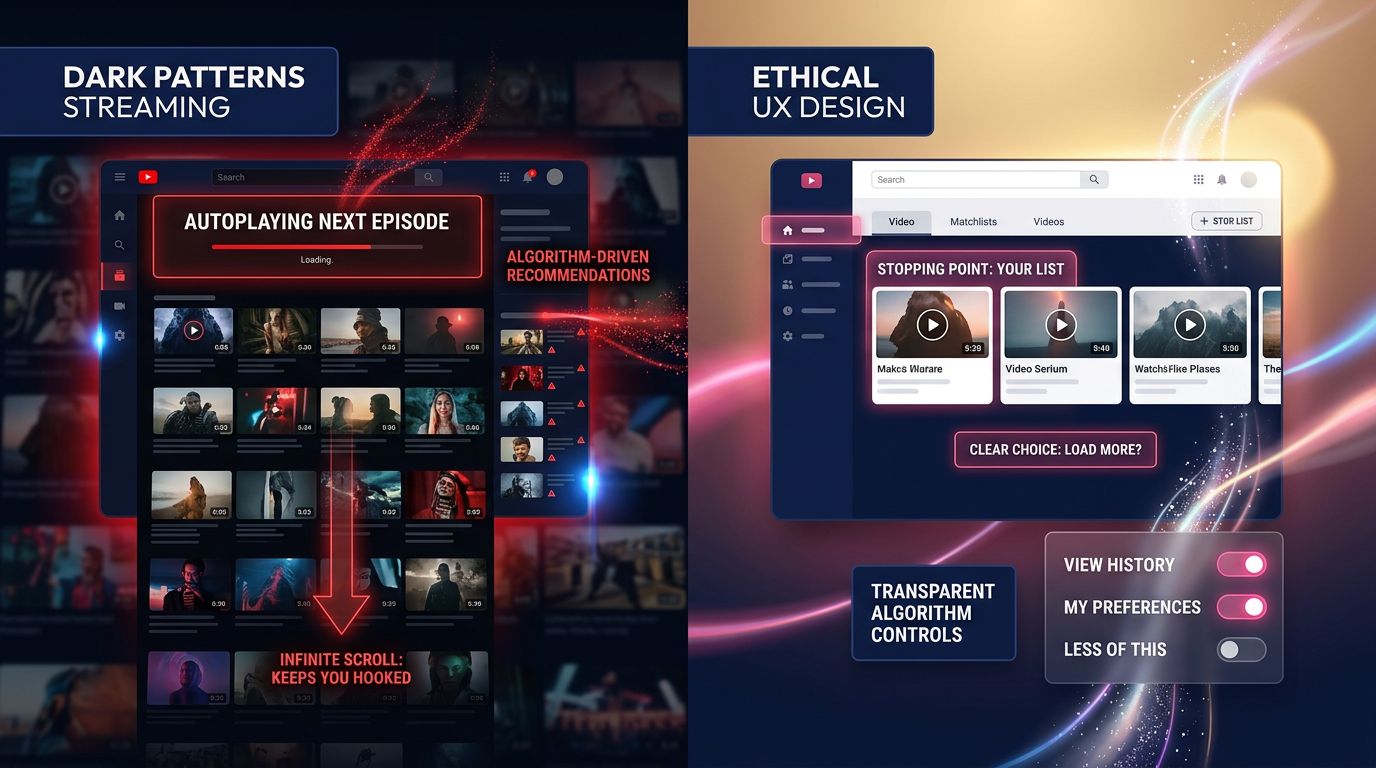
The mechanisms targeted are well documented in UX literature:
- Autoplay, which removes the conscious decision to continue
- Infinite recommendation loops calibrated to the user’s emotional profile
- The deliberate absence of time indicators (“you have been watching for 4 hours”)
- Push notifications optimized for moments of vulnerability
These patterns have a name in the industry: dark patterns. And they are no longer merely an ethical question — they are becoming a question of legal liability. This is precisely the framework we integrate into our AI agency services: designing intelligent systems that serve users without manipulating them.
AI at the Heart of the Problem — and the Solution
What makes this case particularly relevant for 2026 is the central role of artificial intelligence in these mechanisms.
Netflix’s recommendation systems are not manually curated lists. They are machine learning models trained on billions of interactions, optimized for a single objective: maximizing watch time. AI does exactly what it was designed to do. The problem is the objective function itself.
“When you tell an algorithm to maximize engagement, you are not telling it to make people happy. You are telling it to hook them.” — Tristan Harris, co-founder of the Center for Humane Technology
This is precisely where regulation becomes complex. Can a company be held responsible for the outputs of an AI model it trained? The legal answer is beginning to take shape: yes, if design intentions are documented and if effects on users are foreseeable.
The European AI Act, in progressive application since 2024, moves exactly in this direction. AI systems classified as “high risk” — particularly those that influence behavior at scale — will need to demonstrate ethical compliance. What Texas is doing through litigation, Europe is doing through regulation. Both paths lead to the same place.
What This Concretely Changes for Agencies and Developers
Let us move past theory. What does this mean for someone building websites in 2026?
First reality: practices previously considered “good UX practices” will be re-examined. Aggressive exit pop-ups, artificial countdown timers on offers, poorly calibrated push notifications, dark patterns for unsubscribing — all of these are in the crosshairs. Not necessarily illegal today. But the regulatory trajectory is clear.
Second reality: France’s CNIL is already active in this space. Fines for dark patterns related to cookies have begun. This is only the beginning of an escalation that will extend to other design practices — we detailed a concrete case in our article on how Google will penalize back-button hijacking.
Third reality, and this is the one I find most important: ethical design is going to become a competitive differentiator, not just a moral argument.
In our day-to-day as an agency, we already see clients — particularly in healthcare, education, and services for vulnerable populations — explicitly requesting interfaces without addictive mechanics. Not out of activism. Out of anticipation of legal and reputational risk.

Information Architecture: The Next Regulatory Frontier
Information architecture is the discipline that organizes how content is structured, hierarchized, and presented to the user. It determines whether you can easily find the “unsubscribe” button or whether you have to spend 3 minutes hunting through settings.
This field is going to be profoundly impacted by the current regulatory wave.
The European Digital Services Act (DSA) already requires very large platforms to justify their recommendation systems and offer non-algorithmic alternatives. For medium-sized platforms, obligations are arriving progressively. And for agencies building these platforms, the question of design liability will become increasingly clear.
In concrete terms, here is what will change in development practices:
Algorithmic Transparency Becomes a Requirement
Recommendation systems will need to explain their choices. “You might like this” will need to say why. This is not merely an interface question — it is a technical architecture constraint that must be anticipated from the design stage.
Disengagement Mechanisms Must Be as Prominent as Engagement Mechanisms
If you have autoplay, you will need an equally visible stop. If you have push notifications, unsubscribing must be one click away. Symmetry of access becomes a design standard.
Minor Protection Is Embedded in Code
The Texas lawsuit specifically targets the impact on users under 18. Systems that do not differentiate behavior based on user age will be exposed. What COPPA has done in the United States since 1998 for data, new regulations will do for engagement mechanics.
What We Do at GDM-Pixel — and What We Recommend
On projects we have led over recent months, we have begun systematically integrating a “dark patterns” audit into our deliverables. Not for ethical marketing purposes. To protect our clients from a real risk.
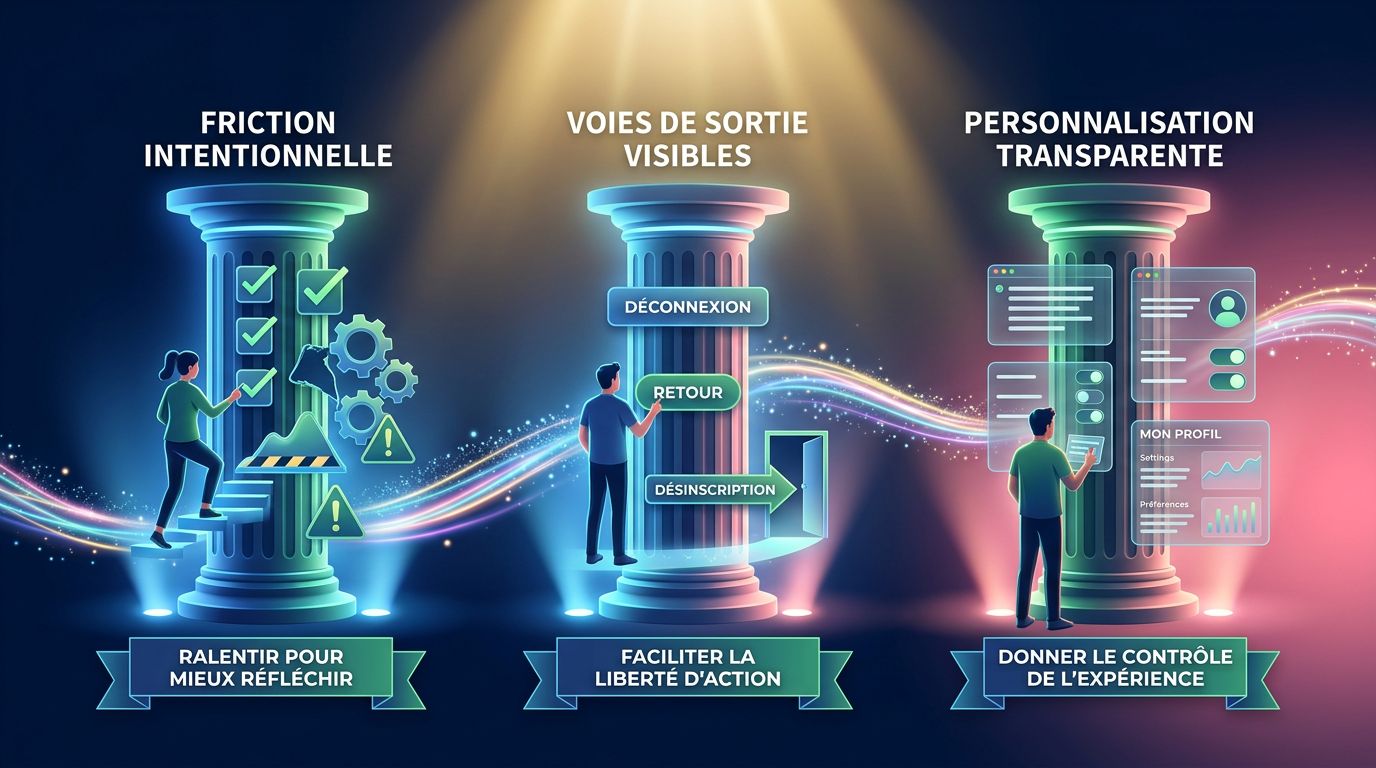
Here are the three principles we now apply by default:
Intentional friction on irreversible actions. A purchase, an account deletion, a subscription — these actions deserve an explicit confirmation step. Not to complicate the user’s life. To ensure they are certain of what they are doing.
Visibility of exits. Unsubscribing, data deletion, cancellation — these journeys must be as accessible as the sign-up journeys. We document them in specs, test them, and deliver them.
No engagement optimization without informed consent. If we implement push notifications or recommendation systems, the user’s choice must be real — not pre-checked, not buried in advanced settings.
This is not revolutionary. It is sound design practice. But in an industry that has spent 20 years optimizing engagement without asking these questions, it represents a genuine shift in posture.
“Ethical design is not the enemy of conversion. It is the guarantee of long-term trust.” — a conviction we have defended for several years at GDM-Pixel, and that regulators are now transforming into an obligation.
The Three Things to Remember — and to Do Now
The Texas lawsuit against Netflix is not merely an American news story. It is a weak signal that will become a strong one. Here is what to do with it in concrete terms:
Audit your existing interfaces with a regulatory eye. Not your designer’s or marketer’s eye — the eye of a regulator looking for where the user loses control. If you do not know how to do this, ask someone who did not design the site to find out how to unsubscribe from your newsletter. Time it. You will have your answer.
Document your design choices. In the near future, being able to show that your UX choices were deliberate and justified — and not optimized to capture attention at any cost — will be real legal protection. Design specs become compliance documents.
Anticipate rather than react. The companies that will suffer from the regulatory wave are those that wait for the law to force them to change. Those that will benefit are the ones building today’s products that users — and regulators — can trust.
What Comes Next
The technology industry has built the last 30 years on a simple principle: capturing attention is a virtue. The more time users spend on your platform, the better. Engagement metrics have become success metrics.
This paradigm is cracking. Not because tech companies have had an ethical revelation. Because regulators, courts, and a growing proportion of users have decided that human attention is not a natural resource to be exploited without limits.
For web agencies, developers, and entrepreneurs building digital products, this is an opportunity as much as a constraint. Those who master ethical design and responsible information architecture will be in a position of strength — this is the whole stakes we develop in our reflection on design in the AI era between transparency and accessibility. Those who continue to optimize engagement without asking these questions will find themselves exposed.
After 15 years building websites for SMEs in Normandy, I have seen many trends come and go. This one is not a trend. It is a fundamental shift.
Do you want to know if your website or application is exposed to these risks? We conduct UX and compliance audits in 48 hours. No 80-page report — an actionable diagnosis with the points to correct as a priority. Contact GDM-Pixel — we tell you what we see, not what you want to hear.
 Social networks
 Analyze with AI