+33-9-7266-3068
 contact@gdm-pixel.fr








 TL;DR - Key Takeaways at a Glance
The checkout assistant who isn’t coming back
Estée Lauder is cutting thousands of in-store positions. Not because of a crisis. Not due to a bad season. It is a strategic decision, fully assumed and documented: human contact in-store no longer justifies its cost against new purchasing channels.
Meanwhile, Mirakl — one of the most widely used marketplace platforms in Europe — has just launched what they call “Agentic Activation”: a technology that prepares product catalogues to be read, interpreted and purchased directly by AI agents, without human intervention.
Two signals. One underlying shift.
Online commerce is changing in nature. And if you manage a store, you have every interest in understanding what is happening — before it catches up with you.
What Mirakl is really doing with its “AI agents”
To understand what is at stake, we first need to demystify the term “AI agent”. This is not science fiction.
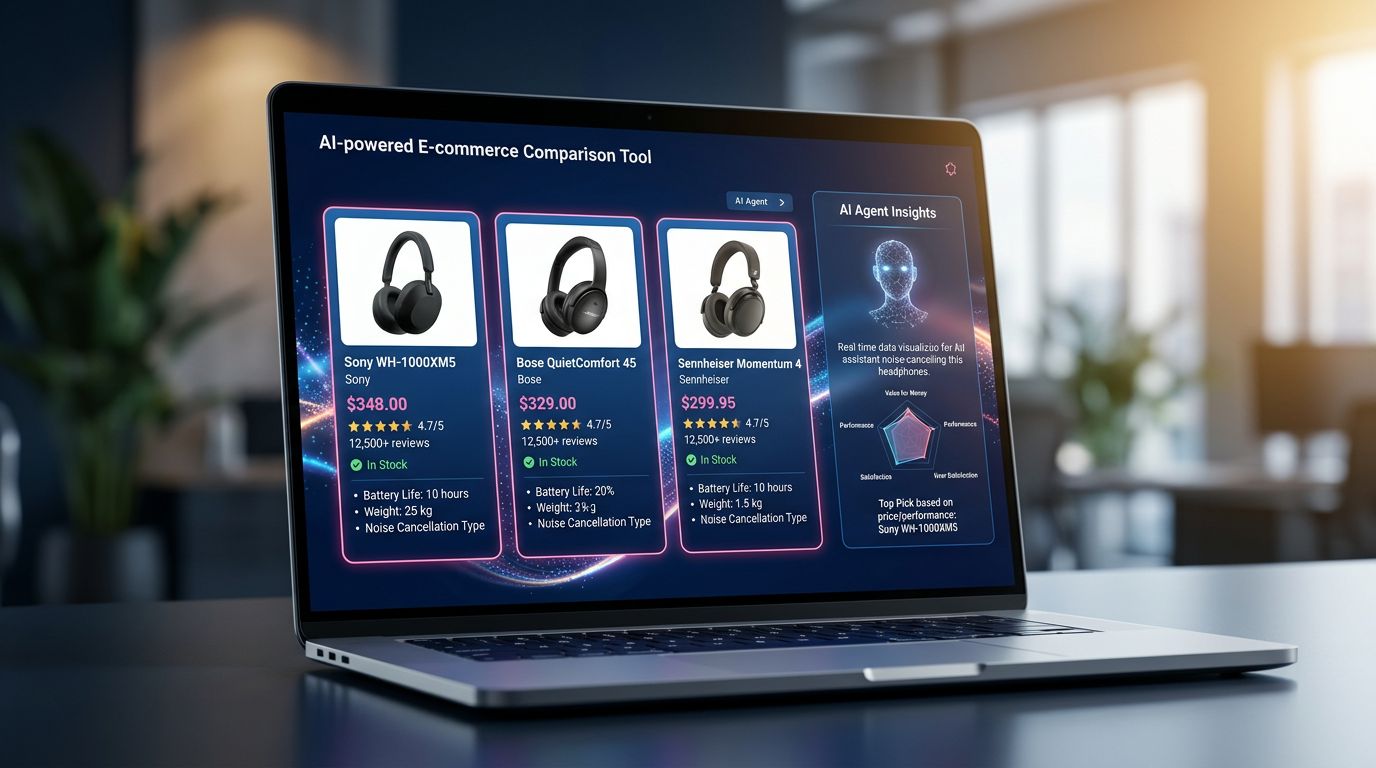
An AI agent, in the e-commerce context, is a programme capable of navigating a site, comparing products, reading technical specifications, evaluating availability and price — then placing an order. On its own. Without a human validating each step.
Concretely: tomorrow, a company will be able to programme its purchasing system to automatically restock inventory by querying marketplaces. The agent compares, selects, orders. The purchasing manager simply receives a summary.
What Mirakl is preparing with its “Agentic Activation” is exactly that: structuring product data so that it is readable by these agents. Not by Google. Not by humans. By AIs that buy. This is why best practices for creating product listings are now a strategic issue, and not merely a stylistic exercise.
Here is where it gets interesting: if your product listing is not structured to be understood by an AI agent, you do not exist in this new purchasing channel. No poor ranking. No second page. Zero visibility, full stop.
Estée Lauder and the end of the sales advisor
Let us return to Estée Lauder. The brand is massively reducing its customer-facing in-store teams. These positions — beauty consultants, demonstrators, specialist sales staff — had for decades formed the backbone of their sales strategy.
The model rested on simple logic: a good salesperson knows the product, understands the customer’s need, and converts. It was human advice in service of conversion.
That model is being dismantled.
Why? Not solely because AI is “cheaper”. It is more structural than that. Purchasing behaviours have changed. A growing proportion of purchasing decisions are made before even entering a physical store — or an online store. The customer arrives already informed, often decided. The role of the human salesperson has evolved towards something algorithms are beginning to do very well: recommending, comparing, reassuring.
“The role of the salesperson is not to disappear. It is to move up in value — or be replaced by something that does the job cheaper and 24/7.” — Field analysis, GDM-Pixel agency
What we see concretely with our e-commerce clients in Normandy: conversion rates rise when product listings are well built, reviews well highlighted, and the customer journey well designed. Not necessarily when a human chat is available.
What this means for an SME selling online
Let us be direct. If you manage an online store with 200 or 2,000 product references, here is what this movement concretely means for you.
First impact: the quality of product data becomes critical.
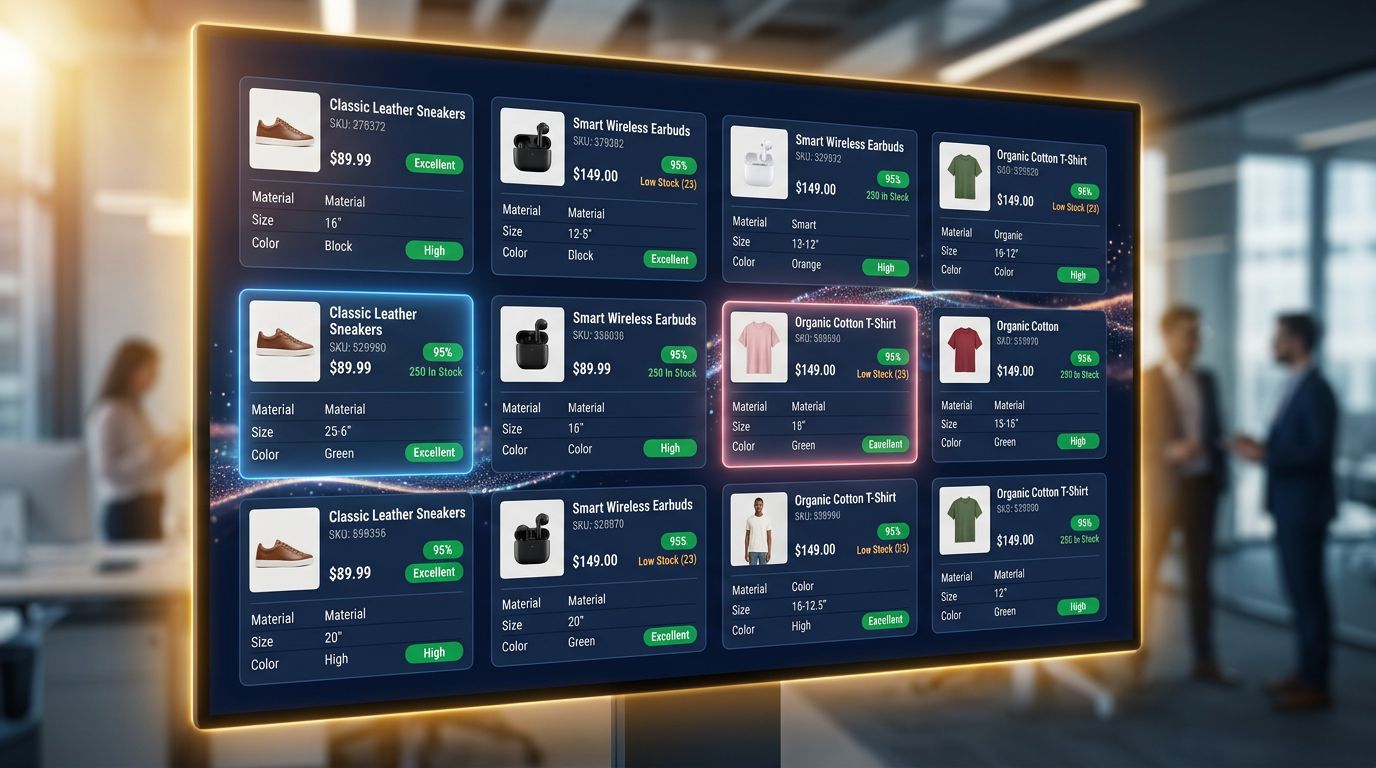
Not “important”. Critical. An AI agent browsing a marketplace to buy office supplies will select products whose data is clean, structured and complete. Exact name, standardised description, filled technical attributes, quality images, real-time stock.
If your catalogue looks like what we still see too often — descriptions copied from the supplier, missing attributes, blurry images — you will be invisible to these new automated buyers.
Second impact: classic SEO is no longer enough.
Until now, optimising for Google was sufficient to capture traffic. Tomorrow, you will also need to optimise for agents that do not read like Google. They look for structured data, clean JSON-LD, consistent APIs. Our SEO guide for e-commerce covers precisely these technical foundations — structured data, catalogue architecture, the signals that Google and agents read first. It is a new channel to factor into your visibility strategy.
Third impact: the human customer relationship repositions itself.
This is not “human versus machine”. It is “human where they create irreplaceable value”. Complex after-sales service, dispute management, advice on high-stakes purchases — this is where humans remain indispensable. Repetitive tasks, frequently asked questions, order tracking: automation is gaining ground, and that is a good thing if it frees up time for what matters.

Is your catalogue ready for AI agents?
This is the real question to ask today.
Not “is my site beautiful?” Not “is my SEO good?”. But: is my product data clean and structured enough to be used by an AI that buys?
To answer that honestly, here is what to check:
- Are product attributes complete and consistent? Dimensions, materials, compatibilities, variants — everything must be filled in a standardised way.
- Is your Schema.org markup in place? Structured data (Product, Offer, Review) allows AI agents to read your information unambiguously.
- Is your stock synchronised in real time? An agent ordering an out-of-stock product means a cancelled order and a damaged commercial relationship.
- Are your prices and conditions accessible via API? More and more B2B purchasing systems query APIs directly rather than browsing web pages.
On the e-commerce projects we have carried out in recent months, we clearly see two categories of stores: those whose catalogue is a clean and usable database, and those whose catalogue is a jumble inherited from ten years of manual imports. The first are ready for the next wave. The second will need to clean house.
Automation is not the enemy — it is the playing field
There is an understandable human reflex in the face of these developments: seeing automation as a threat. Estée Lauder cutting positions, AI agents placing orders without human contact — it can seem frightening.
But let us flip the situation.
For an SME selling online, well-deployed automation is a direct competitive advantage against large retailers. Why? Because large groups have heavy legacy systems, complex organisations, and silos between teams. You can move fast.
A clean catalogue, a well-documented API, product listings structured with real-time data — that is achievable. Not in three years. In a few weeks if you get seriously to work.
What nobody in agencies ever tells you: most catalogue migrations we carry out reveal that 30 to 40% of references have incomplete or inconsistent data. This is not a technical problem. It is an internal organisational problem that has accumulated silently.
“A clean e-commerce catalogue is an asset. A neglected catalogue is a debt that grows every month.” — GDM-Pixel field experience, PrestaShop and WooCommerce projects
The good news: this cleaning and structuring work can largely be automated today with the right tools. What used to take weeks of manual work now takes a few days with the right workflows.
Three concrete actions to take this year
No theory. Here is what I would do if I were in your position, with an online store and a limited budget.
Action 1: Audit the quality of your product data. Export your catalogue as a CSV. Open it. Count the empty fields. Spot the copy-pasted identical descriptions, missing attributes, absent images. You will have a real picture of your data debt. It is often a cold shower — but better now than in two years.
Action 2: Implement Schema.org markup on your product listings. If you are on PrestaShop or WooCommerce, there are modules and plugins that do the heavy lifting. It is an investment of a few hours that improves your ranking today and prepares you for AI agents tomorrow. If you would like us to audit your store and propose an action plan, our team has been supporting SMEs with creating and optimising e-commerce stores for 15 years. Google itself recommends this structured data in its documentation for merchants.
Action 3: Think about your channel strategy. Are you present on marketplaces? Do you have a product API? Is your data synchronised across your different sales channels? Data fragmentation is the number one enemy of future visibility. A single source of truth for your catalogue is the foundation.
What does not change
Amid all these developments, one thing remains true: people buy from people they trust.
AI can place orders. It cannot create the trust relationship that makes a customer return, recommend you, forgive a delivery error and remain loyal despite competition.
In Normandy as everywhere in France, the SMEs that survive this transformation will be those that have understood where to automate without hesitation — and where to invest in people strategically.
Technology changes the rules. It does not change human nature.
What you must decide now: do you endure this transition, or do you anticipate it?
Want to know where your online store stands?
At GDM-Pixel, we conduct honest e-commerce audits. Not to sell a redesign — to tell you exactly what is holding back your performance and what can be fixed quickly.
If your PrestaShop or WooCommerce catalogue deserves an outside perspective, if you want to understand how to structure your data for the next wave of automation, or if you simply want to deliver faster with less effort — contact us. We tell you what we see, unfiltered.
15 years of e-commerce projects. Zero bullshit.
 Social networks
 Analyze with AI