+33-9-7266-3068
 contact@gdm-pixel.fr







 TL;DR - Key Takeaways at a Glance
Customer loyalty is no longer just a points card
A shop owner running an online store in Caen called me a few months ago. His return-customer rate had stalled. His loyalty program had existed for three years. Almost nobody actually used it. He’d done everything “by the book” — points, discounts, automated emails — and nothing was moving.
His problem wasn’t technical. It was structural.
E-commerce has changed its rules. Customers no longer expect an online store to simply reward repeat purchases. They expect an experience that extends beyond the transaction. And the brands that have understood this are no longer playing the same game as everyone else.
Here’s what’s actually changing, and what it means for your business.
Cross-brand loyalty programs: the end of exclusive territory
For a long time, a loyalty program was simple: buy from me, collect points, come back to me. Closed loop. Classic retention logic.
That model is running out of steam.
Consumers today juggle between 15 and 20 different retailers depending on their needs. Forcing them into a program that only works in your store means asking them to split their attention — and their wallet — across dozens of unusable little accounts.
The rising trend is cross-brand loyalty. Coalitions of merchants pooling their programs to offer customers cumulative value. You buy from the online grocer, and you earn points redeemable at the bookseller, the florist, or a local service provider. The customer doesn’t change their habits — they get rewarded across their entire shopping ecosystem.
What we see in practice with our clients: stores that join these network schemes see their retention rate rise not because they “improved” their program, but because they widened its perceived value.
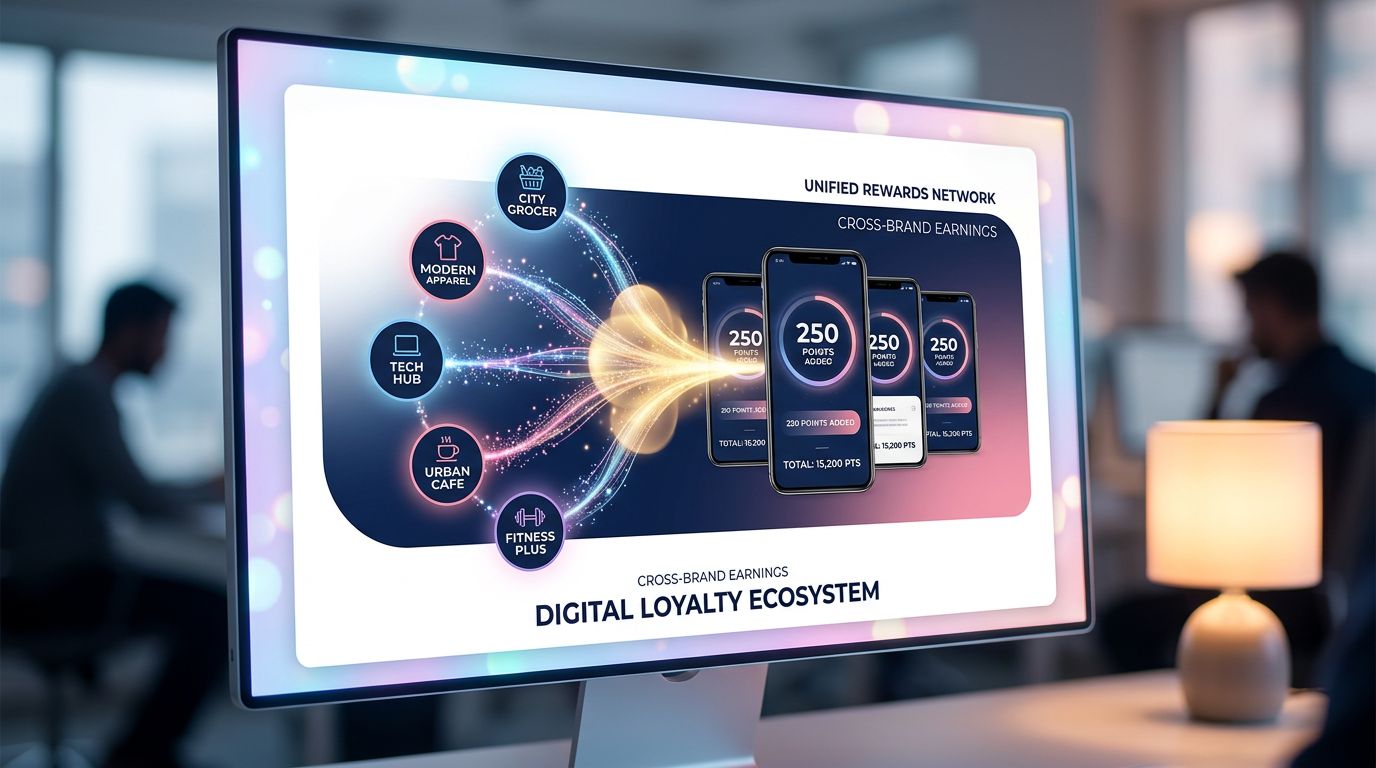
What does this mean for a Normandy-based SME? You don’t need a massive budget to enter this logic. Solutions like Loyoly, Smile.io, or direct partnerships between local merchants let you build bridges without custom development. What matters is the relevance of the pairing — not the size of the network.
“Loyalty is no longer built within a single retailer. It’s built within an ecosystem of trust.” — A recurring observation from the e-commerce audits we’ve been running since 2020.
Social commerce imposes its own logistics rules
Here’s where it gets really interesting — and where many merchants get caught off guard.
TikTok Shop, Instagram Shopping, live-selling on Facebook. Selling through social networks is no longer an experiment — it’s a full-fledged sales channel. In France, FEVAD estimates that social commerce represents a growing share of online purchases, particularly among 18-35 year-olds.
But here’s the problem no agency will tell you: social commerce has zero tolerance for standard delivery times.
When a customer buys right after seeing a product in a livestream or a story, they’re in a state of emotional purchase. The buying impulse is strong, and so is their impatience. A delivery time of D+5, which would be acceptable on a classic e-commerce site, becomes a source of frustration — and negative reviews — for a social purchase.
The standards this channel imposes are unforgiving:
- Near-instant order confirmation
- Real-time tracking updates
- Expected delivery time: D+1 to D+2 for common products
- Responsive customer service on the same channels where the purchase happened (Instagram DMs, TikTok comments)
This isn’t a gentle evolution. It’s an operational rupture.
What this means concretely for your fulfillment
If you sell online and you’re integrating — or considering integrating — social networks as a sales channel, your logistics chain needs to be rebuilt accordingly.
Specifically, here are the three levers we see working for merchants who handle this well.
Automate order processing from the moment it’s received
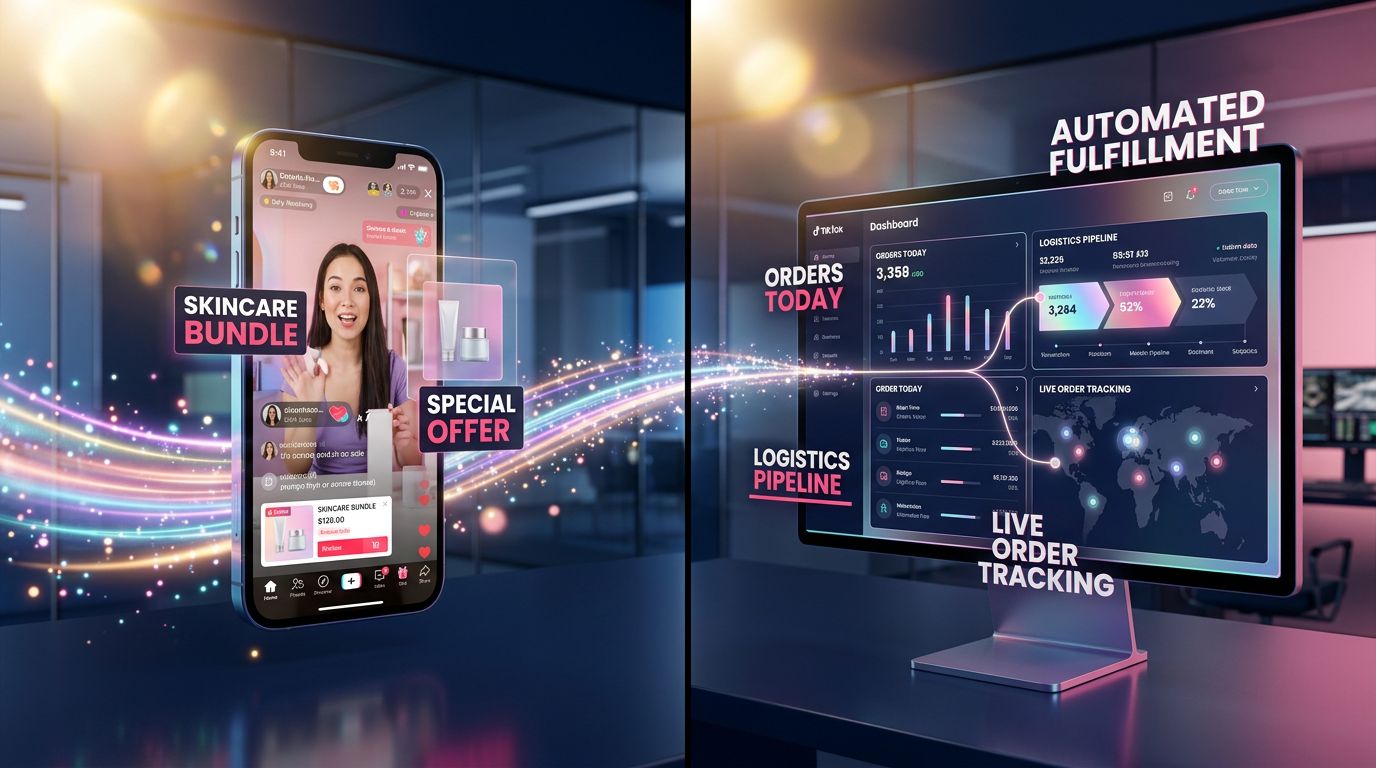
An order that goes through manual validation before being sent to the warehouse is already too slow for social commerce. Merchants who perform well have automated workflows: order received → stock checked → pick ticket generated → carrier notified. No human intervention on the standard steps.
On the e-commerce projects we deliver, this automation usually comes down to connecting PrestaShop or WooCommerce to a logistics management tool via API. It’s not a six-month project — it’s often a week of well-targeted development.
Bring stock closer to the customer
Pure dropshipping, with stock sitting in Asia, no longer holds up against French social-commerce expectations. Merchants who handle this shift well have either brought part of their stock back to France, or worked with 3PLs (third-party logistics providers) with regional warehouses. In Normandy, proximity to logistics hubs like Rouen or Le Havre is an advantage that’s often underused.
Unify customer service management
If your customer buys on Instagram and has to email you for a return, you’ve already lost them. Tools like Gorgias or Zendesk let you centralize incoming messages from every channel (email, social networks, chat) into a single interface. For a small business, that’s the difference between spending two hours a day juggling browser tabs and having a clear view in 20 minutes.
Loyalty and logistics: two sides of the same coin
What no agency ever tells you — because it doesn’t fit neatly into a box — is that customer loyalty and operational efficiency are directly linked.
A customer who receives their order within 24 hours after an impulsive TikTok purchase is already 70% convinced to come back. Add a thoughtful unboxing experience, a personalized message, a cross-brand loyalty code with a relevant partner — and you’ve turned an emotional purchase into a lasting relationship.
Conversely, a brilliant loyalty program won’t save a disastrous delivery experience. Google reviews and social media feedback are merciless.
“Loyalty starts at delivery, not at the points program.” — What we keep telling our e-commerce clients for the past two years.
The real question isn’t “which loyalty tool should I choose?” It’s: does your operations match up to your marketing promises?
Three concrete actions to put in place right now
No theory. Just what actually works on the projects we’ve run.
1. Audit your average order-processing time. Not the advertised time — the real one, from order receipt to actual shipment. If you don’t know it precisely, that’s the first problem. Measure it over 30 days. If you exceed 24 hours on average for standard orders, you have a priority project on your hands.
2. Identify a complementary partner for a cross-brand loyalty program. It doesn’t have to be a complex platform. Sometimes it’s as simple as an agreement with two or three merchants in your sector or your local area. You send them customers, they send you some. Formalize it with a shared promo code and measure the incoming traffic.
3. Centralize your customer service before expanding your social presence. Before opening TikTok Shop or activating Instagram Shopping, make sure you have a unified solution for handling messages. Opening a sales channel without being able to manage the support that comes with it is building a time bomb.

What this changes for your overall digital strategy
E-commerce in 2025 no longer rewards whoever has the biggest catalog or the lowest price. It rewards whoever offers the best total experience — from discovering a product on a social network all the way to the parcel on the doorstep, with a customer relationship along the way that makes people want to come back.
That requires two things many merchants haven’t yet aligned: an agile operational infrastructure and a loyalty strategy that goes beyond the transaction.
After 15 years building e-commerce sites for Normandy SMEs, what we increasingly see is that the problem isn’t a lack of tools — it’s a lack of connection between the tools. A high-performing PrestaShop on one side, an Excel spreadsheet for logistics on the other, and a points program nobody checks. Everything exists, nothing talks to each other.
That’s exactly what we solve on the e-commerce automation and integration projects we run at GDM-Pixel.
Take the next step
Your online store generates sales — but does your operations really keep pace with new customer expectations? And does your loyalty program actually create value, or is it just a box ticked in your strategy?
If you want an honest answer to these two questions, contact us for an e-commerce audit. No diagnostic sold in advance — a direct conversation about what’s blocking you and what can be improved quickly.
We don’t sell a full redesign when a three-day integration project will do. That’s been our commitment from the start.
 Social networks
 Analyze with AI