+33-9-7266-3068
 contact@gdm-pixel.fr








 TL;DR - Key Takeaways at a Glance
When a brand changes course mid-flight
One of our e-commerce clients called us on a Tuesday morning, slightly panicked. Sales had dropped 18% in two weeks. Not a technical issue. Not a payment bug. A pricing decision made too quickly, without listening to market signals. We spent three days analysing their data, rebuilding a coherent pricing strategy, and relaunching their campaigns.
Result: +12% in week 3. But three lost weeks that never come back.
e.l.f. Beauty just experienced something similar — on a much larger scale. The American cosmetics brand, known for its ultra-accessible positioning, attempted to adjust its prices upward. Immediate consumer reaction. Forced reversal. What the specialist media called an “about-face” — a brutal U-turn.
The lesson does not only concern industry giants. It concerns every online store that sets prices by gut feeling and discovers too late that the market has already decided.
What the e.l.f. story really reveals
e.l.f. Beauty is not an amateur brand. It is a publicly listed company with structured marketing teams and an impressive growth track record. And yet, it found itself publicly correcting course.
Why? Because the speed at which consumers react today exceeds the speed at which most organisations process their data.
This is not a budget problem. This is not a talent problem. It is a marketing capabilities problem. Precisely what English-speaking markets now call “next-gen marketing capabilities” — the ability to detect, analyse and respond to consumer signals in near real time.
Here is where it gets interesting: these capabilities are no longer reserved for large corporations. They are accessible. But you need to know how to build them.
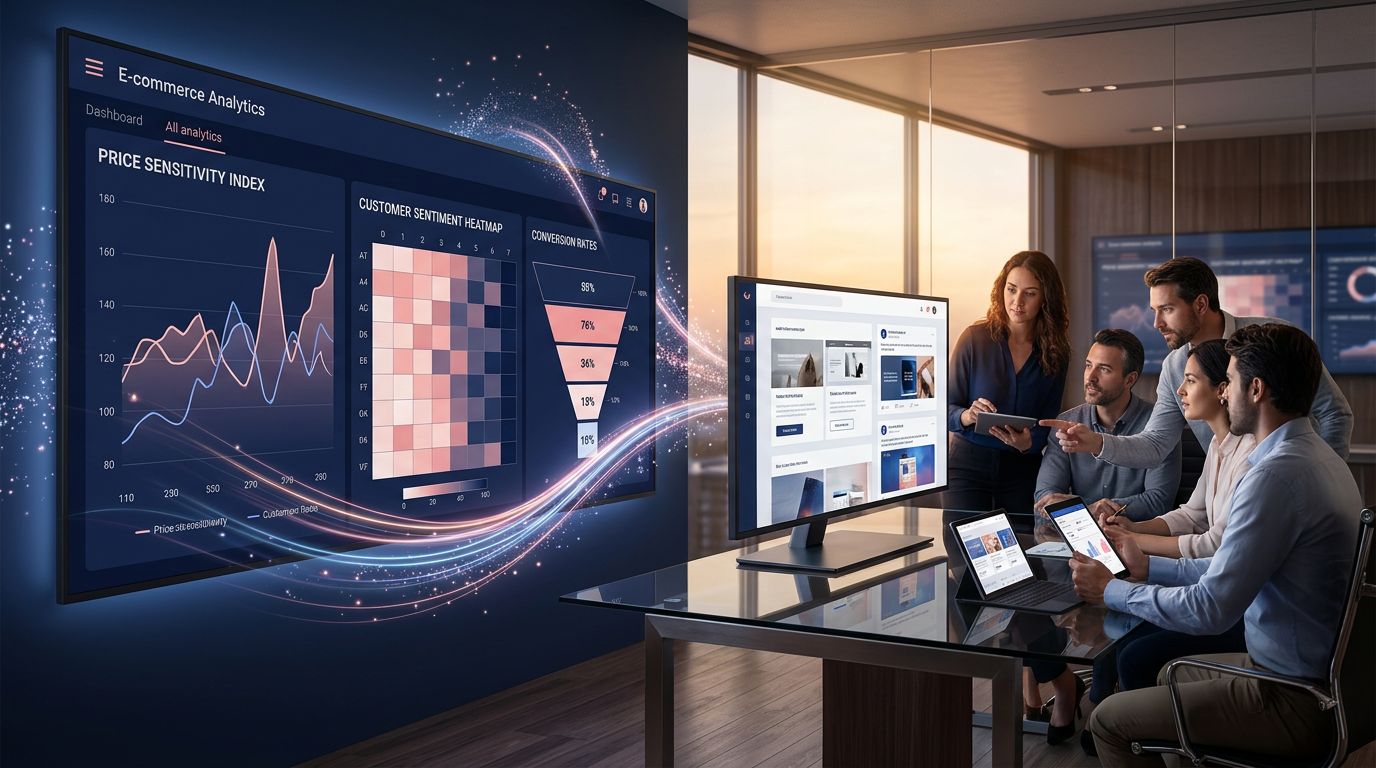
Pricing: an underestimated lever for most SMEs
Let’s be direct. Most online stores set their prices in one of three ways:
Cost-plus margin — you calculate the cost price, add a percentage, and hope it works. It feels reassuring, but it completely ignores perceived value and competition.
Copying competitors — you look at what the neighbour does and align. Problem: if the neighbour is wrong, you are too. And you have no differentiating advantage.
By gut feeling — the owner decides based on their intuition, history, and empirical knowledge of the market. It works… until the day the market changes faster than instinct.
According to a McKinsey study, companies that adopt a data-driven approach to pricing decisions record on average 2 to 7% additional margin without touching their volume. That is not marginal. On a store with €500,000 in annual revenue, that is €10,000 to €35,000 in recovered margin. But you first need to know how to analyse your store’s performance to turn that data into decisions.
The question is not “is smart pricing worth it?”. The question is: “how much is it costing you each month not to have it in place?”
Building agile marketing capabilities: what that means in practice
The term “next-gen marketing capabilities” can sound like consulting jargon. Let’s break down what it actually means for a human-scale e-commerce store.
Real-time signal listening
Consumers are talking constantly. Product reviews, social media comments, cart abandonment rates, searches on your site — every behaviour is a signal. The problem is that without infrastructure to collect and interpret them, these signals remain noise.
A tool like Google Analytics 4, paired with a properly configured Looker Studio dashboard, already gives you actionable insight. This is not magic — it is good plumbing.
Systematic price testing
e.l.f. changed its prices at scale without sufficient testing. An A/B pricing test on 10% of your traffic for two weeks gives you a factual answer before rolling out to your entire catalogue.
Tools like AB Tasty or even PrestaShop’s native features let you do this without writing a single line of code. What we see concretely with our clients: those who test before deploying reduce their risk by 60 to 70% on pricing decisions. Testing before deploying is also one of the most direct levers to optimise your store’s conversion.
Adjustment automation
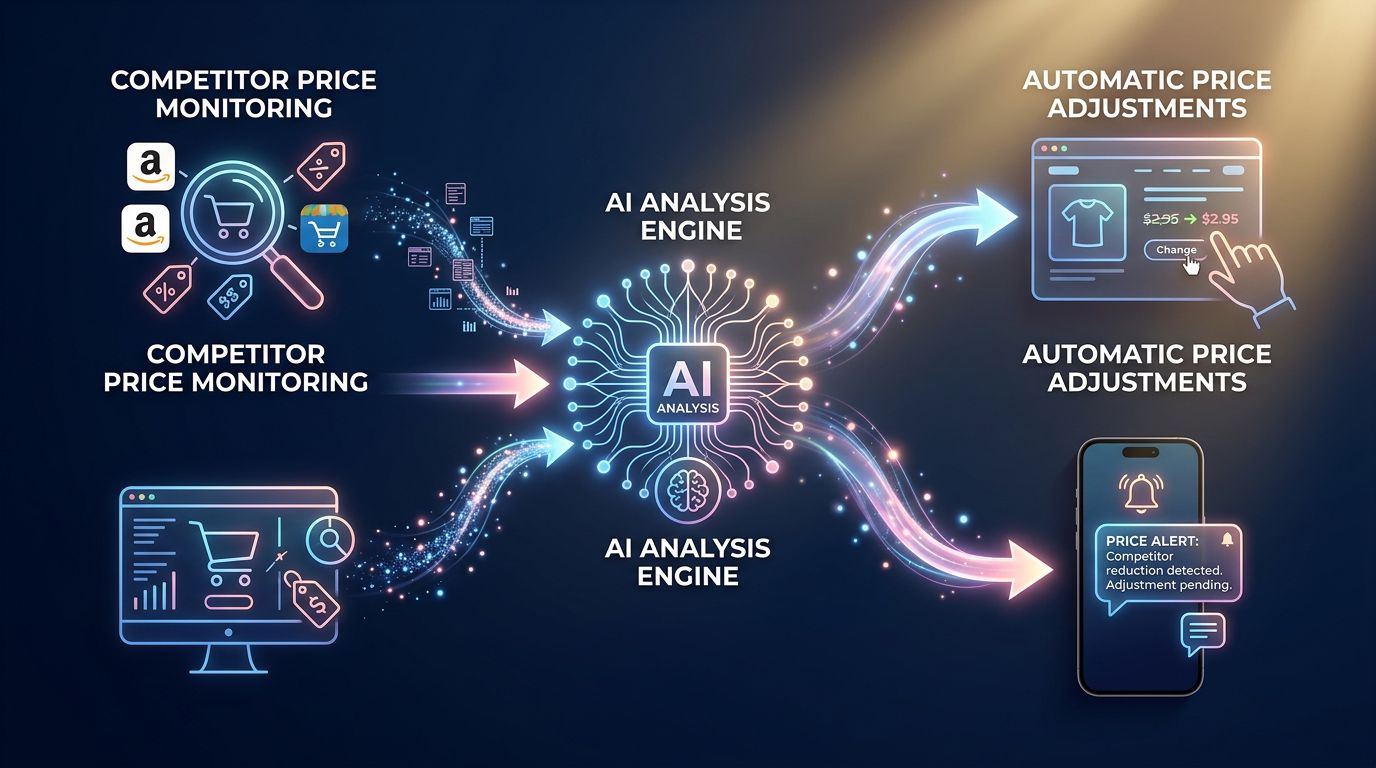
This is where AI truly comes into play. Not the AI fantasised about at conferences — practical AI that monitors your stock, margins, competitor prices, and automatically adjusts according to rules you define.
For a PrestaShop store, modules like Boostmyshop or integrations via n8n let you build automated repricing workflows. We implemented this for a client in professional equipment distribution: estimated time saving of 4 hours per week on manual price management.
The mistake brands make when they “pivot” on pricing
Back to e.l.f. Beauty. What made their situation difficult was not so much the decision to raise prices — it was the way it was communicated, or rather poorly communicated.
Consumers accept price increases. What they do not accept is the feeling of being taken for fools without explanation.
“Price is what you pay. Value is what you get.” — Warren Buffett
This quote applies directly to e-commerce. If your price increase is not accompanied by clear communication on added value, the consumer only sees the increase. Not the value.
What agencies never tell you: communication around a pricing change is just as important as the change itself. Often more so.
When we support a client through a pricing grid overhaul, we systematically deliver two things: the new price structure and an associated communication plan. Customer emails, updated product pages, refreshed FAQ. It takes two additional days. It prevents three-week crises.
Three concrete actions for an online store
You are not e.l.f. Beauty. You do not have their marketing budget or their data team. But you can apply the same principles at your scale.
Action 1 — Audit your price behaviour data Look at your cart abandonment rates by price range. If your products between €80 and €120 have a 30% higher abandonment rate than your products under €50, you have a signal. It is not a certainty, but it is a hypothesis worth testing.
Action 2 — Set up a pricing test on one category Choose a product category, change the price by 5 to 10% on half of your traffic for 3 weeks. Measure the conversion rate and margin generated. Deploy the winning version. Repeat.
Action 3 — Automate your competitive intelligence You do not need a dedicated team to monitor your competitors’ prices. An n8n or Make workflow that scrapes the product pages of your 3-4 main competitors and sends you a weekly summary via Slack or email — it can be built in a day. We have done it for several clients. Cost: a few hours of setup, zero ongoing expense.

What “agile” really means in an SME context
You hear the word “agility” a lot in the digital world. Often, it is empty dressed up as a concept.
In our day-to-day work as an agency, agility is simple: the ability to change a decision in 48 hours without it costing a fortune.
e.l.f. Beauty had to publicly reverse course because its infrastructure did not allow it to detect the problem early enough and adjust smoothly. If it had had the right measurement tools beforehand, the reversal could have been managed silently, progressively, without reputational damage.
For an SME, marketing agility is built on three pillars:
Fresh data — not monthly reports, weekly dashboards as a minimum. Short decision processes — the owner must be able to adjust a campaign or a price without going through three levels of validation. Tools that execute quickly — when you decide to change, the change must be live in hours, not weeks. All of this rests on a solid e-commerce store built right from the start.
SMEs that have invested in these three pillars consistently come out stronger from periods of economic turbulence. Those that still operate on gut instinct and Excel spreadsheets end up reacting too late.
Conclusion: pricing is no longer a decision, it is a process
The real lesson of the e.l.f. Beauty episode is not “don’t change your prices”. It is: if you change your prices without a real-time measurement system, you are flying blind.
The marketing of tomorrow — the kind that allows you to survive in an increasingly competitive e-commerce environment — is not the one that invents the best creative campaigns. It is the one that builds the infrastructure to detect, test, adjust and communicate faster than the competition.
This is not out of reach for a human-scale online store. It is a matter of priorities and method.
At GDM-Pixel, we support e-commerce businesses on exactly these topics: auditing their analytics stack, setting up automated workflows, and building the capacity to react quickly. No vague promises — concrete deliverables, realistic timelines, measurable results.
How long does your online store take to react when the market changes? If the answer is “I don’t know” or “a few weeks”, now is the right time to talk about it.
Contact GDM-Pixel for an audit of your e-commerce stack — honest diagnosis, no commitment, no bullshit.
 Social networks
 Analyze with AI