+33-9-7266-3068
 contact@gdm-pixel.fr








 TL;DR - Key Takeaways at a Glance
When external forces threaten your revenue
One of our clients — an online ready-to-wear store, 8 years in business, solid SEO — saw their conversion rate drop 23% in three weeks. No technical issue. No bug in the checkout flow. A wave of discontent on social media, a hashtag going around, customers hesitating before buying.
More and more e-commerce owners are experiencing exactly this scenario. External pressures — consumer boycotts, bad buzz, industry controversies — are no longer rare events. They are part of the operational risk of running an online store in 2025.
The question is no longer “will this happen to me?” but “what do I do when it does?”
And that is where AI-driven advertising changes the game. Not as a miracle solution. As a measurable resilience tool.
What “e-commerce resilience” actually means
Forget the buzzword. In practice, an online store’s resilience is its ability to maintain an acceptable revenue stream when an external variable deteriorates.
Concretely: when your organic traffic drops because users are downvoting you on Google, when your usual audience retreats, when your email campaigns show dismal open rates — do you have a substitution lever you can activate quickly?
Online advertising, and more specifically AI-driven Google Ads Performance Max campaigns, answers exactly that need. Here is why.
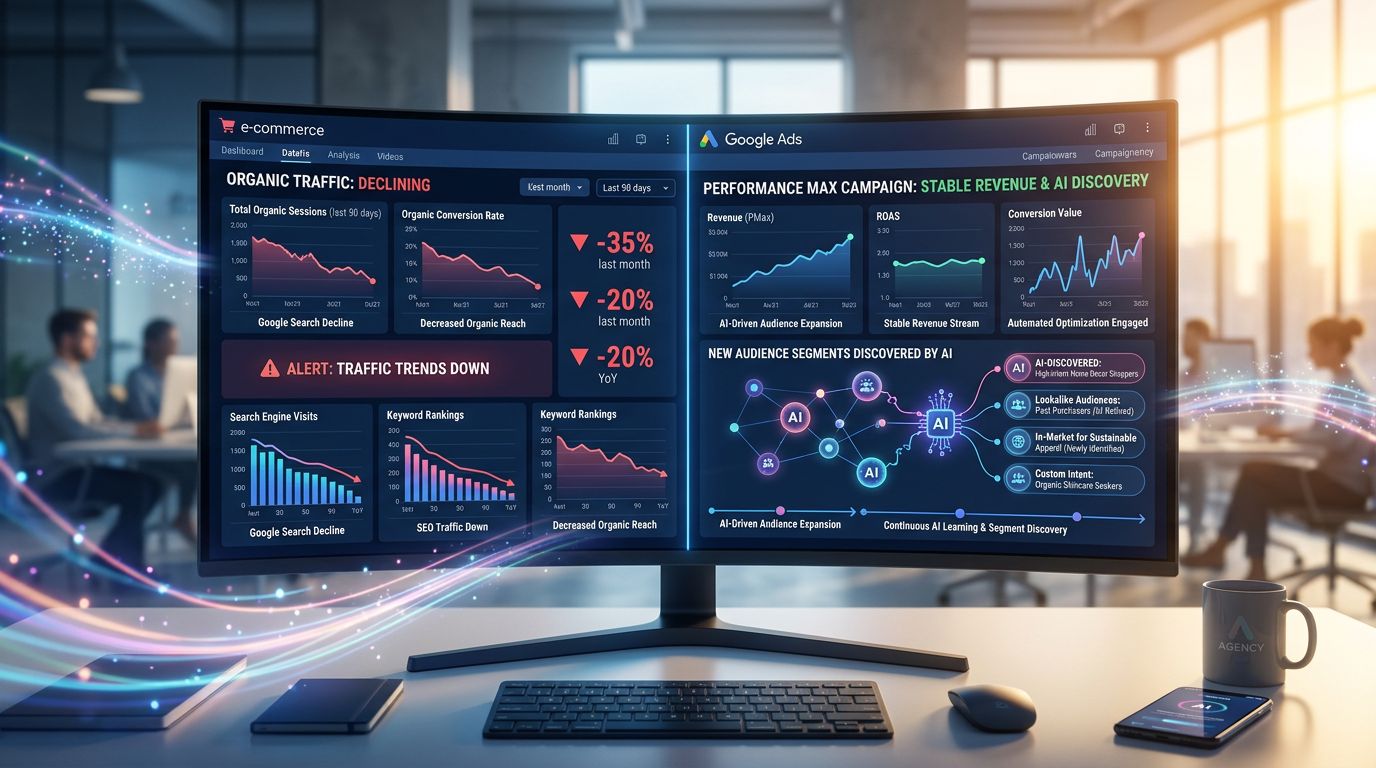
A boycott hits one audience, not all audiences. This is the point most store owners miss. If 15% of your regular customers are temporarily turning away, that still leaves 85% of your market — plus all the prospects you have never reached. AI advertising is constantly seeking out those new audiences. It does not suffer from the confirmation bias you carry about your historical customer base. This is precisely the logic we detail in our comparison of AI tools for managing your web marketing campaigns — choosing the right co-pilot determines how quickly you explore new segments.
Performance Max: what AI actually does for you
Google Performance Max is not new — but its maturity level in 2025 is radically different from what it was at launch. Audience signals, real-time bid adjustments, the ability to test creatives automatically: all of it has been refined.
What changes for an e-commerce store under external pressure is the speed of adaptation.
Automatic channel rebalancing
When your usual Shopping audience converts less well — because some of your regular buyers have temporarily decided to avoid you — Performance Max redistributes the budget toward channels that perform. YouTube, Display, Search, Gmail: the algorithm arbitrates continuously without any manual intervention on your part.
Concrete result: you do not burn your entire budget on an audience that is no longer converting. It shifts toward those who are still buying.
Audience signals vs rigid targeting
The classic mistake during a reputation crisis: restricting campaigns to “protect the brand.” You tighten targeting, cut broad audiences, and retreat toward loyal customers.
This is often the wrong reflex. Loyal customers are precisely those most exposed to bad buzz. Going after new audiences — people who do not know you yet and therefore have no negative bias — is often where the replacement revenue lies.
Performance Max with well-configured audience signals does exactly this: it uses your first-party data (past buyers, site visitors, email list) as a starting point, then explores similar profiles who have no reason to boycott you.
“Brands that maintain their advertising presence during a reputation crisis recover on average 40% faster than those that cut their budgets.” — Source: Think with Google, study on digital brand resilience
The trap of “cut everything during the storm”
It is a human reflex. Understandable. When controversy grows, the instinct is to lie low. Not spending money on ads when your image is tarnished seems logical.
In practice, it is often an economic mistake.

Here is what actually happens when you cut your campaigns during a difficult period:
Your competitors keep appearing on your keywords. Prospects who are unaware of the bad buzz — and there are many — search for your products, do not find you in the ads, and buy elsewhere. You lose not only the customers who are boycotting you, but also those who would have bought without even knowing there was a problem.
The real calculation is not “how much am I spending on ads right now.” It is “how much market share do I lose if I disappear for 3 weeks.”
My advice for a store with a limited budget: do not cut — reposition. Redirect the advertising message. Highlight your values, your commitments, your positive social proof. AI takes care of finding who to show that message to — you focus on what the message says. To go further on the acquisition mix to activate in parallel, see the best marketing strategies for an e-commerce business that complement Performance Max campaigns.
Three concrete levers to activate immediately
What we implement for our e-commerce clients when external pressure threatens their business:
1. First-party audience signal audit
Before touching the campaigns, we audit the available data. Customer list from the past 12 months, site visitors segmented by behaviour, abandoned carts. This data feeds the Performance Max signals. The cleaner and more segmented it is, the more effectively AI finds similar profiles not exposed to the bad buzz.
Time required: 2 to 4 hours. Impact: immediate on the quality of the audiences explored.
2. Diversification of advertising creatives
Google’s AI automatically tests combinations of headlines, descriptions, and visuals. But it tests what you give it. During a crisis, feeding Performance Max with creatives that highlight reassuring elements — verified customer reviews, guarantees, concrete commitments — allows the algorithm to find the messages that convert despite the context.
No defensive creatives. Creatives that speak to those not yet caught up in the controversy.
3. Target ROAS management by product segment
Not all your product categories are equally exposed to a boycott. Some lines continue to perform normally. Adjusting ROAS targets by segment — rather than a global ROAS — allows AI to allocate budget where it still generates returns, without burning money on the most affected segments.
This is precise management. But with current Google Ads tools, it can be configured in under an hour.
What this looks like in real numbers
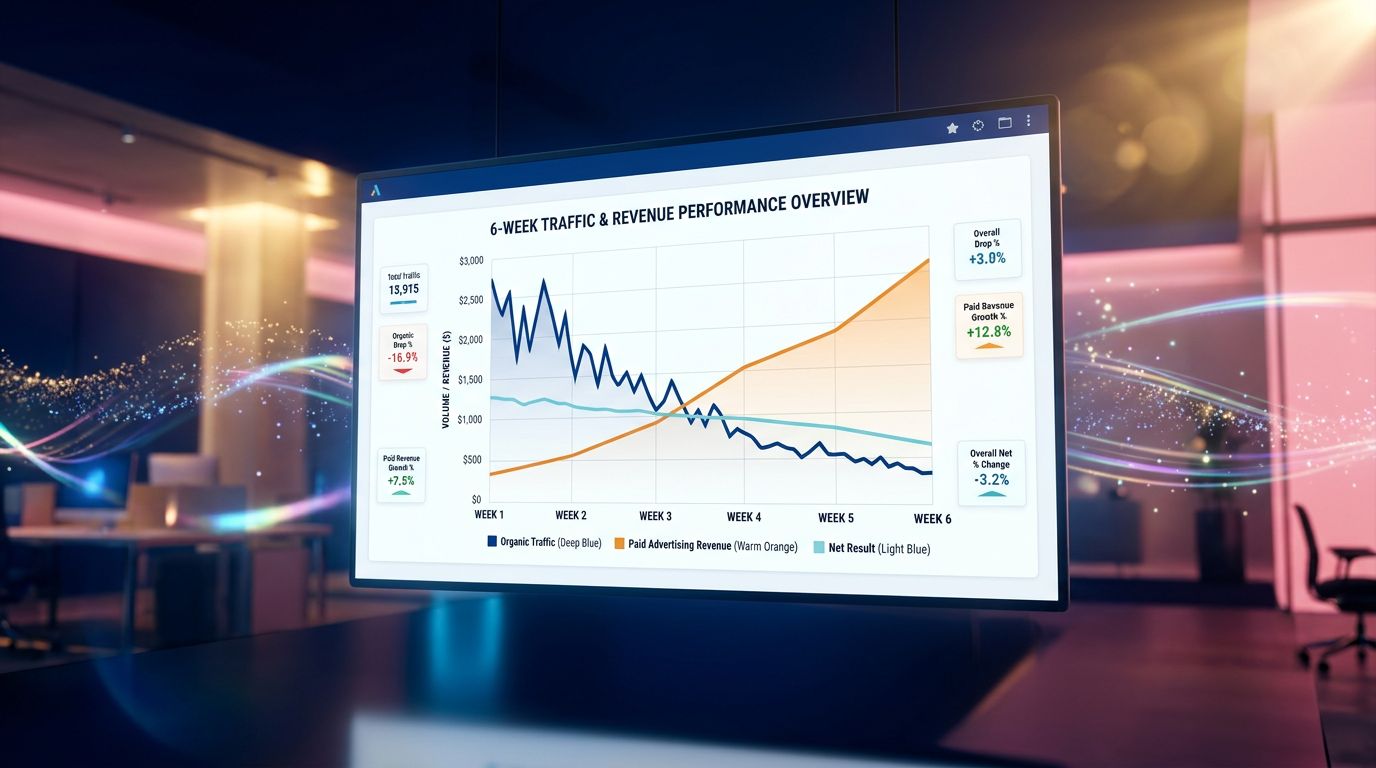
On an e-commerce project we supported during a turbulent period (food sector, supplier controversy), here is what we observed over 6 weeks:
- Organic traffic: -31%
- Performance Max campaign revenue: +18% (new audiences)
- Overall acquisition cost: +12% (normal under pressure)
- Total revenue: -8% instead of the projected -35% without intervention
AI advertising did not save everything. It absorbed the shock. That is exactly its role in a resilience strategy.
The three takeaways
1. A boycott hits one audience, not your entire market. AI advertising continuously explores new audiences without bias. That is precisely where your replacement revenue lies when part of your customer base retreats.
2. Cutting campaigns during a crisis is often an economic mistake. You do not only lose the disgruntled customers — you also lose everyone who would have bought without knowing there was a problem. Reposition the message; do not disappear.
3. Resilience is built before the crisis. Clean first-party data, diversified creatives, segment-level management: all of this is configured when things are going well. When pressure hits, you activate — you do not build under urgency.
Conclusion: AI advertising is not a luxury, it is insurance
After 15 years supporting e-commerce businesses in Normandy and beyond, what strikes me is the number of stores with an excellent product, a real customer base, and no plan B when their usual acquisition channels falter.
The tools exist. Performance Max, first-party audience signals, granular ROAS management — this is no longer reserved for large brands with dedicated teams. A mid-sized e-commerce store can activate it with the right setup, typically integrated into a digital marketing strategy built for resilience.
The question is not whether your store will face external pressure one day. It is whether you have the levers to absorb it without losing six months of growth.
If you want us to audit your current advertising setup — first-party data, campaign structure, automation potential — contact GDM-Pixel. We give an honest diagnosis. If your configuration is already solid, we will tell you. If it has weaknesses, we show you exactly where and how to fix them.
Evidence before promises. As always.
 Social networks
 Analyze with AI