+33-9-7266-3068
 contact@gdm-pixel.fr








 TL;DR - Key Takeaways at a Glance
You’ve been selling online for months — but at what cost?
Here’s a question few e-commerce consultants dare to ask: is your online store working for you, or are you the one working for it?
One of our clients — a craft decoration shop owner in Normandy — called us at the start of the year. His revenue had doubled in 18 months. A great result on paper. Except he was sleeping 5 hours a night, managing his Meta campaigns at 11pm, and hadn’t taken a holiday in two years. “I’ve succeeded, but I no longer know why I launched this project,” he told us.
This is not an isolated case. It’s the reality for many e-commerce entrepreneurs who have built a revenue-generating machine… and find themselves stuck inside it.
This is where a recent development deserves serious attention: Pinterest has just launched a conversational AI application designed for product discovery. Not just another gadget. A building block that, used intelligently, can profoundly change the way you manage your customer relationship — and therefore the time you spend on it.
What Pinterest’s AI really does (and what it changes for you)
Pinterest is not a social network like the others. Its 500 million monthly active users don’t scroll to pass the time — they look for inspiration to buy, decorate, cook, travel. Commercial intent there is structurally higher than on Instagram or TikTok.
Their new AI application goes further than classic algorithmic recommendation. It enables a natural conversation with the user: “I’m looking for a gift for a 40-year-old woman who loves yoga and minimalism”, and the AI suggests products, refines them based on feedback, and guides the user to the purchase decision.
For an e-commerce merchant, this shift is fundamental.
Until now, you spent hours writing optimised product descriptions, building segmented landing pages, testing advertising audiences. All of that to try to simulate a conversation your customer would have wanted to have with a real advisor. Pinterest’s conversational AI does this work for you — in real time, at scale, without proportional extra cost. This is exactly the shift we analyse in what changes when AI replaces the salesperson in an online store.
This is not magic. It’s automation applied where it creates the most value: product discovery.

Automation doesn’t replace your value — it unleashes it
Here is the trap many e-commerce merchants fall into when facing AI tools: they see them as a threat or a gadget. Neither is correct.
Pinterest’s AI — like any well-integrated automation tool — does not replace your product expertise, your sense of customer, your brand identity. It handles the low-value-added tasks to let you do what only you can do.
Concretely, what does this mean for your daily life?
Less time on repetitive product enquiries. “Do you have this model in size L?”, “Which product would you recommend for sensitive skin?” — these questions that you or your team handle ten times a day can be managed by a conversational AI trained on your catalogue.
More time on what builds your difference. Supplier relationships, developing new product ranges, building a community around your brand, the 12-month strategy. These are the activities that create lasting value — and that you never do because you’re buried in operations.
A decoupling between your growth and your workload. This is the central issue. Doubling your revenue should not mean doubling your hours. If it does, you don’t have a business — you have a very stressful job where you are your own boss.
“The goal is not to work smarter to sell more. It’s to sell smarter to live better.” — A truth the e-commerce world forgets too often.
Pinterest AI in a real e-commerce workflow: what it can look like
Let’s be concrete. How do you integrate this building block into an existing e-commerce workflow without reinventing everything?
Here is the architecture we recommend to our clients who are starting to explore Pinterest as an acquisition channel:
Step 1: Structure your catalogue for AI
Conversational AI can only recommend what it understands. Your product listings must be rich in semantic attributes: material, use, ideal user profile, atmosphere, season. Not just “Blue ceramic vase 25cm”. But “Handmade ceramic vase, Scandinavian style, ideal for minimalist decoration, housewarming gift, medium size”.
This is an enrichment task that Claude Code can automate from your existing data — we have done it for several PrestaShop stores, with a 70% time saving on copywriting. This is also why the quality of your product data becomes a critical asset in the era of autonomous AI.
Step 2: Connect Pinterest to your catalogue via the Pinterest Catalogue
Pinterest offers a native integration with product feeds (XML/JSON). Your catalogue is synchronised automatically. Stock updates, price changes, availability are reflected without manual intervention.
Step 3: Activate enriched Product Pins
These are the pins that directly display the price, availability, and purchase link. They feed Pinterest’s recommendation AI with structured data. The cleaner your data, the better the AI positions you in product discovery conversations.
Step 4: Measure what really matters
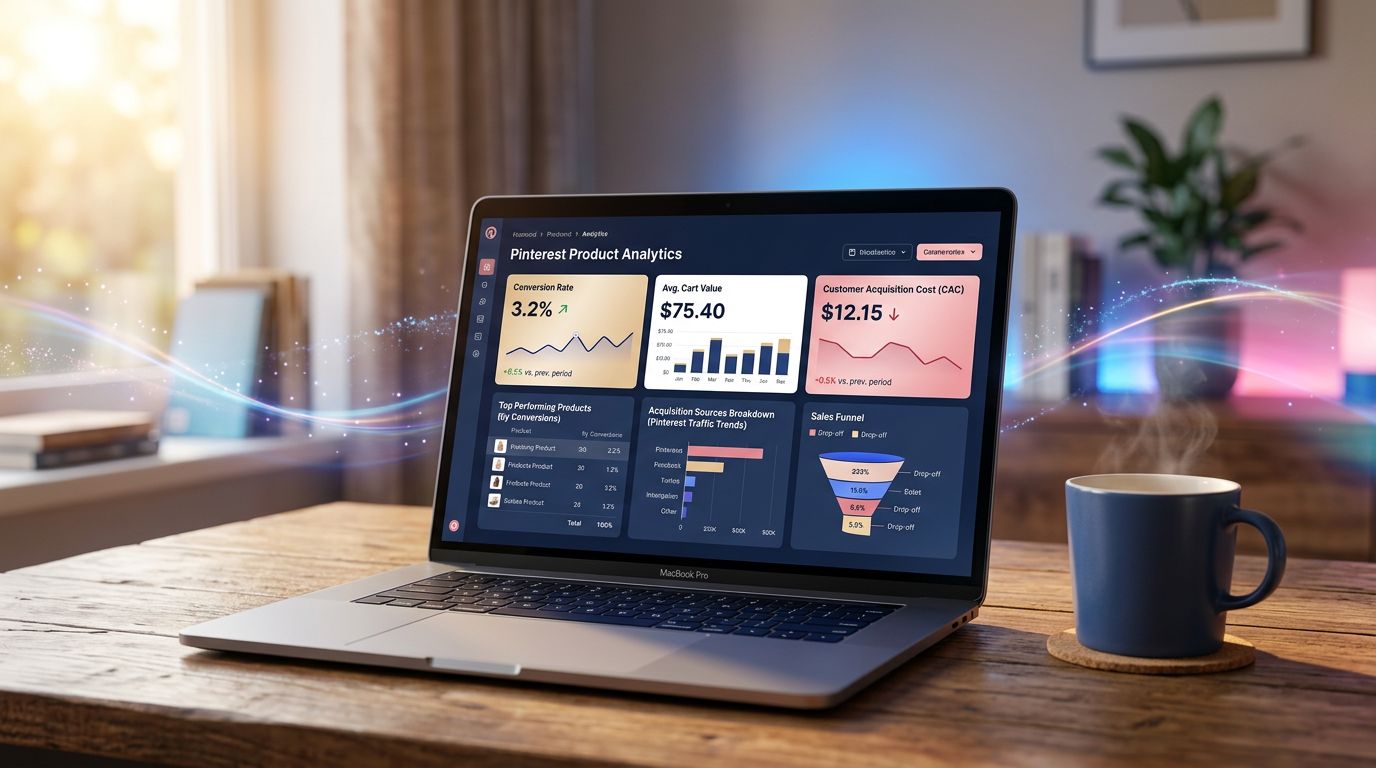
Not just the click-through rate. The conversion rate by conversational query type, the average basket of customers acquired via Pinterest AI versus Meta Ads, the real cost of acquisition. These are the figures that will tell you whether the tool is working for you — or whether you are working for the tool.
The real challenge: aligning your sales tool with your life project
Here is what is never said in e-commerce webinars: a good tool is not the one that maximises your revenue. It’s the one that maximises your revenue relative to the time you spend on it and the life you want to live.
Some of our clients want to scale aggressively — €10 million in revenue, a team, investors. For them, AI is a pure growth lever.
Others want a store that runs well, generates €8,000 to €15,000 in net profit per month, and leaves them two full weekend days with their family. For them, AI is a lever of freedom.
These two goals do not require the same configurations. But they both require the same discipline: automate what can be automated, to free up what cannot.
Pinterest AI fits into this logic. Product discovery — that moment when a stranger becomes an interested prospect — is one of the most time-consuming phases of e-commerce. Delegating it to a well-fed conversational AI means reclaiming hours every week. Hours you choose to invest wherever you want.
According to a Salesforce study, 69% of consumers prefer conversational interactions for the discovery of complex products. This is not a trend — it is already the dominant behaviour.
Three concrete actions to take this week
We never finish an article at GDM-Pixel without giving you something concrete to execute. Here are three measurable actions, in order of priority:
1. Audit your product catalogue. Take your 20 best-selling products. Does each listing contain enough semantic attributes for an AI to recommend it in a natural conversation? If not, this is your priority project. A well-structured catalogue benefits all your channels — not just Pinterest.
2. Activate the Pinterest catalogue feed if you haven’t already. PrestaShop and WooCommerce have native modules or third-party extensions to generate a Pinterest-compatible feed. It’s a half-day configuration that opens access to 500 million users with high purchase intent. If your technical foundation isn’t ready for this, it’s time to review your e-commerce store creation.
3. Define your freedom KPI. Not just your revenue target. Define how many hours per week you want to work in 12 months. Then build your automation stack around that goal. Pinterest’s AI, combined with automation of your customer service and content management, can save you 10 to 15 hours a week. Where do you want to put them?

Building a business that resembles you, not a business that consumes you
Pinterest’s conversational AI is one building block among many. It won’t transform your life overnight. But it represents something more important than a simple marketing tool: it embodies a paradigm shift in how e-commerce entrepreneurs can delegate operations to the machine.
We have supported dozens of online stores for 15 years. Those who fare best over the long term are not necessarily those with the largest catalogue or the highest advertising budget. They are those who understood that true competitiveness means letting AI do what it does better than you — so you can focus on what only you know how to do.
Your product sense. Your relationship with your community. Your brand vision. Your life project.
These things no algorithm can replace. But the algorithm can give you more time to nurture them.
Do you run an online store and want to automate your product discovery or structure your catalogue for recommendation AIs? At GDM-Pixel, that’s exactly what we do — with concrete tools, realistic timelines, and zero empty promises.
Let’s discuss your project — honest diagnosis, no commitment.
Sources: Pinterest Newsroom, Salesforce State of the Connected Customer 2024, GDM-Pixel internal data.
 Social networks
 Analyze with AI