+33-9-7266-3068
 contact@gdm-pixel.fr







 TL;DR - Key Takeaways at a Glance
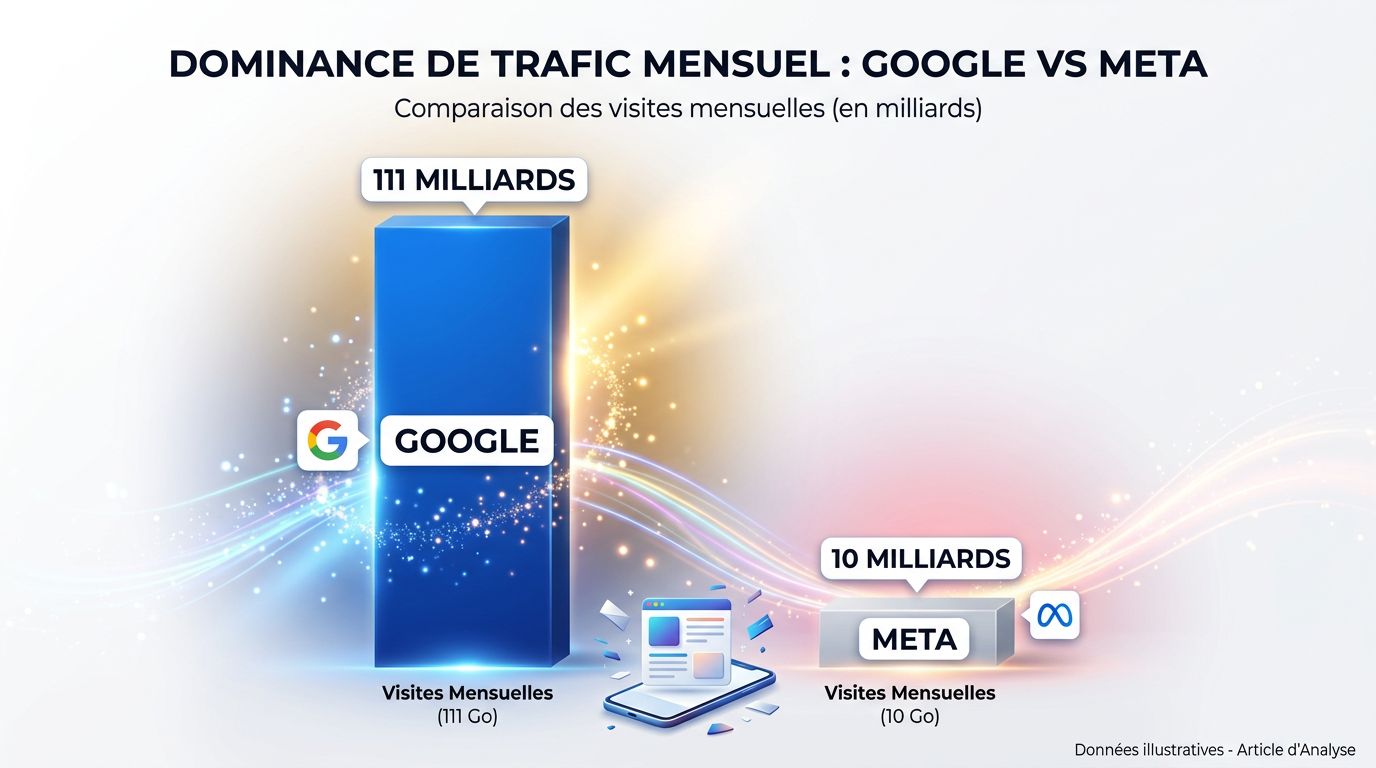
111 billion versus 10 billion. The match is over.
Every month, Google records 111 billion visits. Meta — Facebook, Instagram, and Threads combined — captures 10 billion.
Ten times less.
Yet how many businesses pour most of their energy into social media? How many SME owners spend their mornings posting Reels while their Google presence generates zero qualified visitors?
This isn’t a judgement. It’s a simple arithmetic fact. And it should change the way you allocate your digital budget.
Why Google crushes everything else — the numbers speak for themselves
Those 111 billion monthly visits don’t come out of nowhere. They represent something fundamentally different from visits on Meta or TikTok.
Here’s what changes everything.
Purchase intent
On Google, people search. They type “emergency plumber London”, “best accountant in Yorkshire”, “buy a condensing boiler”. These are queries with a clear intent — often an immediate intent to buy or get in touch.
On Meta, people scroll. They’re not looking for anything. Your ad interrupts them. It’s a push model, not pull.
The difference between a Google visitor and a Meta visitor is the difference between someone walking into your shop and someone you hand a flyer to on the street.
Traffic durability
An Instagram post lasts 24 to 48 hours before disappearing into the algorithm. A well-ranked blog post on Google can generate visits for 3, 5, sometimes 10 years.
I have pages on client websites that have been running since 2019. They bring in qualified traffic every single week, with no additional advertising budget. No social post can compete with that over time.
Search market share
Google holds over 91% of the global search market share, according to StatCounter. In France and the UK alike, the gap is even wider. Bing, Yahoo, DuckDuckGo — they exist, but only marginally.
When you work on your Google SEO, you’re working on the channel that captures virtually all of your potential customers’ searches.
The social media trap for SMEs
Here’s what we see in practice when clients come to us with their digital audit results.
Many have an active Facebook page, a polished Instagram account, sometimes even a LinkedIn presence. They post regularly. They have followers. They invest time in it.
The result? Their website generates 150 visits a month. Their conversion rate sits at 0.8%. 80% of their leads come from word of mouth.
The problem isn’t that social media is useless. The problem is that it creates an illusion of digital activity without generating lasting qualified traffic. This is exactly the mechanism we break down in our analysis of the reasons why a website generates no clients.
“Social media gives you visibility. Google gives you customers.” — That’s the distinction I make systematically in every first meeting.
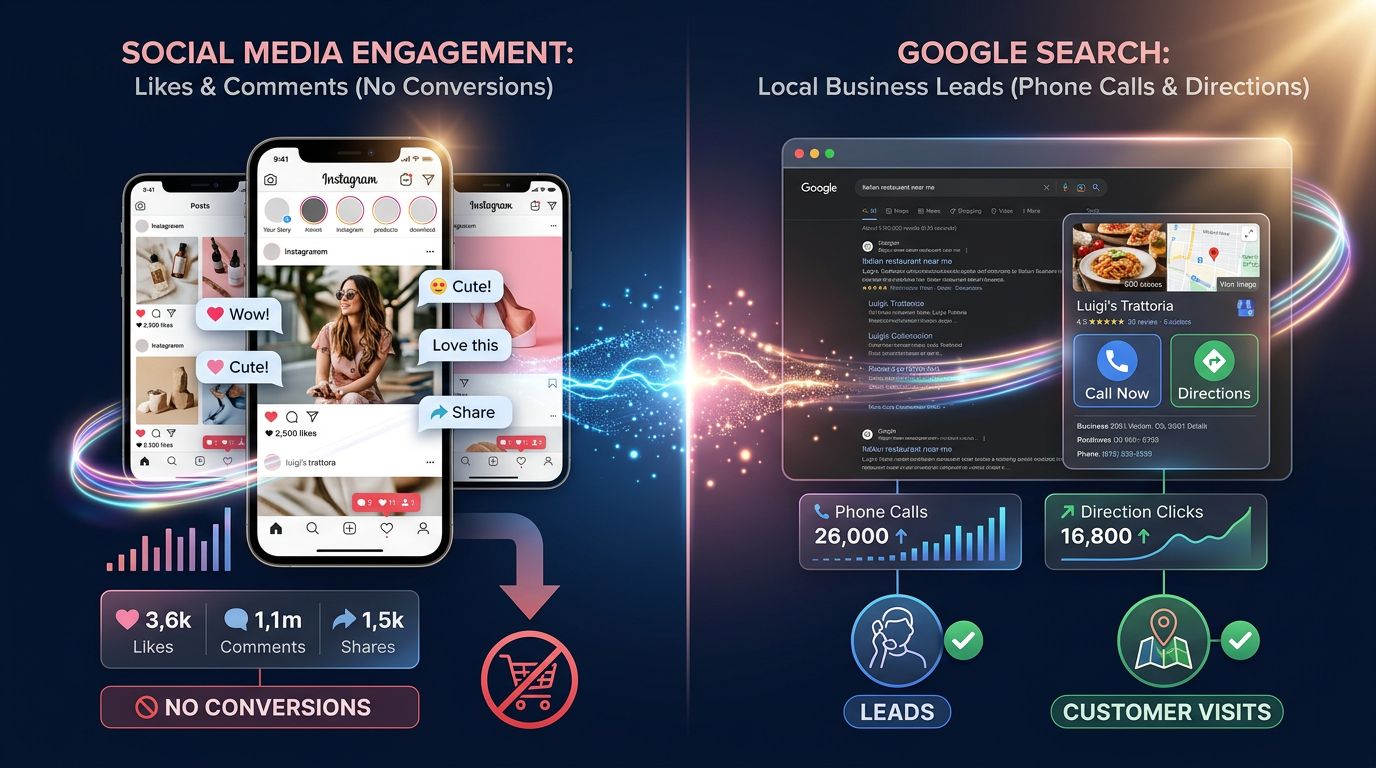
A “like” on Instagram doesn’t pay your rent. A Google search that lands on your listing, your website, your contact form — that does.
Where French SME budgets actually go
According to data from ACSEL (Association de l’Économie Numérique), social media investment by French SMEs grew by 34% between 2020 and 2023. Meanwhile, investment in organic search stagnated.
The market chases novelty. While it does, Google keeps distributing visits to those who understood the rules of the game.
What Google really rewards — and what most businesses miss
SEO has a bad reputation for one simple reason: many people tried “doing SEO” back in 2015, stuffed their pages with keywords, and saw nothing happen.
Since then, Google has changed. Radically.
Today, the algorithm rewards three fundamental things.
Genuinely relevant content
Google has become extraordinarily good at distinguishing useful content from content manufactured to please robots. Its E-E-A-T evaluation framework (Experience, Expertise, Authority, Trustworthiness) pushes up content written by people who actually know what they’re talking about.
For a tradesperson, a doctor, a lawyer, a retailer — this is good news. Your professional expertise is a real competitive advantage in SEO.
Technical site quality
A website that takes 4 seconds to load loses 25% of its visitors before even displaying its content. Google knows this, and it penalises slow sites in its rankings.
Core Web Vitals, HTTPS, URL structure, semantic markup — these are technical criteria we cover in detail in our guide to technical SEO and they carry significant weight in your positioning. Most SME sites I audit fail at least two of these criteria.
Authority built over time
Backlinks — links from other sites pointing to yours — remain a major trust signal for Google. You can’t buy them (well, not legally). They’re built with content worth citing, local partnerships, and a presence in reputable directories.
It’s a long-term investment. That’s why those who start today will have a lead in 12 months that their competitors will struggle to close.

Local SEO: the playing field for regional SMEs
If you’re an SME with a defined geographical catchment area — a restaurant in town, an electrician in the suburbs, a dental practice in a smaller city — local SEO is your most powerful and most underused lever.
Why? Because competition there is infinitely less fierce than for national queries.
Ranking for “plumber Caen” is far more achievable than ranking for “plumber”. And local searches carry an even stronger purchase intent than average.
Three concrete levers to prioritise:
- Google Business Profile: your Google listing is often the first thing prospects see. It must be complete, up to date, with recent photos and active customer reviews.
- Geo-targeted content: pages or articles that mention your service areas, neighbourhoods, and nearby towns. Not keyword stuffing — genuinely useful content for someone searching for a local provider.
- Local citations: your NAP (Name, Address, Phone number) must be identical across every directory where you appear. A single inconsistency between a business directory and Google Business is enough to weaken your local ranking.
What we see in practice with our clients: a properly optimised Google Business Profile can double incoming calls within 60 to 90 days. Without any advertising budget.
The budget question: SEO vs paid advertising
This is the debate I have regularly with clients who are on the fence.
Google Ads or Meta Ads generate traffic immediately. You pay, you get visits. You stop paying, the visits stop.
Organic search takes 3 to 6 months to show significant results. But once you’re ranked, the traffic continues — with no additional marginal cost per click.
“SEO is buying a property. Paid advertising is renting. Both have their uses, but one of them is yours.”
For an SME with a limited budget, my recommendation is always the same: invest first in SEO foundations — technically sound website, quality content, optimised Google listing. That’s precisely the bedrock of our organic search optimisation service. Use paid advertising for specific campaigns or to test new markets.
At the 12-month mark, the cost per lead via SEO is consistently lower than via paid advertising in the vast majority of local sectors.
Three concrete actions to take back control of your Google visibility
No theory here. These are the three first projects we launch systematically with our clients.
Audit your real situation. Log in to Google Search Console (free) and see how many clicks your website actually generates from Google. If you don’t have Google Search Console set up, that’s your first priority. You’re flying blind.
Optimise your Google Business Profile. Fill in every field. Add photos (minimum 10). Respond to every review, positive or negative. Publish one update per week. That’s 30 minutes a week that makes a tangible difference to your local visibility.
Publish one useful piece of content per month. An article that answers a real question your customers ask. Not a press release about your company — an answer to “how to choose a [your trade] in [your town]” or “how much does [your main service] cost”. These are the queries your prospects type when they’re looking for someone like you.
What these numbers mean for your 2025 strategy
111 billion monthly visits on Google. 10 billion on Meta.
This isn’t a short-term trend. It’s the fundamental structure of the web for the past 20 years, and nothing in current data suggests a reversal is coming.
Social media has its place in a complete digital strategy — for brand awareness, customer retention, certain demographic targets. But it doesn’t replace Google. It doesn’t capture the same type of intent. It doesn’t generate the same type of traffic.
The question isn’t “Google or social media?”. The question is: in what proportion are you allocating your time and budget between the two?
If your current answer leans heavily towards social media, these numbers should push you to rebalance.
Want to know exactly where your Google visibility stands today?
At GDM-Pixel, we always start with an honest diagnosis before recommending anything. Technical SEO audit, Google Business Profile analysis, identification of local ranking opportunities — we tell you what’s working, what’s blocking you, and what’s genuinely worth prioritising.
No promises of a first-page ranking in 30 days. Concrete, measurable actions, tailored to your sector and your budget.
Contact us for an initial conversation — no commitment, no bullshit.
 Social networks
 Analyze with AI