+33-9-7266-3068
 contact@gdm-pixel.fr








 TL;DR - Key Takeaways at a Glance
Digital saturation isn’t your enemy. Your method might be.
A client called us a few months ago. Three e-commerce sites, two different markets, a five-figure monthly ad budget. Result: stagnating leads, rising acquisition costs, a marketing team running on fumes.
His problem wasn’t the market. The market is saturated everywhere. His problem was that he was trying to scale an artisanal method. What works for one site, one audience, one funnel — you can’t duplicate that by hand across three structures simultaneously.
Here’s the real question: how do you generate leads consistently across multiple sites or stores without tripling your team and without sacrificing the quality of what converts?
The answer isn’t in the latest trendy tool. It’s in the marketing principles that have worked for 30 years — amplified by AI.
What hasn’t changed in lead generation (and won’t)
Before talking automation, let’s set the foundations. Because the classic mistake is wanting to automate strategies that don’t work by hand in the first place.
The fundamentals of lead generation are simple and immutable.
Relevance before volume. A qualified lead is worth ten times a cold contact. Always. Regardless of channel, regardless of era.
Trust is built before conversion. Your prospect needs to see you, read you, understand you before clicking “request a quote” or “add to cart.” That was true in 1995 with direct mail marketing. It’s true in 2025 with SEO content.
The message must match the intent. Someone searching “best price hiking shoes” isn’t in the same mindset as someone searching “how to choose trail running shoes.” Two intentions, two pieces of content, two funnels. Always. This is the foundation we detail in our overview of the best marketing strategies for e-commerce.
No AI replaces these principles. But AI can apply them at a scale impossible to reach humanly.

The specific problem of multi-site: exhaustion by duplication
Managing one e-commerce site is already a full-time job. Managing three sites in different markets is mathematically impossible without an industrialized process.
What we observe with our multi-site clients is always the same exhaustion pattern.
At launch, the energy is there. You produce content, optimize product pages, create differentiated email campaigns per site. Three months later, site number two is running at half speed. Six months later, the third is nearly abandoned.
Result: one site performing, two draining budget without return.
“The problem isn’t lack of strategy. It’s lack of execution capacity.” — That’s what I say at every multi-site audit.
AI solves exactly this problem. Not by replacing strategy — by executing strategy at scale.
How AI concretely amplifies your lead gen (without losing your brand’s soul)
Here’s what we’ve implemented on multi-site structures. Not theory — documented real work.
Parallel SEO content production
On a single site, producing 4 blog posts per month is already challenging. On three sites with different themes, it’s humanly unmanageable without a substantial budget.
With a well-built AI pipeline — automated semantic monitoring, AI-generated briefs, assisted writing, strategic human review — you go from 4 articles/month to 12-16 articles/month per structure, at marginal cost.
The critical point: human review remains essential. AI generates volume and structure. Humans provide nuance, field expertise, brand voice. Removing this step means publishing generic content that doesn’t convert.
Conversion funnel personalization by audience
This is where AI makes the real difference in multi-site e-commerce.
Each store has different personas. Different purchase intentions. Different objections. Creating personalized email sequences, pop-ups, and landing pages by segment, by hand, for three sites — that’s weeks of work.
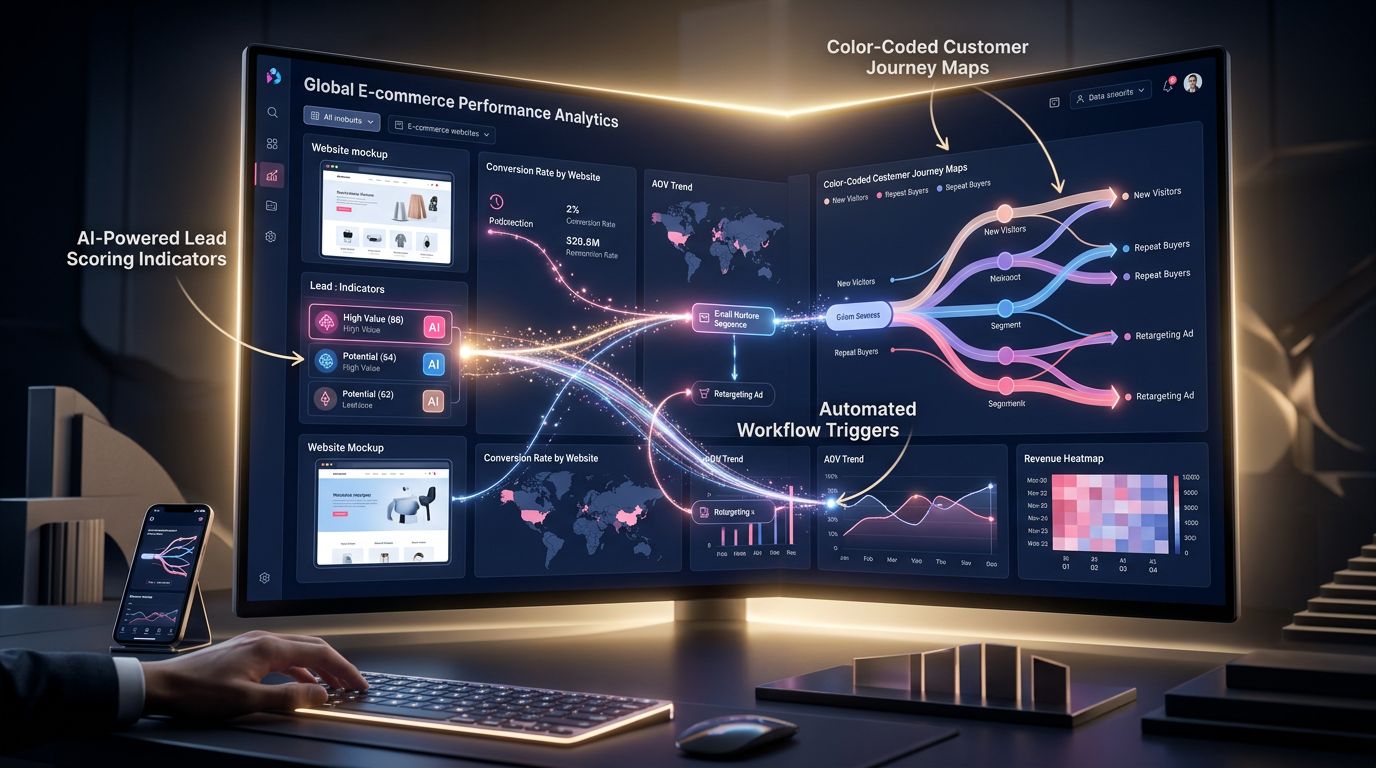
With tools like n8n coupled with a LLM, you can generate personalized message variations by segment automatically, trigger different sequences based on browsing behavior, and adapt promotional hooks based on purchase history.
This isn’t magic. It’s automation in service of proven marketing principles.
Real-time lead scoring and qualification
On a single site, qualifying leads manually is doable. On multiple sites with high volumes, you miss your best prospects because you don’t have time to process every signal.
AI can automatically score your leads based on behavioral criteria: pages visited, time spent, products viewed, interaction history. It can also trigger different actions based on the score — a hot lead receives a personalized commercial proposal within the hour, a cold lead enters a long-term nurturing sequence.
Concrete result: fewer lost leads, better conversion rate, sales team working on real prospects. We addressed this logic from a complementary angle in our analysis of AI in e-commerce and its impact on the seller’s role.
The 3 mistakes that cause AI scalability to fail in e-commerce
What we see in the field when automation projects go off the rails — and they often derail for the same reasons.
Mistake 1: Automating before validating. If your conversion funnel doesn’t work on one site, automating it across three sites will just multiply failure by three. AI doesn’t repair a broken strategy. It amplifies what exists — good and bad.
Mistake 2: Removing the human layer. The obsession with “fully automatic” is a beginner’s mistake. The best performances we observe are on hybrid setups: AI produces, humans validate and orient. Removing human validation from content or commercial communications means losing quality and brand consistency.
Mistake 3: Neglecting cross-site consistency. Managing three e-commerce sites under the same group without message consistency risks cannibalizing yourself. AI can help you maintain this consistency — provided you defined a clear brand architecture from the start. Without it, you’re automating chaos.
What it looks like concretely: a real case
On one of our projects — a structure with two online stores in complementary segments — here’s the workflow we put in place.
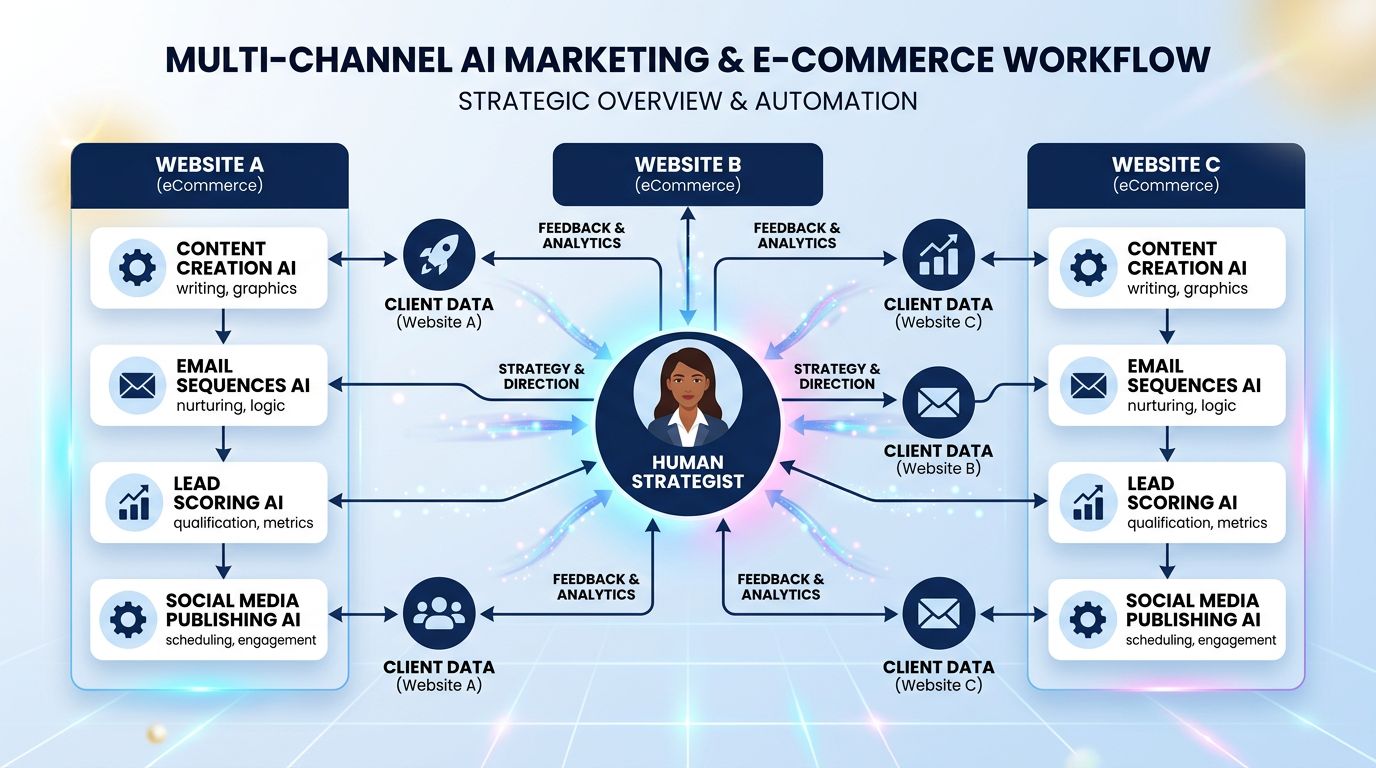
Competitive and semantic intelligence is automated via an n8n pipeline that monitors trends each week and generates prioritized content briefs. SEO writing is AI-assisted with human validation before publication. Post-purchase email sequences are personalized by purchased product category, generated automatically. Cart abandonment scoring triggers differentiated follow-ups based on cart value and customer profile.
Before: one part-time person per store, content published irregularly, cart abandonment follow-up rate under 20%.
After: one part-time person for both stores, content cadence maintained, follow-up rate at 85% with automatic personalization.
This isn’t exceptional. It’s what well-designed industrialization enables.
The tools that actually do the work (without an exhaustive list)
I won’t give you a 40-tool comparison table. What works in our multi-site stack is simple.
n8n for workflow orchestration — open source, self-hostable, powerful. It’s our automation backbone.
A LLM (Claude or GPT-4) connected to content pipelines via API for assisted generation.
A centralized CRM that aggregates data from the different sites to avoid information silos.
And clear human governance: who validates what, at what frequency, with what quality criteria.
Technical sophistication isn’t the objective. The objective is a system that runs with minimal human intervention on repetitive tasks, and maximum human attention on strategic decisions.
“AI does the grind. Humans do the strategy.” That’s the principle guiding all our setups.
What to remember before getting started
Three actionable points if you manage multiple sites or are preparing a multi-store deployment.
Start by auditing before automating. Identify what already converts on your best site. That’s what you’re going to scale — not your weakest processes.
Build your brand architecture first. Voice, positioning, key messages by segment. AI can only maintain consistency if that consistency is defined. It doesn’t invent it.
Measure real impact at 30, 60, 90 days. Not the number of articles published. Not the volume of emails sent. Cost per lead, conversion rate, revenue per site. If the numbers don’t move, the process doesn’t work — no matter how automated it is. This is the guiding thread of our digital marketing services: measurement before the promise.
Conclusion: AI doesn’t replace strategy — it gives it scale
Digital saturation is real. Competition on e-commerce markets is intense. But the companies that will win in the next 3 years aren’t those with the biggest advertising budget.
They’re the ones that will have industrialized the execution of marketing principles that work — relevance, trust, consistency — at a scale their competitors can’t reach by hand.
That’s exactly what we build at GDM-Pixel. Not promises of digital transformation. Documented workflows, measurable results, and systems that run even when you’re not watching.
Managing multiple sites or preparing a multi-store deployment? We can audit your current architecture and show you concretely where automation makes sense — and where it doesn’t. Contact us for an honest diagnosis.
 Social networks
 Analyze with AI