+33-9-7266-3068
 contact@gdm-pixel.fr







 TL;DR - Key Takeaways at a Glance
The AI Shift Is Accelerating — and This Time It Directly Affects You
A customer sends a message at 11pm on your Facebook page. They want to know if you have the product in stock, what the delivery time is, and whether you offer bulk discounts. You’re asleep. So is your competitor. But they’ve activated an AI agent that responds in 30 seconds, qualifies the request, and sends a link to the catalogue.
That’s what Meta is currently rolling out at scale.
In parallel, Google continues advancing with AI Overviews — those AI-generated summaries that answer directly in search results, before the user even clicks on your site. And the UK has just ruled: publishers can ask to be excluded, but no one is obliged to pay them for it.
Two separate news stories. One strong signal.
AI is reshaping both ends of your online presence: how you find your customers, and how you respond to them.
What Meta Is Actually Deploying with Its AI Agents
Meta didn’t announce a gimmick feature. They announced an infrastructure.
The idea: allow businesses to deploy AI agents directly on their Meta channels — WhatsApp, Messenger, Instagram — to handle customer conversations autonomously. Answer frequently asked questions, assist with a purchase, follow up with a prospect, confirm an order.
This isn’t a basic chatbot with decision trees. Meta’s agents are trained to understand context, maintain coherent conversations across multiple exchanges, and integrate with businesses’ product catalogues via Commerce Manager. This is part of a broader logic explored in our analysis of creative and discreet AI tools that are deeply transforming businesses.
For an SME that sells online or receives dozens of messages per week on its social channels, this is a regime change.

Concretely, Meta is targeting three priority use cases:
Automated customer service. Opening hours, product availability, order tracking, return policy — everything that represents 80% of the repetitive questions your team handles manually today.
Catalogue conversion. The agent can present products, address objections, suggest alternatives. Not just inform — sell.
Lead qualification. Before a human sales rep even intervenes, the agent can collect key information, understand the need, and prioritise requests.
What’s notable is the scale. Meta announces 3 billion active users across its platforms. If even 10% of commercial exchanges go through these agents in the next 18 months, we’re talking about an absolutely massive volume of automated transactions.
The Real Question: Does It Work for a Small Business?
Let’s be honest. Major Meta announcements — we take them with a pinch of salt.
But here, the signal is different. Why? Because WhatsApp Business is already used by millions of micro and small businesses across Europe to communicate with their customers. The infrastructure exists. Meta isn’t inventing new behaviour — it’s automating behaviour that’s already in place.
What we concretely see with our clients: many receive more requests via Instagram or WhatsApp than via their contact form. The customer prefers to send a quick message rather than fill out a form. That’s already the reality.
The problem? Those messages wait. Sometimes hours. Sometimes all night. And during that delay, the prospect has gone elsewhere.
An AI agent that responds in 30 seconds at 11pm doesn’t replace your expertise — it simply prevents the customer from leaving before you’ve had the chance to speak with them.
The real limitation, for now: personalisation. A standard Meta agent doesn’t know your way of working, your specific conditions, your tone of voice. It needs to be configured, fed content, and tested. It’s not an “on” button you activate and you’re done.
AI Overviews: Google Harvests Your Content, and the CMA Says “That’s Legal”
On the other end of the spectrum, there’s what’s happening on Google.
AI Overviews — called SGE in the US — are AI-generated answer blocks that appear at the top of search results. Google reads your content, summarises it, and presents it directly to the user. Without necessarily them clicking on your site.
For content publishers and sites that rely on organic traffic, this is a direct threat. You’ve been producing quality content for years. Google uses it to feed its AI responses. And you no longer see the visitors.
The UK’s Competition and Markets Authority (CMA) has just examined the issue. Its conclusion? Publishers can technically request to be excluded from AI Overviews — via robots tags or direct negotiations with Google. But there’s no right to automatic compensation for the use of their content.
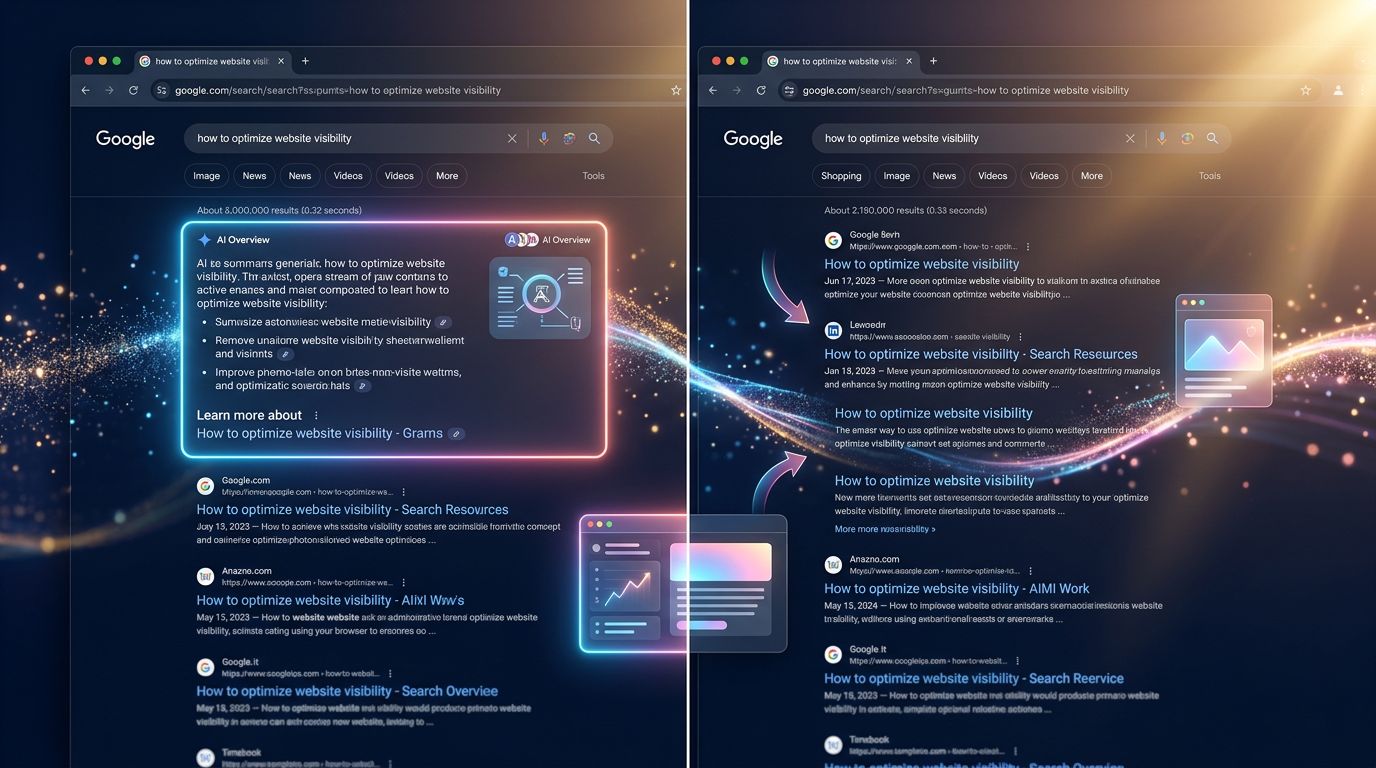
Direct translation for you, as a business owner: if your site generates traffic via blog articles or informational pages, that traffic will decrease on certain queries. Not all of them. Not immediately. But the trend is there.
“AI Overviews answer the question before the user clicks. For simple informational queries, organic traffic can drop by 20 to 60% depending on the sector.” — a trend documented by several independent SEO studies since the US rollout.
What This Concretely Means for Your Content Strategy
The stupid response to this situation: stop producing content because “Google steals it anyway”.
The smart response: understand which types of content withstand AI Overviews, and focus your efforts there.
AI Overviews are effective on generic and informational queries. “How does a mortgage work?”, “What are the opening hours of Caen town hall?”, “Normandy tart recipe.” This type of content — generic, encyclopaedic — is exactly what Google’s AI summarises well.
On the other hand, AI Overviews struggle with several types of content:
Local expertise content. “Best plumber in Bayeux”, “Carpenter specialising in Normandy half-timbering”, “Artisan bakery Caen city centre” — Google can’t summarise who you are, because you’re unique and rooted in a territory.
High-intent transactional content. Someone searching for a service provider for a specific project isn’t satisfied with a generic AI answer. They want to see examples, prices, reviews.
Concrete case studies and real experience content. What you’ve done, how you did it, what it cost, what results it produced. AI cannot invent your results.
Your content strategy needs to pivot towards what AI cannot reproduce: your field experience, your client case studies, your local grounding. For more on the exact mechanics of Google’s editorial choices, see also how Google AI Mode and preferred sources really change your online visibility.
The Connection Between These Two Stories That Nobody Is Making
We’re talking about Meta on one side, Google on the other. On the surface, two separate topics.
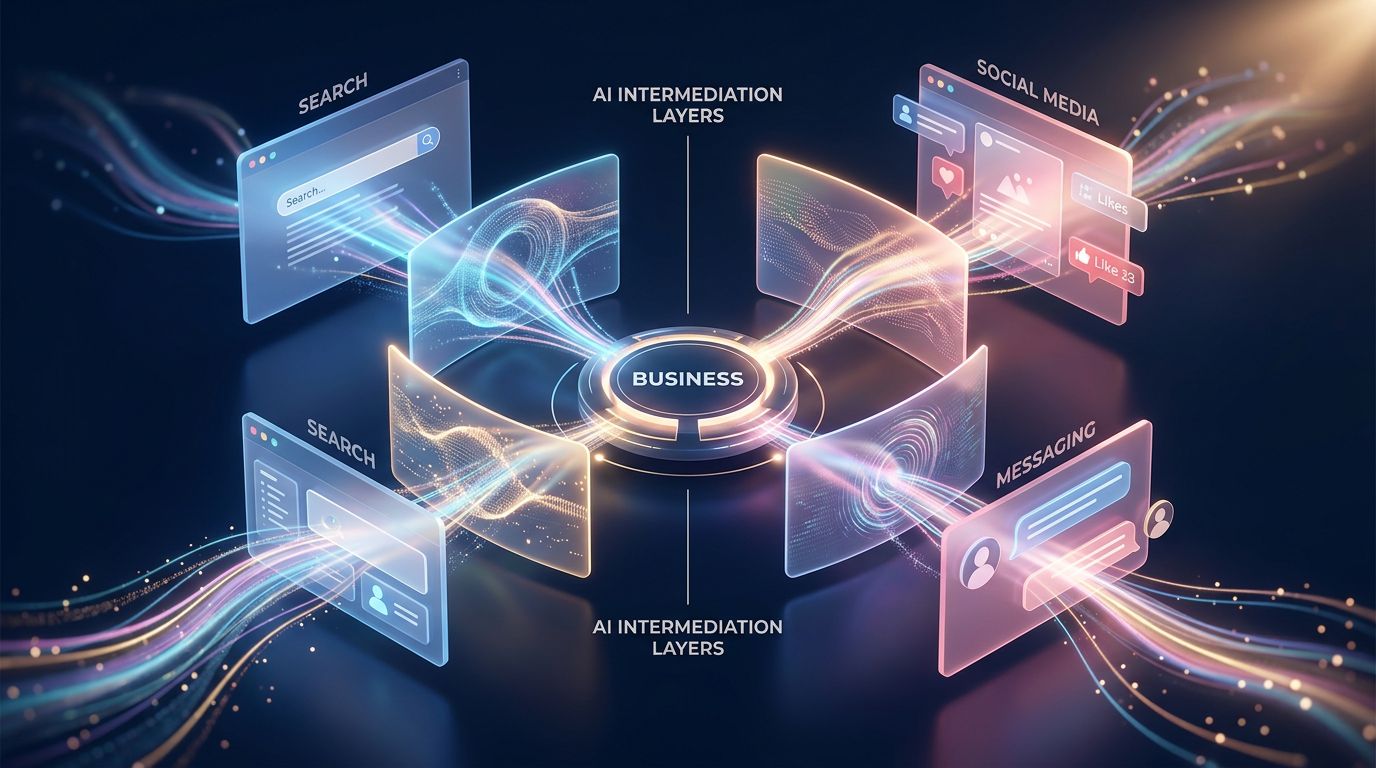
But look at the global movement: the big platforms are placing AI between your business and your customers.
Google puts an AI answer before your site. Meta puts an AI agent before your salesperson. Amazon puts AI recommendations before your product listing.
The result? Your direct visibility decreases. Algorithmic mediation increases.
This isn’t necessarily catastrophic — provided you understand the new rules of the game.
Rule number one: if AI speaks on your behalf, it might as well speak well. A poorly configured AI agent on WhatsApp does more damage than a total absence. Weak content that disappears in AI Overviews wasn’t serving much purpose anyway.
Rule number two: invest in what AI cannot replace. Your local reputation. Your client reviews. Your case studies. Your expertise specific to your trade and your territory.
Three Concrete Actions to Implement Now
No more theory. Here’s what’s actionable this week.
1. Audit your messaging channels. How many messages do you receive per week on WhatsApp Business, Instagram, Messenger? What’s your average response time? If you’re responding in more than 2 hours during the day, you’re losing leads. Set up at minimum first-intent automatic replies while Meta’s agents roll out.
2. Identify your “AI-proof” content. Look at your 10 best articles or content pages. Which ones talk about your field experience, real client cases, your geographic area? Those are the ones to reinforce. For purely informational and generic content — consider consolidating or transforming them into expertise content.
3. Strengthen your presence on the signals AI uses. Google’s AI Overviews rely heavily on sources it considers authoritative. An optimised Google Business Profile, regular client reviews, consistent local mentions — those are the foundations that AI respects.
What All This Means for 2025 and Beyond
AI isn’t going to destroy your online business. But it will reshuffle the cards.
The businesses that will suffer: those that built their visibility on generic content, slow responses, and a digital presence with no real differentiation. AI does exactly what they were doing — better and faster.
The businesses that will benefit: those with genuine expertise, strong local presence, and who know how to use AI tools to respond faster without losing their identity.
“AI doesn’t replace the good ones. It eliminates the mediocre ones faster.” — that’s the brutal reality of the moment.
At GDM-Pixel, we’ve been building our clients with this logic from the start. Fast sites, expertise content, automations that free up time for what matters. This isn’t a reactive strategy to AI — it’s what has always worked, and what AI now makes indispensable. That’s also exactly what our AI agency offers SMEs: deploying useful assistants without breaking what already works.
Your website should work for you, not just exist. If you’re not sure it does, now is the right time to talk.
Get in touch with GDM-Pixel — we’ll look together at what can be optimised, without selling you a redesign if it’s not necessary.
Sources: official Meta for Business announcements, CMA (Competition and Markets Authority UK) report on AI Overviews, Google SGE/AI Overviews deployment data.
 Social networks
 Analyze with AI