+33-9-7266-3068
 contact@gdm-pixel.fr








 TL;DR - Key Takeaways at a Glance
Does your SEO sleep when you go on holiday?
Three weeks in August. Phone on aeroplane mode. And in the meantime, your competitor publishes two articles, updates their Google Business listings, and chips away at the positions you spent six months building.
We see this scenario every September with our clients. SMEs that did great SEO work from April to July, then left everything on hold during the holidays — and who call us in September to understand why their organic traffic dropped by 20 to 30%.
The real question isn’t “how do we catch up?” It’s: how do we never fall behind, even when you’re not there?
This is exactly what I built for GDM-Pixel and our clients: a continuous SEO system that runs without permanent human supervision, but remains steered by a solid human strategy. Here is the real architecture, without the marketing fluff.
Why SEO doesn’t tolerate breaks
Organic search is like a fireplace. You can leave it for a few hours without tending to it — it will keep burning on its momentum. But if you abandon it for a week, you start from scratch with cold embers.
Google crawls your site permanently. Its algorithms measure signals that evolve daily: content freshness, user engagement, inbound link authority, Core Web Vitals. A site that stagnates for three weeks sends an implicit negative signal: “nobody is looking after this.”
What we observe concretely in the audits we carry out: sites that publish regularly — even one article every two weeks — maintain their rankings far better than those that publish in bursts and then disappear. Regularity beats one-off intensity.
Consistency is a SEO ranking factor in its own right.
And this is precisely where automation changes the game. Not to replace strategic thinking — that’s your job, or ours — but to mechanically execute what needs to be executed, 24/7. This is also the entire challenge of the future of SEO with AI: delegate execution to machines to focus human effort on strategy.
Proactive scheduling: the work you do before you leave
Automation doesn’t replace preparation. It amplifies it.
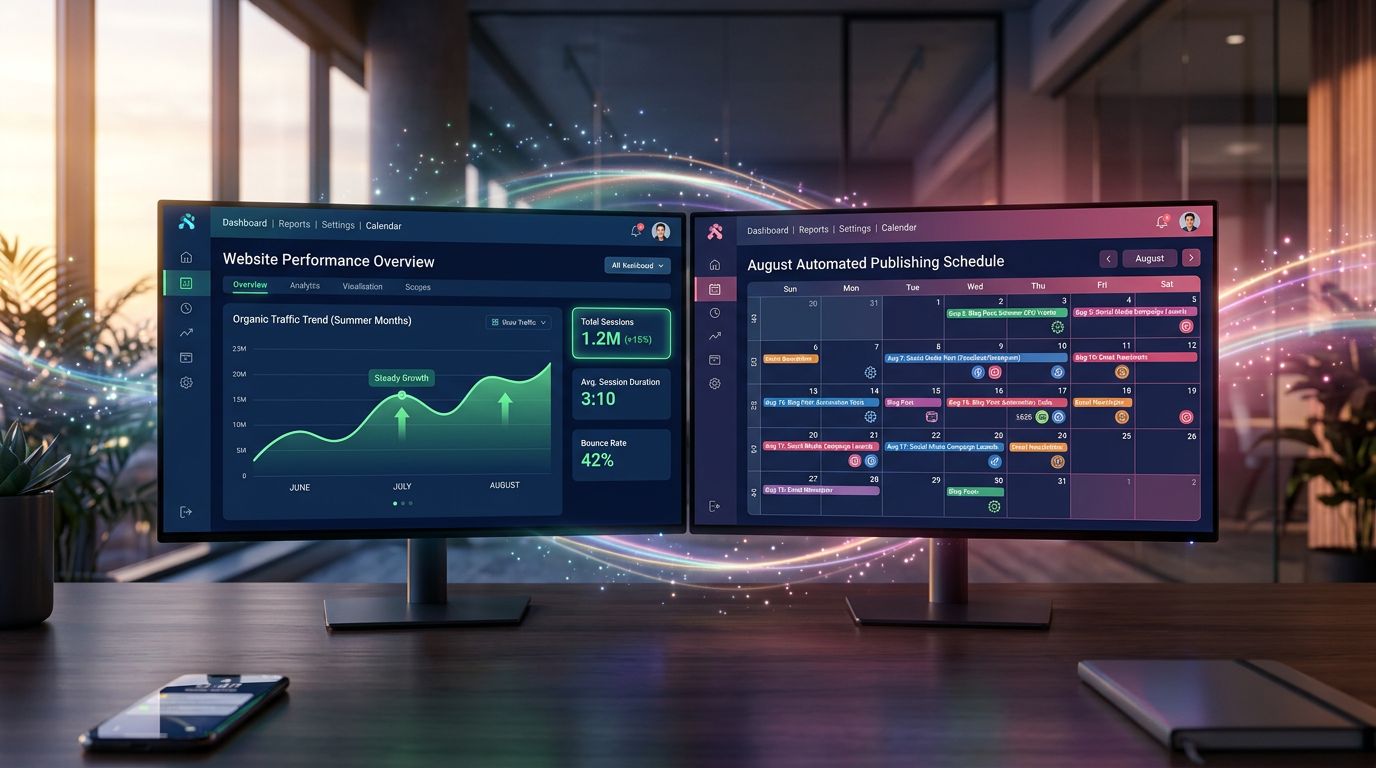
Before each period of absence — whether it’s a week’s holiday or a busy month on a major project — best practice is to prepare a “content stock” ready to be published automatically. At GDM-Pixel, we call this the editorial pipeline.
Building your pipeline before you disconnect
The principle is simple: you write (or have written) three to six weeks of content in advance. Blog articles, product page updates, social media posts linked to SEO content. Everything is scheduled with precise publication dates in your CMS.
On Astro, our main stack, we handle this via Markdown files with a publication date in the frontmatter. The automatic build takes care of the rest. On WordPress or PrestaShop, native scheduling features are more than sufficient.
This isn’t a revolutionary practice. What is revolutionary is associating it with a genuine keyword strategy worked out in advance. Each scheduled article targets a precise search intent, with a structure designed to answer the real questions your potential customers ask on Google.
Elements to prepare before you leave
Your pre-absence checklist to avoid losing ground in SEO:
- Editorial content scheduled for the entire period (minimum 1 article/week)
- Update of title tags and meta descriptions on strategic pages
- Verification of Core Web Vitals and correction of identified technical errors
- Review of Google Business Profile listings (hours, photos, scheduled posts)
- Audit of broken links and missing redirects
Two days of preparation prevents three weeks of catch-up.
Real-time data stacks: your SEO team that never sleeps
Scheduling covers the editorial aspect. But SEO is also about reactivity: a competitor dropping on a strategic position, an emerging query linked to your sector’s news, a Google algorithm update reshuffling the cards.
For this, scheduling alone is not enough. You need systems that monitor, alert, and in some cases act — in real time.
This is what we call a live data stack for SEO.
What an effective SEO monitoring stack watches
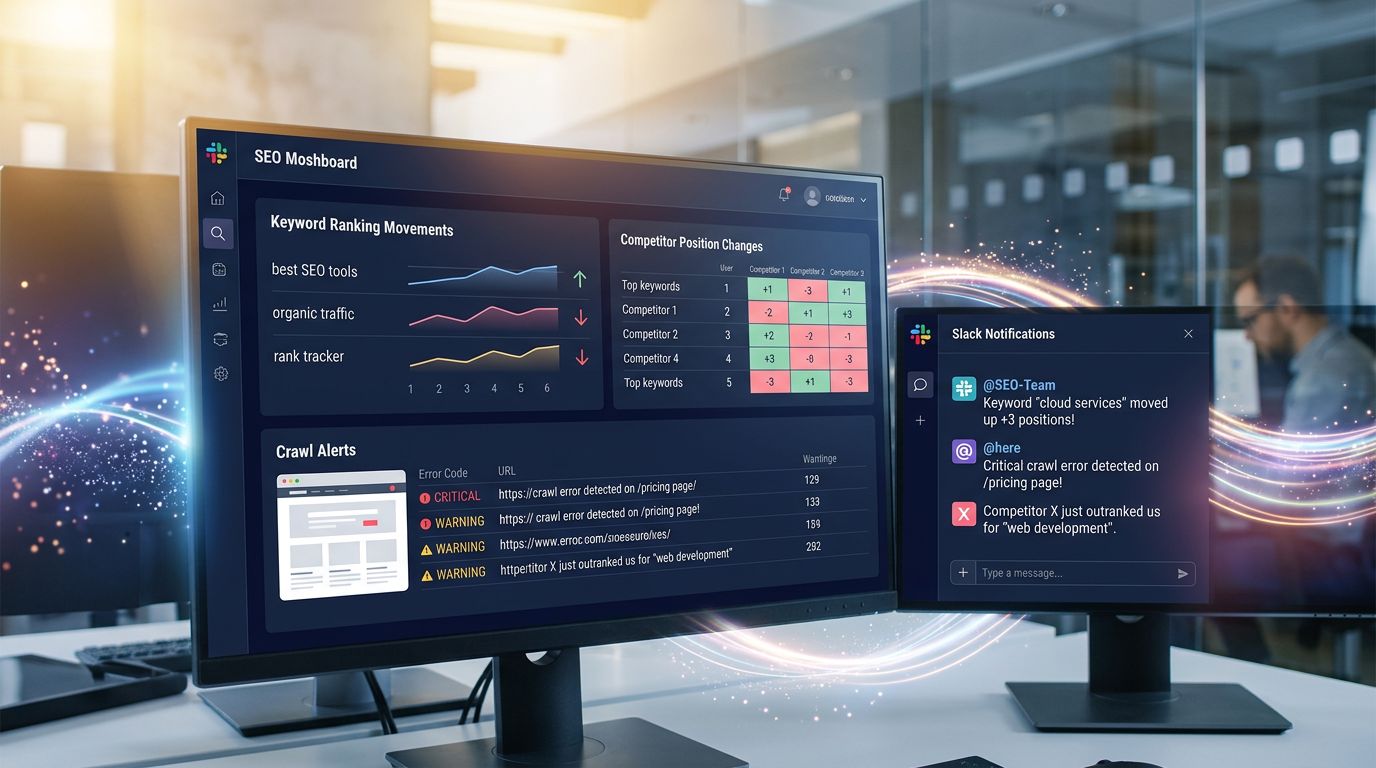
An effective data stack aggregates several sources in real time and surfaces critical information to you without you having to go looking for it:
Ranking variations. Tools like Semrush, Ahrefs or Sistrix can be connected via API to send alerts as soon as one of your strategic pages loses (or gains) more than X positions. You learn immediately what has changed, without logging into the tool every morning.
Technical errors. Google Search Console API + a webhook to your notification tool (Slack, Discord, email) alerts you in real time if Google detects indexing errors, Core Web Vitals issues, or manual penalties. No need to go and check — the information comes to you.
Competitor activity. Automated monitoring scripts can watch the new publications of your main competitors on strategic topics. If your main competitor publishes an article on your target keyword during your holiday, you know it as soon as you return — and you can react quickly.
At GDM-Pixel, we connected these alerts directly to Discord. Result: even when travelling, a glance at my phone gives me the SEO status of all our active projects. Without opening a single dashboard.
“Automated SEO doesn’t replace human judgement — it gives it the right information at the right time.” — A principle we apply to all our client projects.
AI in the loop: faster, more relevant, but not without a pilot
Artificial intelligence has changed the game in SEO content production. I’m not going to sell you a dream: AI alone doesn’t make good SEO. But coupled with a clear human strategy, it multiplies execution capacity by 5 to 10.
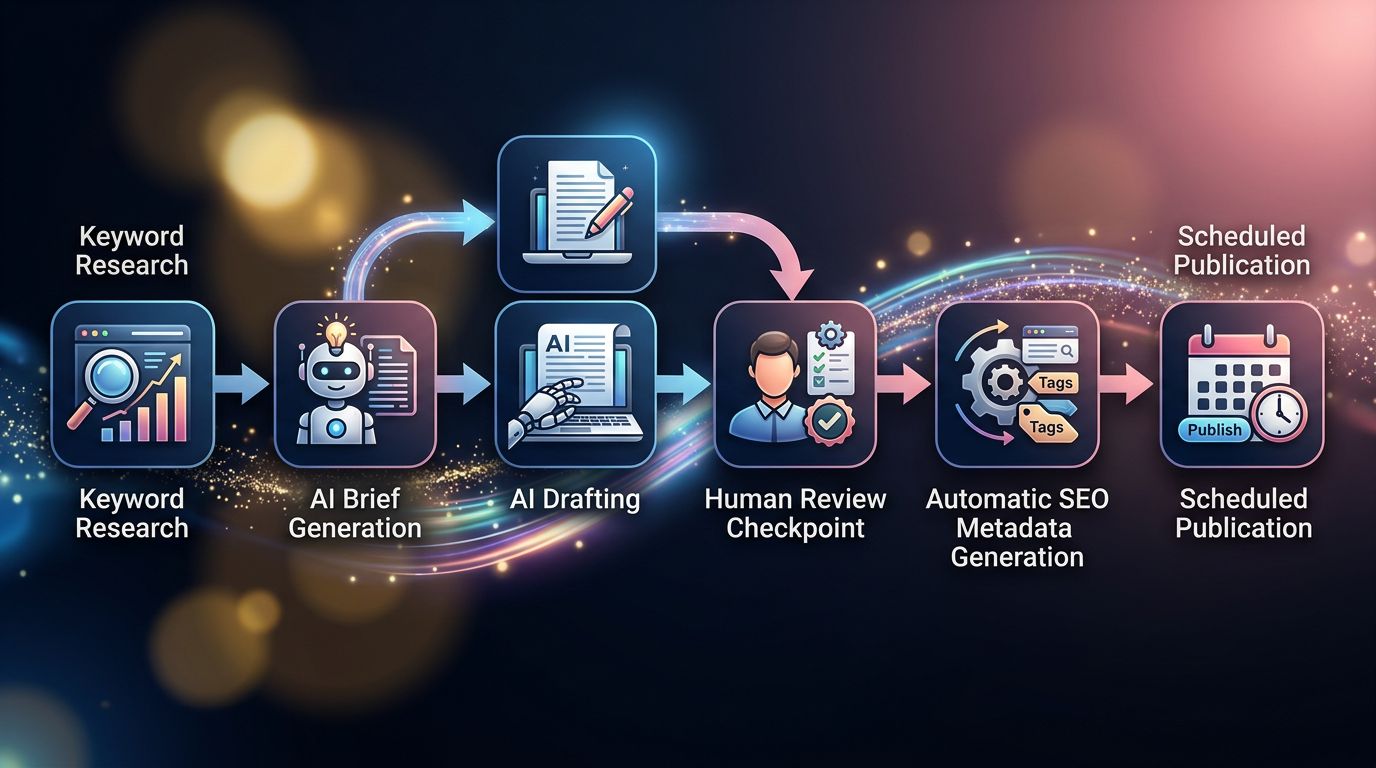
What we do concretely on Nova Mind — our own automated content SaaS — is a complete pipeline: monitoring target topics → generating a structured brief → AI-assisted writing with Claude → human review on strategic articles → automatic publication with SEO metadata. The case of a blog fully automated by an AI agent illustrates well how far this industrialisation can go — and its limits.
The production cost of an optimised article in this pipeline: around €0.12 in AI tokens. Human time: 20 to 30 minutes of supervision and review. Compared to 3 to 4 hours of full manual writing.
This isn’t magic. It’s industrialisation.
What AI handles well (and what it doesn’t)
AI excels at structure, semantic coverage, reformulation, and generating variants. It is effective at producing volume on well-defined topics with a precise brief.
It doesn’t replace sector expertise, real client cases, clear-cut positions, local anchoring. These elements — which are precisely what differentiates high-performing SEO content from generic content — remain human.
The right formula: AI for execution speed, human for strategic relevance.
What this concretely changes for an SME
Concretely, what does this mean for a business without an internal marketing department?
Let’s take a real example: one of our clients, a heating engineer in Calvados, had a showcase website that had produced no content for two years. Good technical foundation to begin with, but zero editorial activity. Result: a ranking that was slowly eroding on their local queries.
We put in place an automated editorial pipeline: two articles per month generated and published automatically, targeting precise local queries (“boiler repair Caen”, “heat pump maintenance Calvados”). Automatic position monitoring with Discord alerts. No intervention required from him.
After six months: +34% organic traffic, three new local queries on the first page of Google, and a measurable increase in incoming quote requests via the site.
He didn’t touch his site. The system worked for him.
According to a HubSpot study, companies that regularly publish content generate 3.5 times more organic traffic than those who publish sporadically. Regularity, not one-off volume.
Three principles for SEO that runs without you
After 15 years of web projects and several years of industrialising our processes with AI, here is what really works:
1. Plan before you disconnect, not after. All content for quiet periods must be ready and scheduled before you leave. One hour of preparation per week of absence avoided.
2. Instrument your site so it talks to you. Search Console API, ranking alerts, Core Web Vitals monitoring — these tools exist, they are often free or low-cost, and they prevent unpleasant back-from-holiday surprises. This is the foundation of our SEO services, where this monitoring is set up from day one.
3. Use AI for execution, keep humans for strategy. AI produces, humans guide. This isn’t a question of trust in technology — it’s a question of efficiency. Every tool in its place.
Your visibility shouldn’t depend on your presence
“Always-on” SEO is no longer a luxury reserved for large companies with dedicated teams. The tools exist. The workflows are documented. AI makes execution accessible.
What is often missing is the initial architecture: someone who connects the right tools, defines the right content strategy, and sets up monitoring adapted to your sector and your geographic area.
This is exactly what we do at GDM-Pixel for SMEs and tradespeople in Normandy — and beyond.
Want to know what this would concretely look like for your site? We start with an honest audit: what works, what’s stuck, and what we can automate without blowing your budget. No vague promises — a factual diagnosis with actionable recommendations.
Contact us for an SEO audit — we’ll tell you what’s blocking, not what you want to hear.
GDM-Pixel — Web agency in Caen. We industrialise what others still do by hand.
 Social networks
 Analyze with AI