+33-9-7266-3068
 contact@gdm-pixel.fr








 TL;DR - Key Takeaways at a Glance
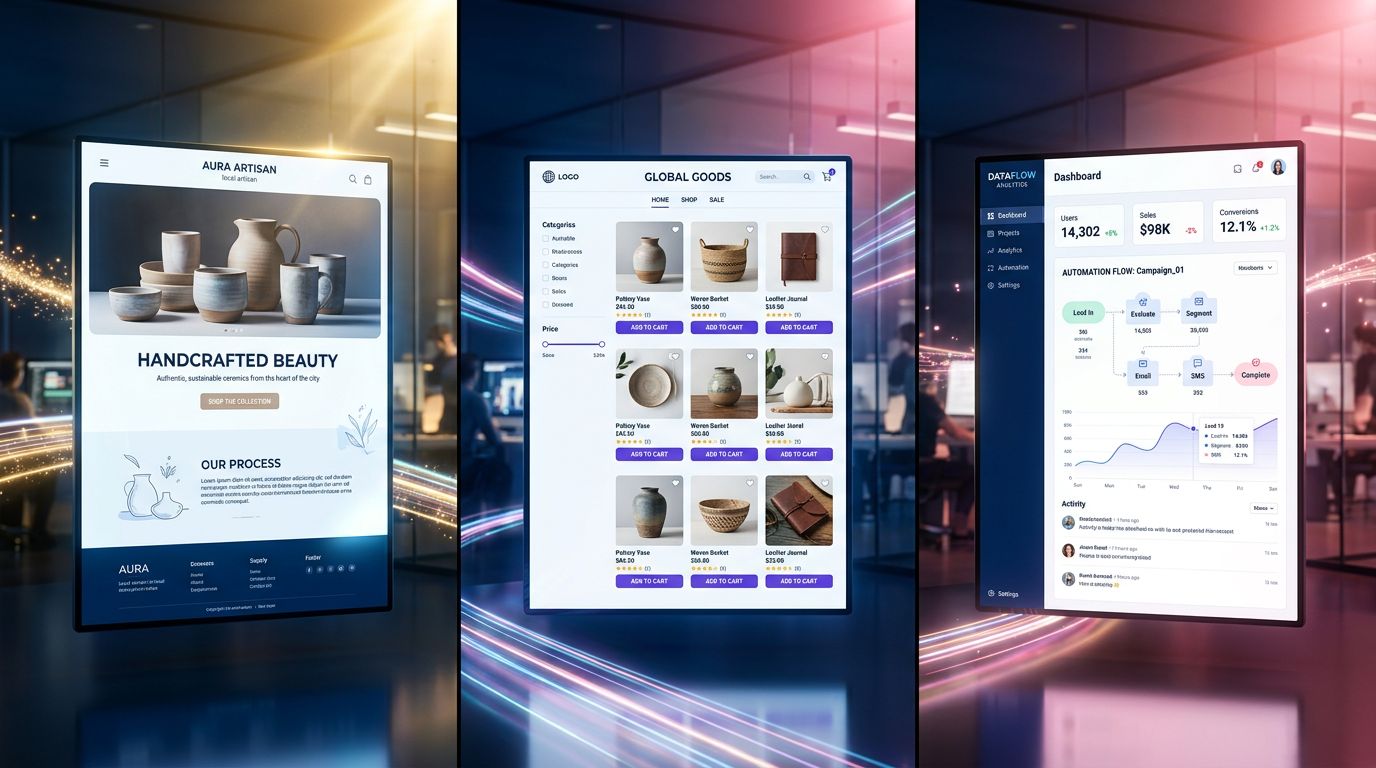
Which type of site for which objective?
A client called us recently. He wanted “a site like Amazon, but for his bakery.” Budget: €2,000. Deadline: two weeks.
This isn’t a joke. It’s our daily reality.
And behind this disconnect lies a real question many business owners can’t quite articulate: which type of site actually matches what I want to achieve?
Because building a site without answering that question first is like ordering a van to go mountain biking. It moves. Just not where you want to go.
Here’s how we approach this choice with our clients, after 15 years of projects in Normandy and beyond.
Showcase site: when presence is enough
The majority of small businesses don’t need a technical monster. They need to be found, to reassure, and to convert a visitor into a phone call or quote request.
A well-built showcase site — 5 to 7 pages, fast, mobile-first, SEO-ready — does that job. Nothing more, nothing less.
What our audits regularly show: small Norman businesses with a clean, well-ranked showcase site that generate more leads than an SME with a €50,000 poorly optimized portal. Technology never compensates for strategy — and our website creation services always start from this scoping logic.
Online store: when the transaction is central
You sell products? The question isn’t “WooCommerce or PrestaShop?” — we’ll get to that. The real question is: does your business model justify the investment in an online store?
A merchant with 30 product references and a loyal local clientele has different needs than a distributor with 8,000 SKUs and ERP integrations. Both may need a store. Just not the same one.
On the e-commerce projects we’ve run, the number one success criterion isn’t the platform chosen. It’s the clarity of the purchase journey and the quality of the product page. The rest is plumbing — important, but secondary.
Business application or SaaS: when the site becomes a tool
This is the third type, often misunderstood. It’s no longer a “site” in the traditional sense — it’s software accessible via a browser. Booking management, customer portal, business dashboard, automated workflow.
Here, the architectural decisions made at the outset will follow you for years. And this is precisely where AI-integrated projects begin to reveal their fragilities.
The invisible technical debt: the real risk of AI projects
Here’s where it gets interesting — and where few agencies speak frankly.
For 18 months, we’ve been integrating AI into our own production tools (Nova Mind, our automated content pipeline) and into some clients’ projects. And we learned a hard lesson: AI doesn’t just create value. It also creates invisible technical debt.
What does this mean concretely?
When you integrate a language model or an AI component into your architecture, you introduce a dependency that behaves differently from classic dependencies. A database — you know what it does. An API call to an AI model? The behavior can change depending on the model version, the context of the request, the provider’s load, the provider’s unilateral updates.
This isn’t a reason not to integrate AI. It’s a reason to do it methodically.
Where AI-related architectural debts hide
First trap: tight coupling with a single provider.
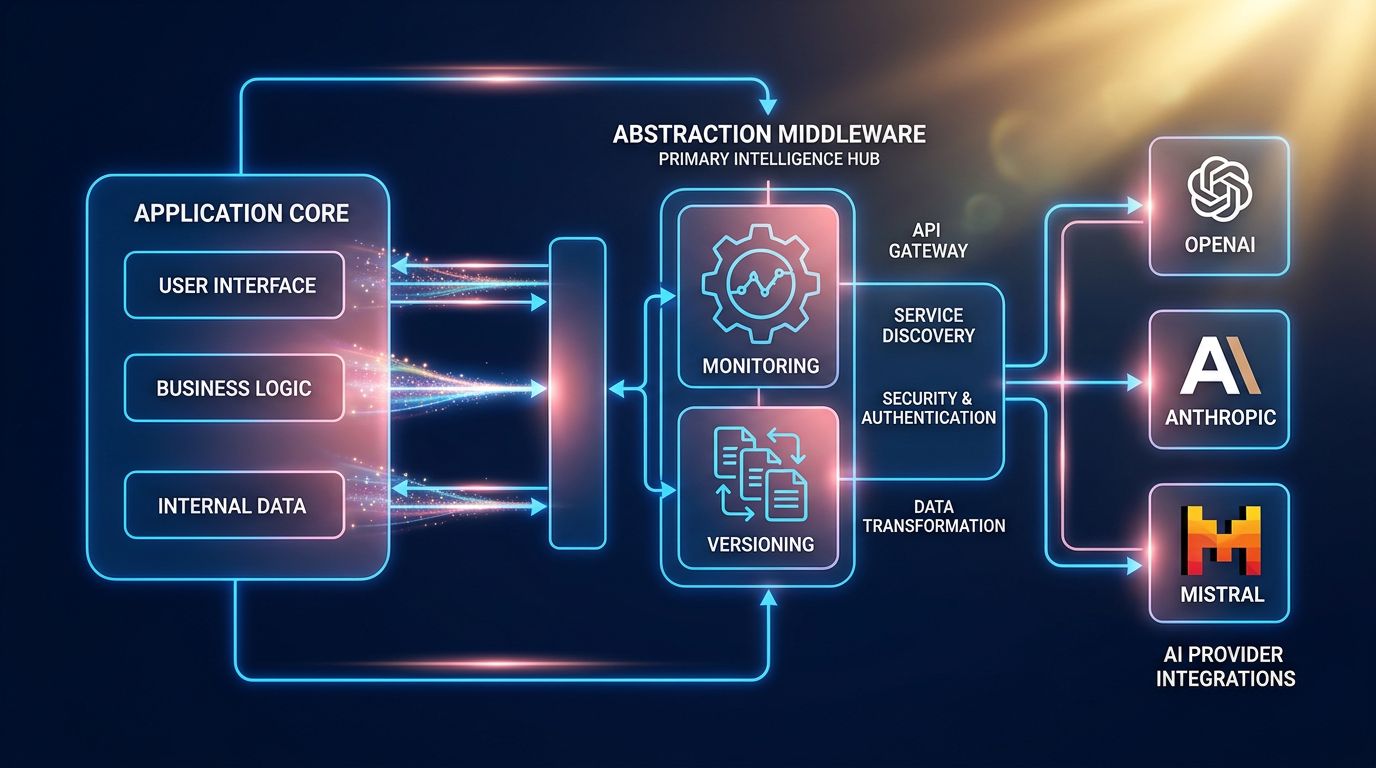
We see entire projects built on the assumption that the OpenAI API will always be available, always at the same price, with the same interface. That’s a time bomb. If you’ve directly wired your GPT-4 calls into your business logic without an abstraction layer, a pricing or model change may require a partial redesign.
Best practice: an abstraction layer between your code and the AI provider. You change models? You modify a configuration file, not 40 functions.
Second trap: unversioned prompts.
Your prompts are code. If you store them in a graphical interface, in a Google Doc, or worse — in the head of the developer who built the project — you have a serious maintainability problem.
On Nova Mind, all our prompts are versioned in Git, with regression tests on critical outputs. When we modify an article generation prompt, we know exactly what changed and why.
Third trap: no monitoring of AI outputs.
A classic bug, you see it: the application crashes, logs go haywire, the error is visible. An AI bug is different. The application runs. Responses arrive. But their quality progressively degrades, or they become inconsistent on certain edge cases.
Without specific monitoring of AI outputs, you won’t know until your users complain. This is also why we advocate for a local-first architecture centered on human UX: fewer opaque dependencies, more control over what the user sees.
Building to last: the principles that hold
After 15 years of building sites “by hand” and now industrializing with AI, here’s what hasn’t changed: the good architectural fundamentals remain the same, whether there’s AI or not.
What changes is their relative importance.
Separation of concerns
In any digital project — showcase, e-commerce, or AI application — the basic rule holds: each component must have a single, clearly defined responsibility.
Your AI content generation component shouldn’t also manage caching, authentication, and email sending. If it does, you have a design problem that AI will amplify, not solve.
What we concretely observe with clients who integrated AI tools urgently, without prior architecture: systems that work in demo, and collapse at the first load spike or provider change.
Reversibility of technical decisions
“Good architectural decisions are those you can undo without rebuilding everything.”
That’s the principle we systematically apply to our projects. Before choosing a technology or provider, we ask: if we need to exit in 18 months, how much will it cost?
For AI, this means: don’t write business logic into your prompts. Don’t store critical state exclusively in an AI system. Don’t build workflows that can only function with a specific model.
Observability from day one
On non-AI projects, observability (logs, metrics, alerts) is often added after the fact. That’s already bad practice. With AI, it’s professional malpractice.
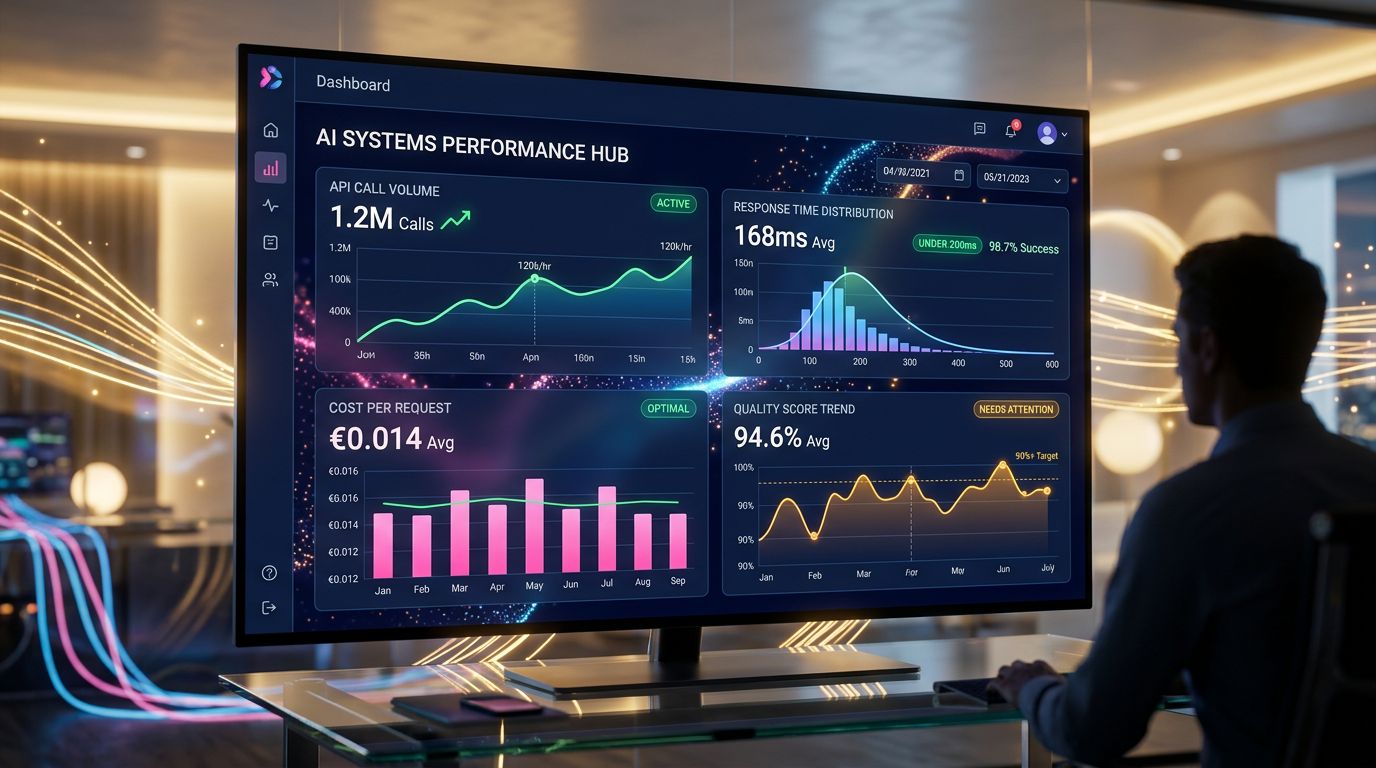
You need to know, in real time: how many AI calls you’re making, at what cost, with what success rate, with what latency. And when an AI output is used to make a business decision, you must be able to trace it.
On Nova Mind, we monitor every article generation: model used, tokens consumed, response time, estimated quality score. Not for the love of numbers — to detect drifts before they become problems.
The 3 questions to ask before launching your digital project
Whether you’re building a showcase site or a complex AI application, these three questions must have clear answers before writing the first line of code — or signing the first quote.
1. What is the measurable result expected in 6 months?
Not “have a nice site.” Not “be present online.” A concrete result: X leads per month, Y% cart conversion, Z hours saved on a business process. If you can’t answer this question, the project isn’t ready.
2. What are the critical dependencies in your architecture?
For each technology component: what happens if it disappears or changes its pricing in 12 months? This question is uncomfortable. It’s essential. We learned this the hard way on a project where an automation tool changed its pricing terms overnight — and our client was entirely dependent on that tool.
3. How will you maintain and evolve this system?
A delivered site is not a finished site. It’s a living system that will require updates, corrections, and evolutions. Who handles it? With what budget? According to what process? Projects that fail long-term are generally not badly built — they’re badly maintained.
What this means concretely for your project
According to a McKinsey study on digital transformation projects, more than 70% of projects don’t meet their initial objectives. This isn’t a matter of budget or technology. It’s a matter of method and clarity of objectives.
In Normandy and across France, SMEs that succeed in their digital projects share one thing: they took time to scope before building. Not for months — a few days suffice. But that scoping exists, and it’s as valuable for a showcase site as for a project that anticipates the upheavals ahead with AI.
If I were in your position, here’s what I’d do before starting any project:
- Define the type of site suited to your real objective (not your initial idea)
- Identify the 3 main architectural risks, especially if you’re integrating AI
- Set a method for measuring results from day one
It’s not glamorous. It’s not viral. But it’s what makes the difference between a project that delivers value and one you rebuild in 18 months.
Building fast and building well: the two aren’t opposed
We deliver sites in 3 to 7 days with our industrialized workflow. Some clients think speed = sacrifice on quality or architectural rigor.
It’s the opposite.
We’re fast because the structural decisions are made upfront. Because our stack is proven. Because we don’t reinvent the plumbing on every project.
And on AI-integrated projects, we take the extra time needed to set up the right abstraction layers, version prompts, and put monitoring in place. Not out of perfectionism — out of pragmatism. Because the cost of poorly managed technical debt on an AI system far exceeds the few hours invested from the start.
Your digital project deserves to be built to last, not just to be delivered.
If you want us to audit your current architecture, or scope your next project together — showcase site, e-commerce, or AI application — contact GDM-Pixel. We’ll tell you what works, what doesn’t, and what we’d do in your place. No bullshit.
 Social networks
 Analyze with AI