+33-9-7266-3068
 contact@gdm-pixel.fr








 TL;DR - Key Takeaways at a Glance
When the social giant turns into an infrastructure provider
One of our clients called us last week with a simple question: “Am I about to pay to use the AI in my Meta glasses?” Short answer: yes, probably. Long answer: it’s a lot more interesting than that.
Meta is executing a two-speed strategy that will reshape the economics of AI — not just for tech giants, but for every business that depends on this infrastructure. Web agencies like ours included, and the growing number of small businesses weaving AI into their daily operations.
Here’s what’s actually happening, without the marketing gloss.
The end of free AI: Meta starts charging for advanced features
For years, Meta gave AI away by the truckload. Llama open-sourced, Meta AI baked into WhatsApp, Instagram, Facebook — all free. The logic was clear: acquire users, collect data, dominate the attention market.
That model is shifting.
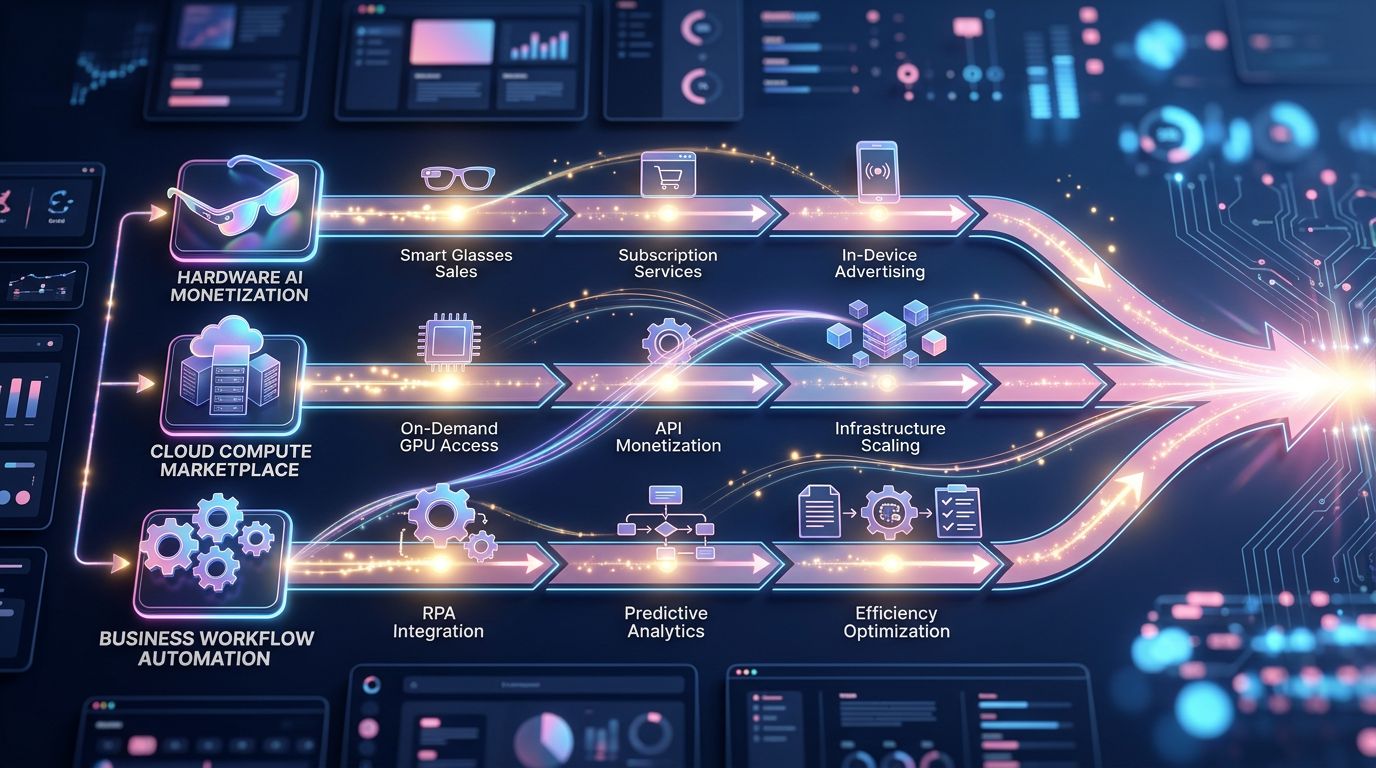
Meta is now signalling its intent to charge for advanced AI features on its consumer hardware, starting with Ray-Ban Meta smart glasses. In practice, certain AI capabilities — advanced visual recognition, real-time assistance, multimodal processing — could move behind a paywall.
That’s not a small detail. It’s an implicit admission that AI is expensive to run, and that advertising alone no longer covers the infrastructure bill.
“Generative AI costs roughly 10 times more to run per query than a standard Google search.” — a widely documented estimate across the tech industry.
For everyday users, that sounds like bad news. To understand the real strategy, you need to look at the other side of the ledger.

The cloud market nobody expected from Meta
Here’s where it gets genuinely interesting.
Credible reports suggest Meta is considering selling its excess compute capacity on the open cloud market. In other words, Meta could become a direct competitor to AWS, Google Cloud, and Azure — not by building a general-purpose cloud offering, but by monetizing what it already owns: thousands of Nvidia H100 GPUs, data centers built for AI training and inference.
The logic is blunt: Meta has poured tens of billions into AI infrastructure. That infrastructure runs at full tilt for its own needs — but not 100% of the time. Spare capacity is money sitting idle.
Why not sell it?
That’s exactly what Amazon did in 2006 with the internal servers behind Amazon.com — and it produced AWS, now a $90 billion-a-year cash machine. Meta is running the same playbook, 20 years late but with first-tier AI infrastructure behind it.
What this actually changes for the market: one more major player with massive capacity, pushing AI compute prices down. The commoditization of AI infrastructure just picked up speed.
What this means for businesses using AI
Back to earth. How does this Meta maneuver actually affect you, running a small business or managing digital for a mid-sized company?
First, API costs will keep falling. If Meta enters the cloud compute market, competition among providers intensifies. OpenAI, Anthropic, Google — all will need to adjust. For companies paying for AI subscriptions or API calls, that’s structurally good news.
Second, AI embedded in hardware will become the norm. Meta’s glasses are a niche product today. In three years, they’ll be standard. AI that recognizes what you’re looking at and feeds you real-time context is going to reshape entire job categories. Maintenance technicians, field sales reps, tradespeople — the use cases are concrete, not theoretical.
Third, the question of AI business models now applies to everyone. Meta is proving that “free forever” isn’t viable. If you’re building an AI-driven offering — a SaaS product, automated customer service, an internal tool — pricing becomes a central question far earlier than expected.
On projects we’ve run at GDM-Pixel, we already see this tension: clients want AI in their tools, but consistently underestimate the infrastructure cost at scale. Meta’s announcement is going to force some healthy conversations on that front.

AI commoditization: good news or bad news?
Everyone says AI is going to revolutionize everything. What if the real revolution is it becoming ordinary?
The commoditization of AI infrastructure is following the exact same path as web hosting in the 2000s or cloud storage in the 2010s. At first, it’s expensive, technical, reserved for large enterprises. Then massive players industrialize it, prices collapse, and it becomes a commodity available to everyone.
Meta selling compute is a strong signal: we’re moving from the “AI is rare and expensive” phase to the “AI is baseline infrastructure” phase.
What that actually means in practice:
The competitive edge will no longer be “I have access to AI.” It will be “I use AI better than my competitors.” The gap between a business that automates its processes intelligently and one that just uses ChatGPT to draft emails is going to widen, not shrink.
“Value will no longer sit in access to AI, but in the ability to embed it into workflows that create a real advantage.”
That’s exactly why we built Nova Mind at GDM-Pixel: not to “have AI,” but to have AI workflows that produce measurable results. 21 pages delivered in 10 hours on a recent project. That’s useful AI.
Meta’s model vs. OpenAI’s model: two visions of the market
To understand what’s at stake, it helps to compare the approaches.
OpenAI bets on API access and direct subscriptions. Recurring revenue, a classic SaaS model, but total dependence on Microsoft for infrastructure. When Microsoft sneezes, OpenAI catches a cold.
Google embeds AI across all its existing products — Search, Workspace, Cloud. AI becomes a retention lever on products that are already monetized. A coherent model, but one that depends on holding its dominant position in Search.
Meta is playing a different hand. Open-sourcing Llama let it build an ecosystem and technical credibility without locking itself in. Now it’s monetizing on two fronts at once: consumer hardware (glasses, headsets) and, potentially, cloud infrastructure. It’s an aggressive diversification that reduces its dependence on advertising alone.
What this says about where the market is headed: AI is becoming an infrastructure layer, much like the internet or electricity. And as with those earlier shifts, the companies that win are the ones building on top of that infrastructure — not the ones passively consuming it.
Three takeaways for your digital strategy
After 15 years building web projects and watching technology cycles play out, here’s what I’m actually taking from this Meta news:
1. Plan for the end of “everything free” in your AI tools. If your current workflow relies on free AI features — whether from Meta, Google, or elsewhere — budget for their future monetization. It’s not a question of if, but when. Add an “AI costs” line to your 2025-2026 projections.
2. Integration matters more than access. Compute commoditization means everyone will have access to comparable AI models at comparable prices. The advantage will sit in how you use it: business automation, custom workflows, integration into your existing tools. If you haven’t started thinking about this, now is the time.
3. Watch Meta’s cloud offering closely. If it materializes, it could become a serious alternative to the dominant US cloud providers for hosting AI workloads. On data sovereignty and cost, it’s worth active monitoring — especially for companies bound by strict data protection requirements looking for compliant options.
What this changes for us, as a web agency
My advice for a small business on a tight budget: don’t let these shifts paralyze you. AI infrastructure that cost €50,000 a month to run two years ago costs €5,000 today. In two more years, it’ll cost even less.
What matters now is building internal AI fluency — not waiting for the “right moment” or the “right tool.” Businesses experimenting today, even imperfectly, will have a structural head start over those waiting for the market to settle.
At GDM-Pixel, we made that bet two years ago. We industrialized our production with Claude Code, MCP servers, and n8n workflows. Result: we ship five times faster than the competition for the same client budget. AI commoditization doesn’t scare us — it hands us ever-better tools at an ever-lower cost.
The real question isn’t “will Meta charge for its AI glasses?” It’s: is your business building durable AI capability, or just consuming tools without ever truly integrating them?
Want to understand how to actually integrate AI into your business workflows? We do this every day at GDM-Pixel — for our own projects and for our clients. Get in touch with us for an honest assessment of what can be automated in your business. No magic promises: just a grounded analysis of what would save you time and money, starting now.
 Social networks
 Analyze with AI