+33-9-7266-3068
 contact@gdm-pixel.fr







 TL;DR - Key Takeaways at a Glance
What humanoid robots reveal about our digital interfaces
A humanoid robot serves coffee in a hotel in Tokyo. Another assembles parts on a production line in Detroit. And meanwhile, your website still displays a contact form with 12 mandatory fields.
The connection between the two? User experience. Or rather, its absence.
The rise of humanoid robots — Tesla Optimus, Figure 01, Boston Dynamics Atlas — is not just about industry or logistics. It reveals a truth that web design has been avoiding for 20 years: humans interact better with what resembles them, anticipates their needs, and doesn’t force them to adapt to the machine.
Robotics engineers grasped this principle from the outset. Web designers, far less so.
Why the humanoid form is no accident
Manufacturers could have designed purely utilitarian robots. Robotic arms. Autonomous carts. They did — and it works very well in certain contexts.
But for interacting with humans in environments designed for humans (stairs, doors, counters, tools), the humanoid form emerges as the most pragmatic solution. Not for aesthetics. For operational efficiency.
According to a study by the University of California San Diego, humans place greater trust in and cooperate more naturally with interfaces that replicate human behaviours: gaze, natural language, predictable gestures.
This is not fuzzy psychology. It is user-centred design pushed to its logical extreme.
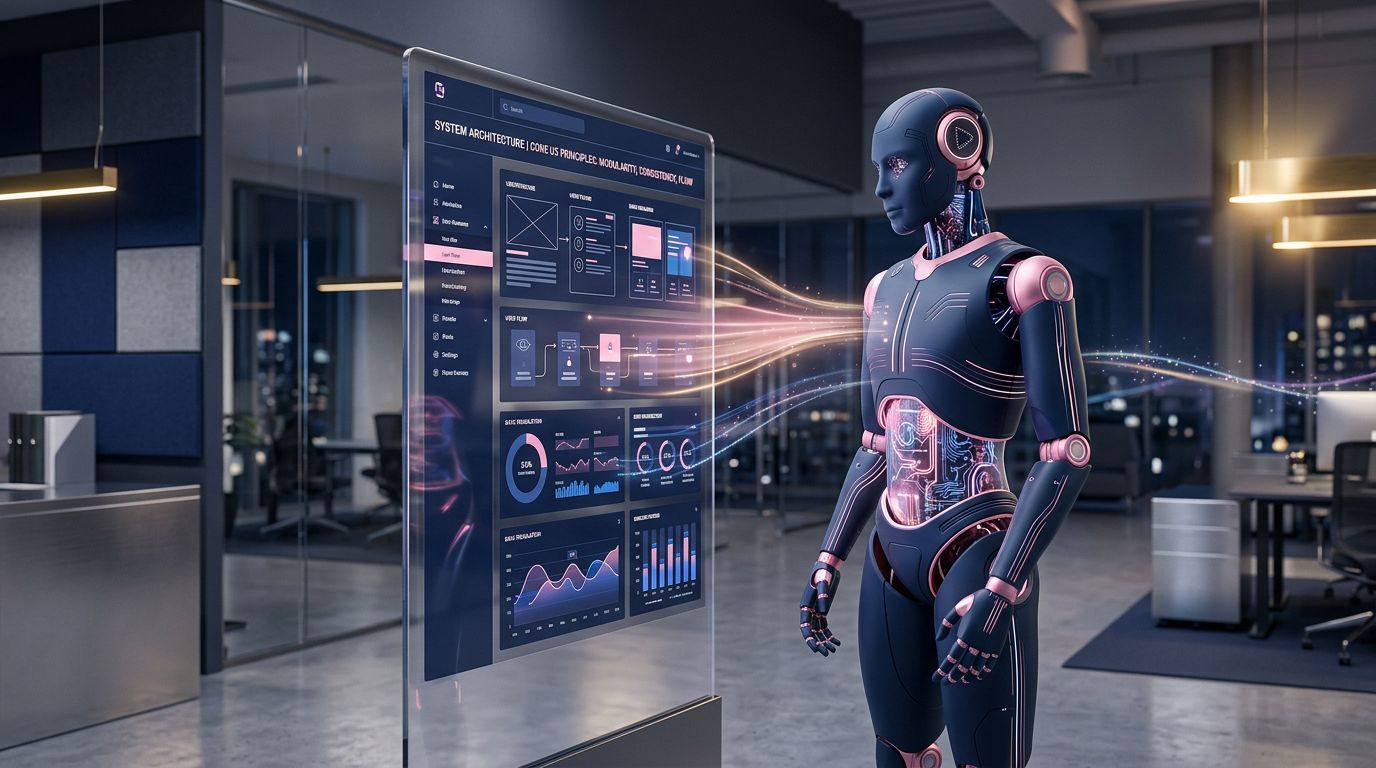
The lesson for the web is direct: if your users have to learn how to use your website, you have failed before they even read your offer. This is often the real reason a website generates no clients at all.
The impact of humanoid robots on UX expectations
Here is what will concretely happen in the coming years. Not vague speculation — already measurable trends.
Users who interact daily with voice assistants, advanced chatbots and physical robots are developing new cognitive expectations. They are getting used to interfaces that understand intent, not just commands.
You type “I want to go on a cheap holiday in August” and the AI understands. You land on a travel site with 47 filters to tick, and you close the tab in 8 seconds.
The gap between conversational AI experience and classic web experience will become unbearable. Quickly.
A few figures to frame it: according to the Baymard Institute 2024 report, 69.8% of e-commerce carts are abandoned — and interface complexity remains the most-cited cause. Meanwhile, conversational interfaces show task completion rates 40% higher on guided purchase journeys.
The humanoid robot does not replace the human — it forces the human to rethink interaction. The web will face the same pressure.
What robotics engineers understood that web designers still ignore
Friction is the enemy, not empty space
A good humanoid robot does not ask the user to explain what they want. It observes, infers, suggests. It reduces cognitive load.
On the web, we do the opposite. We stack options. We multiply menus. We hide key information behind three clicks.
What we see concretely with our clients: the pages that convert best are almost always the most stripped-back. Not the most “rich”. The most direct.
Anticipation beats reaction
Modern humanoid robots use predictive models to anticipate human movement. They do not react — they prepare the response before the request is even made.
In web design, this is known as anticipatory design: displaying delivery costs before the user looks for them, pre-filling forms, suggesting the logical next step without the user having to find it.
Amazon has been doing this since 2005. Most SMEs have not.

Trust is built visually
A robot with jerky, unpredictable movements, or one that “lies” about its intentions (gaze not matching action) generates distrust. Researchers call this the Uncanny Valley effect.
On the web, the equivalent is: an amateurish design on a site promising premium quality. A “Contact us” button that leads to a broken form. A 48-hour delivery promise on the homepage and terms and conditions that say 15 days.
Visual and functional consistency is not a matter of aesthetics. It is a matter of trust.
Three concrete implications for your online presence
Let us move beyond theory. Here is what the humanoid robot age demands of your website, right now.
1. Simplify your contact interface
If your contact form asks for more than 4 pieces of information, you are losing leads. Name, email, message. That is all. You recover the rest during the exchange. A humanoid robot does not open a conversation by asking for your VAT registration number. This is exactly the type of friction that undermines your conversion funnel and drives visitors away without ever contacting you.
2. Integrate a conversational touchpoint
Chatbot, AI assistant, or simply a well-configured WhatsApp Business widget. Users accustomed to intelligent interfaces no longer want to wait 48 hours for an email reply. They want an immediate response, even a partial one. On projects we have delivered with this type of integration, the contact rate increases on average by 30 to 45%.
3. Rethink your information hierarchy
Your user does not read your site — they scan it. Like a robot identifying areas of interest before acting. Your value proposition must be visible in under 3 seconds, without scrolling. If that is not the case, your homepage is working against you.
The challenge for SMEs: not missing the train
Across France, small and medium-sized businesses often have websites built 8 to 12 years ago. Sites that survived several design trends but have not evolved on the essential point: user experience in the age of artificial intelligence.
Competition no longer comes solely from the agency next door. It comes from platforms that natively integrate AI into the customer journey. Marketplaces. Vertical SaaS. Pure players who have invested millions in UX.
Your 2015 showcase website was not built for this context.
The good news: you do not need to rebuild everything. In most cases, a 2-to-3-day audit identifies the 3 or 4 friction points that cost the most leads. We do not sell a full rebuild when a targeted fix is enough — that has been our positioning from the start.

But action is needed before the gap becomes too wide to bridge.
What this changes for agency web design
At GDM-Pixel, we anticipated this evolution two years ago. Our stack (Astro + Tailwind + Claude Code) allows us to deliver modern, fast, conversion-focused interfaces in 3 to 7 days as part of our website creation services. Not because we cut corners — because we have industrialised best practices.
The AI we use in production every day has also taught us something essential: the quality of an interface is measured by the clarity of its intent, not the richness of its animations.
The most effective humanoid robots are not the most spectacular. They are the most predictable, the most reliable, the most useful in their context of use.
That is exactly what a good website looks like in 2025.
Key takeaways: three actionable points
Before you close this article, here is what truly matters:
Simplify before you add. Every element on your site that does not help the user take action costs them attention. And attention is the scarcest resource in 2025.
AI changes expectations, not just tools. Your visitors are already interacting with intelligent interfaces. Your website must align with that level of demand, not ignore it.
Consistency is your first sales argument. A professional design, promises kept, smooth journeys — that is what builds trust. Before price. Before content. Before everything.
Next step: audit your interface
Is your website generating as many contacts as it should? How much does each visitor who leaves without providing their details cost you?
At GDM-Pixel, we conduct honest UX and technical audits. We identify what is blocking conversion, propose concrete solutions with clear pricing. And if your site does not need a full rebuild, we will tell you.
Contact us for a diagnostic — 30 minutes of discussion is enough to get a first read on your situation.
Humanoid robots are learning to interact with the human world. Your website, in turn, must learn to interact with the humans of today. That is not the same thing as those of 2015.
Sources: Baymard Institute, E-commerce Checkout Usability 2024 — UC San Diego Human-Robot Interaction Lab — Goldman Sachs Research, The Rise of Humanoid Robots 2024
 Social networks
 Analyze with AI