+33-9-7266-3068
 contact@gdm-pixel.fr







 TL;DR - Key Takeaways at a Glance
The web is changing its rules. Again.
You spent years understanding how Google works. You invested in SEO, built backlinks, optimised your meta tags. And now, a new platform is joining the conversation — literally.
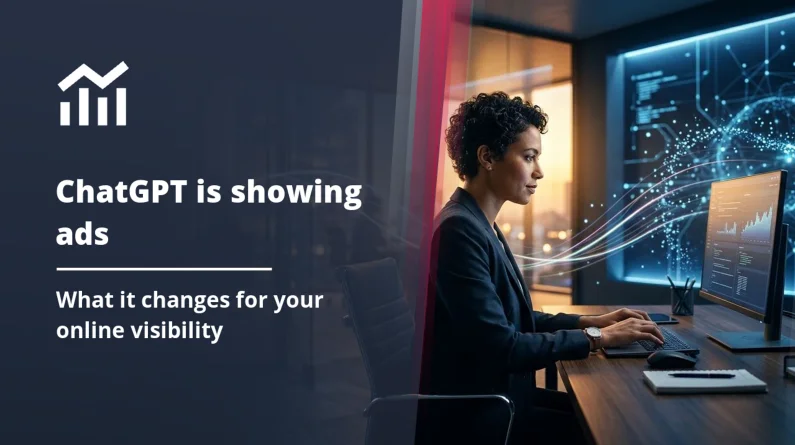
ChatGPT has just opened its advertising to all advertisers. Meanwhile, a deeper question is emerging: if your website ranks well on Google but AI never cites you, are you truly visible?
This isn’t a rhetorical question. It’s the new puzzle for SME owners who want customers, not theories.
ChatGPT goes into advertising mode: what’s actually happening
OpenAI has confirmed the rollout of ads in ChatGPT. Not as a quiet experiment — as a full opening to all advertisers. This move was predictable: the platform has several hundred million active users, and monetising that audience was a matter of when, not if.
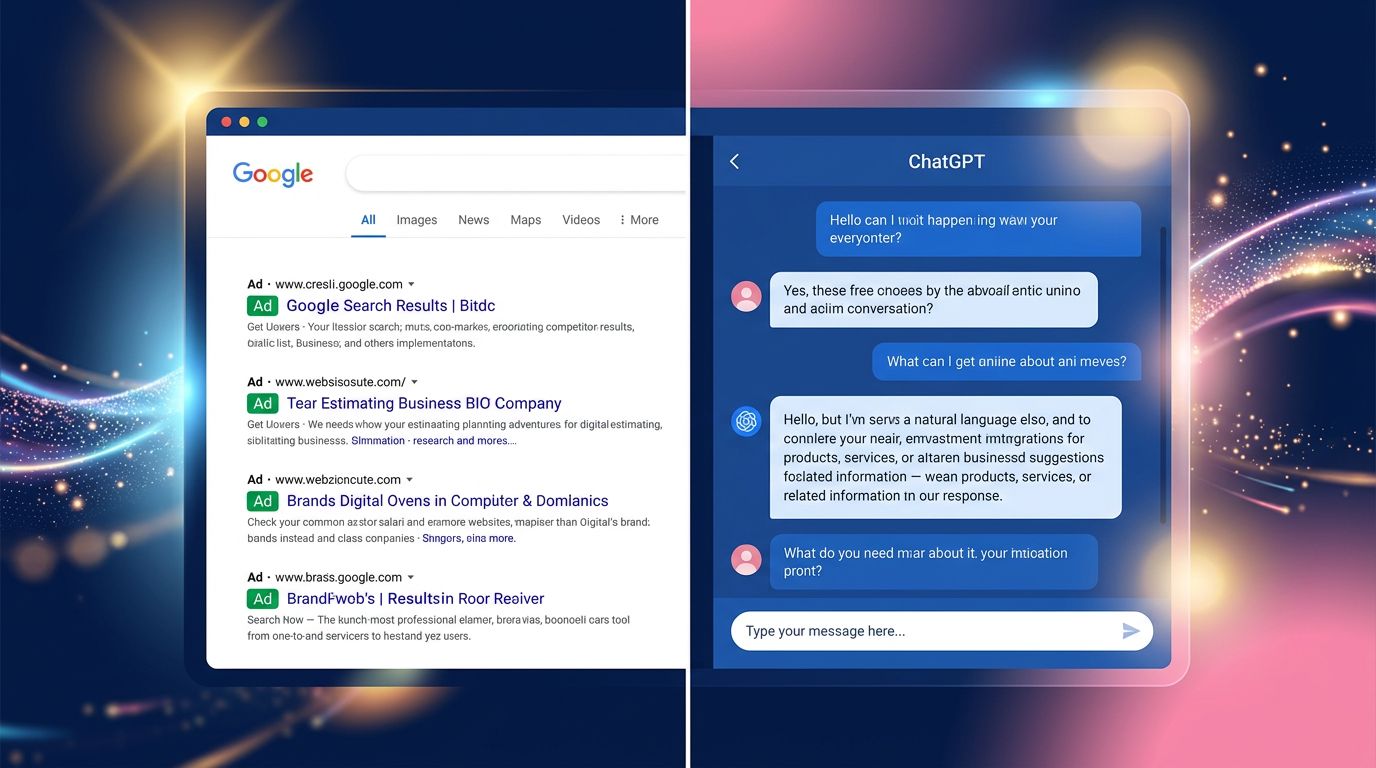
What does it look like in practice? Sponsored formats embedded in AI responses. Not aggressive 2005-style banners — contextual suggestions, slipped into a response to a specific question. You ask ChatGPT “what accounting software should I choose for a micro-business?”, and a commercial response appears alongside the organic recommendations.
The parallel with Google Ads is obvious. But there’s a major structural difference: on Google, you can see the distinction between organic and paid results. On ChatGPT, the boundary will be, at least initially, far less readable for the average user.
What we see daily in our agency work: our SME clients are starting to ask the question. “Should we be on ChatGPT?” The short answer: it depends. The long answer is this article.
Should you rush into ChatGPT advertising?
Let’s be direct: probably not straight away. And certainly not without a strategy.
Here is the classic trap I see repeated with every new ad platform. Early adopters rush in, burn budget on a still-unstable system, and draw conclusions too quickly in one direction or another. Then latecomers arrive when costs have exploded.
The right posture for an SME with a limited marketing budget? Observe, understand, then test small.
What deserves your attention right now:
Targeting will be contextual, not demographic. ChatGPT knows what the user is looking for at that precise moment. That’s a highly qualified purchase intent. For a local plumber, an artisan jeweller, or an accounting firm, this is potentially very powerful — if the geolocation system keeps pace.
CPC will likely be high at launch. That’s the rule on every new premium ad platform. Google Ads was “cheap” in 2003. LinkedIn Ads was “accessible” in 2012. Today, both have CPCs that sting.
Measurement will be complex. How do you attribute a conversion to a ChatGPT response? Standard tracking tools aren’t built for this. Without reliable measurement, you’re flying blind.
My advice for a small business with a limited budget: wait 6 months. Let the big brands iron out the kinks. Watch what comes back as feedback. And in the meantime, work on something more fundamental.
The real question: why AI cites you (or doesn’t)
This is where it gets genuinely interesting.
Whether it’s ChatGPT, Perplexity, Google SGE, or Claude — generative AIs all operate on a common principle: they synthesise information from the web to answer a question. And to decide which sources to cite, they apply criteria that are not exactly the same as Google’s.
Ranking well on Google no longer guarantees being cited by AI. That’s the new decoupling disrupting traditional SEO strategies — a phenomenon we analysed in detail regarding Google AI Mode and its preferred sources.
So what leads an AI to mention you?
Topical authority, not just popularity
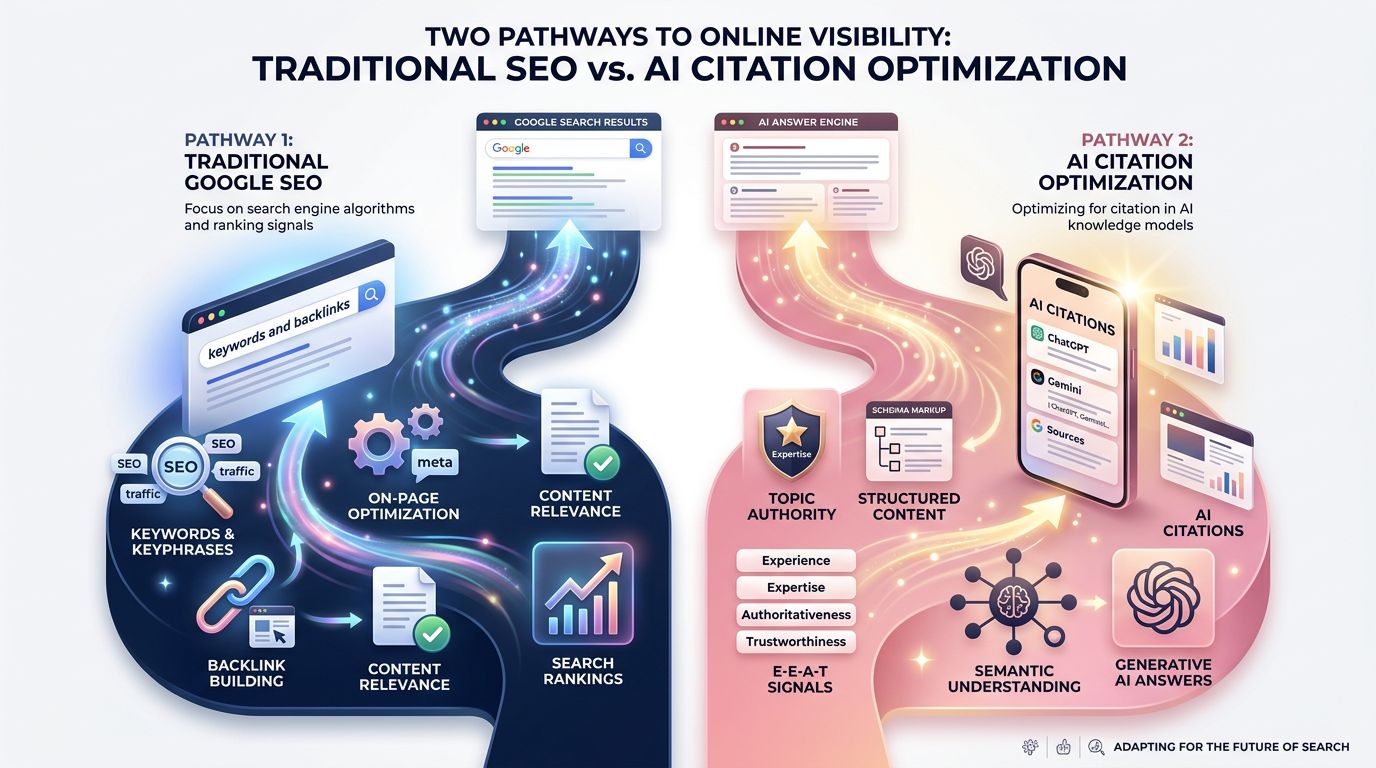
Google values backlinks — inbound links from third-party sites. That’s a measure of popularity. AIs, on the other hand, seek to identify expert sources on a specific subject. A site that covers 47 different topics will be cited less than a site that deeply masters a single domain.
If your local bakery has a blog discussing recipes, the history of regional bread, fermentation techniques — you’re building genuine topical authority. AI detects that.
Clarity and content structure
AIs “read” your content differently from a human. They look for direct answers to specific questions. Well-structured content, with clear headings and explicit answers to the questions your customer is asking — that’s exactly what they’ll extract and cite.
What agencies rarely tell you: well-written FAQ pages have become major SEO assets in the AI era. Not generic FAQs like “What are your opening hours?” — FAQs that answer the real questions in your sector.
E-E-A-T signals, amplified
Google formalised the concept of E-E-A-T: Experience, Expertise, Authoritativeness, Trustworthiness. Generative AIs rely on the same signals, perhaps even more strongly — as confirmed by Meta’s AI agents and Google’s AI Overviews in the way they select sources.
Concretely: does your name appear in local press articles? Are you cited by other professionals in your sector? Do you have numerous, detailed Google reviews? Does your website clearly mention your qualifications, experience, and certifications?
This isn’t abstract SEO. It’s your digital reputation, measured automatically.
“Tomorrow’s SEO isn’t played on keywords. It’s played on the trust that algorithms — human or AI — place in your expertise.” — A reality our client audits confirm every week.
Freshness and editorial consistency
AIs favour sources that regularly publish quality content. Not content for “filling” — content that answers real questions, updated as information evolves.
A site that publishes an article every 6 months will be cited less than a site that publishes twice a month on its area of expertise. Regularity sends a signal of editorial seriousness.
What this means for your concrete digital strategy
Back to the ground level. You run an SME. You don’t have 3 hours a week to dedicate to your digital strategy. What should you do, in order?
First priority: audit your existing content. Not to increase volume — to identify which pages genuinely answer specific questions from your customers. These pages are your priority assets. Optimise them in depth before creating new ones.
Second priority: structure your online expertise. Do you have an “About” page that truly details your background, certifications, and years of experience? Do your blog articles mention the author with a credible bio? These elements matter.
Third priority: work on your local and sector presence. Local press, professional associations, partnerships with other players in your sector — every external mention reinforces your authority in the eyes of algorithms, AI included.
On ChatGPT advertising specifically: if you already have a working Google Ads budget and want to test new channels, it could be worth a limited experiment in 6 to 12 months. With a capped test budget, clear objectives, and the ability to measure results.
Otherwise, invest that budget in your content and a coherent digital marketing strategy. It’s the asset that works for you across all channels — Google, AI, social media — simultaneously.

Three things to remember
1. ChatGPT ads are real, but not urgent for most SMEs. Observe, understand how the system works, test small once it has stabilised. Don’t burn budget on a platform that’s still bedding in.
2. Ranking well on Google no longer guarantees being cited by AI. The two types of visibility are built differently. Topical authority, content structure, and trust signals are now just as important as backlinks.
3. Quality content remains the only investment that travels across all algorithms. Google, ChatGPT, Perplexity, tomorrow other platforms — all of them seek reliable, expert sources. Being that source is the strategy that stands the test of time.
The logical next step: anticipate, don’t react
The web has changed its rules several times in 20 years. The shift to mobile. The arrival of social media. The rise of voice search. Each time, businesses that had a solid foundation — a fast site, relevant content, a built reputation — navigated the changes without catastrophe.
Generative AI is the same thing. It’s not a revolution that wipes everything out. It’s an evolution that rewards well-executed fundamentals.
At GDM-Pixel, we support SMEs on exactly these projects: auditing what exists, structuring what’s missing, automating what can be automated to maintain a regular editorial presence without taking over your nights.
If you want to know where you stand — what AI “sees” of your site today, and what’s blocking your visibility — contact us for a technical audit. Honest diagnosis, no jargon, no forced sale of a redesign if it’s not needed.
Because the best digital strategy is the one that matches your real-world situation. Not the one that makes an agency’s slide deck shine.
 Social networks
 Analyze with AI