+33-9-7266-3068
 contact@gdm-pixel.fr








 TL;DR - Key Takeaways at a Glance
What your competitor will never tell you about their site
A client called us in a panic a few months ago. Their e-commerce site had dropped 40 positions on its main keywords after a Google Core Update. No manual penalty. No duplicate content. No toxic backlinks. Nothing visible in Search Console.
We dug deeper. And we found it.
Their site was exposing order data through predictable URLs. Anyone could access another customer’s information simply by changing a single digit in the URL. A classic IDOR vulnerability — and a massive trust signal against them in Google’s eyes.
That’s the problem no one explains: your site’s technical security isn’t just a data protection issue. It’s a direct SEO authority factor. And recent Google Core Updates have made it impossible to ignore.
What an IDOR vulnerability is and why it concerns your site
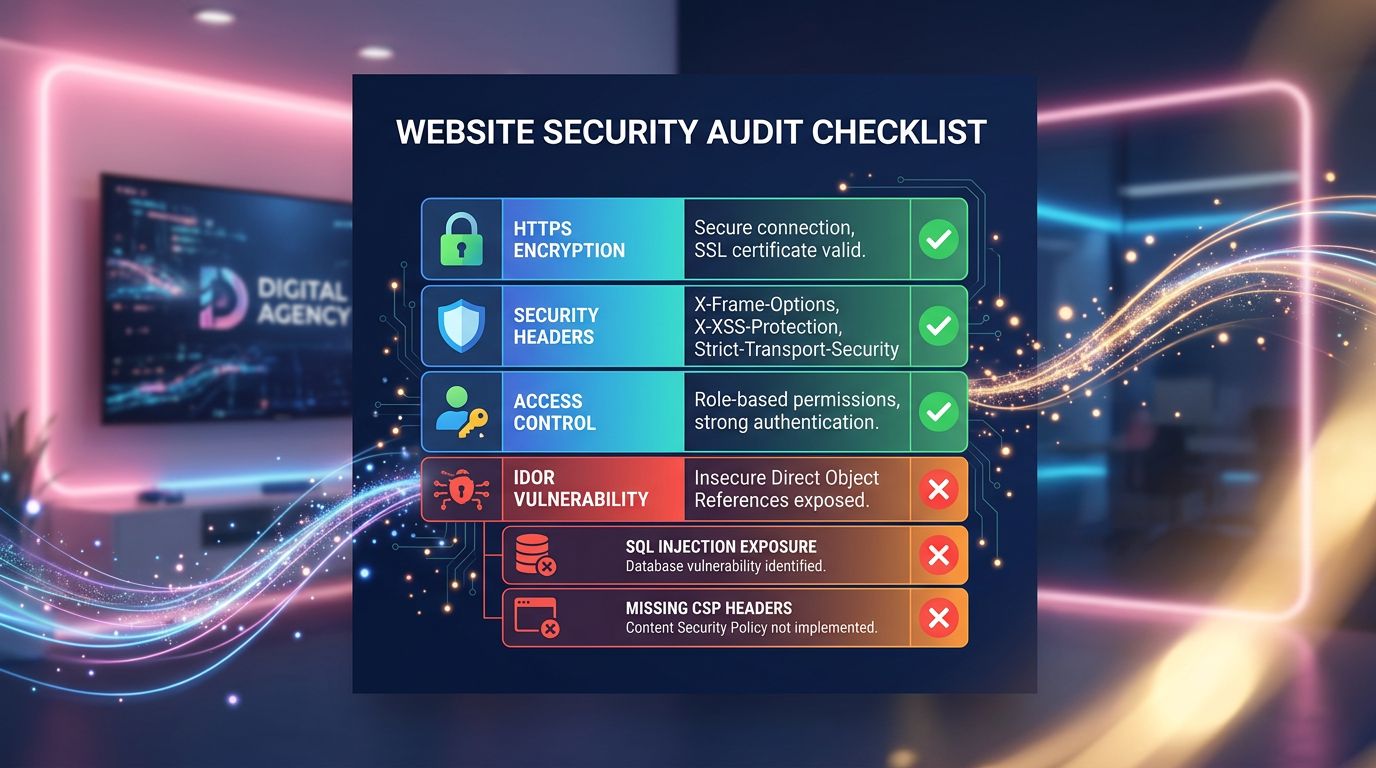
IDOR stands for Insecure Direct Object Reference. Plain-language translation: your site leaves doors open that anyone can push through.
The typical scenario: a logged-in user accesses their order via the URL mysite.com/order/1042. They change 1042 to 1043. And they see someone else’s order — name, address, phone, purchase history.
It’s that simple. And it’s terrifyingly common.
This isn’t a vulnerability reserved for large enterprises. We find it on poorly configured PrestaShop sites, WordPress installations with cheap plugins, and rushed custom builds. After 15 years of audits, we can tell you it’s one of the most underestimated vulnerabilities in SMEs.
Why does this affect your SEO? Because Google crawls your site. Because malicious bots do too. And because when sensitive data becomes publicly accessible — sometimes even accidentally indexed — your institutional credibility collapses. This is exactly the kind of problem highlighted in our complete guide to technical SEO: foundations matter as much as content.

How Google evaluates a site’s technical reliability
Here’s where it gets interesting.
Google doesn’t grade your site on your antivirus quality. But it measures signals that, taken together, build — or destroy — your authority in its algorithms.
Core Updates are not content-only updates. Since 2023, and even more markedly with the 2025-2026 updates, Google has been integrating institutional reliability criteria into its evaluation. The E-E-A-T framework (Experience, Expertise, Authoritativeness, Trustworthiness) has evolved. The T for Trustworthiness now carries more weight than ever.
What we concretely observe with our clients during audits:
- Sites with partial HTTPS configuration errors lose domain authority
- Sites that expose indexable admin pages suffer crawl penalties
- Sites with unsecured redirects have their crawl budget wasted on useless pages
- Sites with known vulnerabilities (listed in public CVEs) are sometimes treated with less trust by ranking systems
“Trust is the new PageRank.” — a formulation we’ve used internally since 2023, and the latest Core Updates are proving it right.
This isn’t theory. It’s what we measure on projects we’ve run.
Technical signals Google interprets as distrust
Let’s flip the perspective. Rather than listing what to do, let’s look at what Google interprets as negative reliability signals.
URLs that expose business logic
/user/1234/invoice or /order/5678/details without server-side access control — it’s an open invitation. If Google or a malicious bot crawls these URLs and finds sensitive content accessible without authentication, your site sends a signal of technical negligence.
Error pages that reveal your stack
A 500 page displaying “MySQL Error: Table ‘wp_users’ doesn’t exist” or a complete PHP stack trace — that’s intelligence served on a plate. Google doesn’t directly penalize these errors, but malicious bots use them to map your vulnerabilities. And the consequences (downtime, hacking, compromised data) have a direct, measurable SEO impact.
A poorly configured SSL certificate
HTTPS has been a prerequisite since 2014. But an expired certificate, mixed HTTP/HTTPS content, or a poorly parameterized 301 redirect — we still see these in our 2025 audits. And they remain a potential demotion signal.
Absent security headers
X-Content-Type-Options, X-Frame-Options, Content-Security-Policy — these HTTP headers are invisible to your visitors but readable by Google and security audit tools. Their absence signals a poorly maintained site. A poorly maintained site is a less trustworthy site — a finding that aligns with Google’s official guide on the real SEO priorities for 2026.
The March 2026 Core Update: what institutional sites understood
Sites that survived — or even improved — during the latest Core Updates have one thing in common. It’s not their publication frequency. It’s not their backlink count.
It’s their systemic reliability.
Google now favors sources that demonstrate overall technical mastery: security, accessibility, performance, clean architecture. Institutional sites (government agencies, major brands, reference media outlets) naturally have these standards. But there’s nothing stopping a small business from reaching them.
What agencies never tell you: technical security is a long-term SEO investment. A secure site doesn’t drop during Core Updates. It doesn’t lose credibility when a competitor reports a vulnerability to Google via a spam report. It doesn’t see its data accidentally indexed and frantically de-indexed.
If I were in your position, with a limited budget, here’s where I’d prioritize:
- Security audit before any SEO audit — no point optimizing content on a leaking site
- Systematic server-side access control — every private resource must be verified, not just hidden
- Security headers configured in 30 minutes — immediate ROI, near-zero cost
- Monitoring of 4xx/5xx errors — crawl anomalies are often symptoms of vulnerabilities
What an audit concretely reveals (and what we do)
On the audit projects we run at GDM-Pixel, we follow a two-phase process.
Phase 1: exposure mapping. We crawl the site the way Google does, identify resources accessible without authentication, test predictable URL patterns, check HTTP headers. In 3 to 4 hours, we have a complete picture of active vulnerabilities.
Phase 2: prioritization by SEO + security impact. Not all vulnerabilities are equal. An IDOR on a customer order page is critical — exposed personal data, GDPR risk, Google distrust signal. A missing header on a static page is a 15-minute quick win. We sort, prioritize, document.
The result: an action plan with realistic deadlines and measurable gains. Not an 80-page report no one reads.
“Our experience confirms it: sites audited and secured before a Core Update hold up better than those that face the update reactively.”
This isn’t a ranking guarantee. It’s a reduction in demotion risk. The distinction matters.

Three concrete actions to take this week
No theory. Here’s what you can check or delegate right now.
Test your logged-in URLs. If your site has a customer area, an order, a form with an identifier in the URL — test it manually by changing the number or identifier. If you access data that isn’t yours, you have an active IDOR vulnerability. Call your developer tonight.
Check your HTTP headers. Go to securityheaders.com and enter your URL. The result is immediate. If you get an F or a D, you have work to do. If you get an A, you’re already in the top 20% of French SME sites.
Audit your Search Console for crawl anomalies. A spike of 404s on URLs with numeric patterns (/page/1, /page/2, /page/999) may signal a bot testing your endpoints. It’s an early signal not to ignore — and one we systematically integrate into our natural SEO services.
These three checks take less than an hour. And they can save you from a ranking drop that will take months to correct.
Security isn’t optional — it’s the foundation of your online credibility
We always return to the same observation after 15 years in the industry: companies that last online are those that treated their site as a serious asset, not a brochure.
A secure site protects your customers. It withstands Core Updates. It sends Google the right institutional reliability signals. And it spares you a panicked Monday morning call because customer data has become publicly accessible.
The good news: these standards are accessible to an SME with a controlled budget. These aren’t €50,000 redesign projects. They’re audits, configurations, development best practices — that you can have in place within a few days.
Is your site ready for the next Core Update?
At GDM-Pixel, we offer technical audits covering security, SEO, and performance in a single pass. Honest diagnosis — we don’t sell redesigns when a 2-day fix is sufficient. Contact us for an initial conversation — we’ll quickly tell you whether your site has active vulnerabilities and what that means as a concrete risk to your rankings.
 Social networks
 Analyze with AI