+33-9-7266-3068
 contact@gdm-pixel.fr








 TL;DR - Key Takeaways at a Glance
What Google I/O 2026 really changes for your website
AI agents coding entire operating systems. Interfaces generated in seconds. Websites assembled without a single line of hand-written code.
This is no longer science fiction. It is what Google demonstrated at I/O 2026.
And while everyone is getting excited about generation speed, nobody is asking the real question: if anyone can create a website in 10 minutes, what will make YOUR site actually useful?
Here is where it gets interesting. The AI revolution in web creation does not make technical expertise obsolete — it shifts the problem. The challenge will no longer be “how to build”, but “what to build, and for whom”.
And that, an AI cannot guess on its own.
The speed trap: generating fast does not mean generating right
After 15 years building websites for small and medium businesses in Normandy, I have seen dozens of projects start from a client’s absolute certainty about what their user wanted.
That certainty was almost always wrong.
The owner of an artisan bakery in Caen was convinced his customers visited his site to see opening hours. In reality, 73% of sessions started with a search for photos of the weekend’s specialty breads — information he had buried at the bottom of the page, four clicks deep.
This gap between what we believe and what users actually do is the fundamental problem that AI does not solve. It accelerates it.
If you feed an AI agent your assumptions about your users, it will very quickly build a very beautiful site that answers questions nobody is asking. You will have industrialised the mistake.
“The real problem of the web has never been construction speed. It is the relevance of what we build.” — a finding that 15 years in the field confirms every week.
What an honest prototype really is — and why it matters more than ever now
A prototype, in our field, is a clickable mockup. A simulation of your future website, without the code behind it.
But there are prototypes and prototypes.
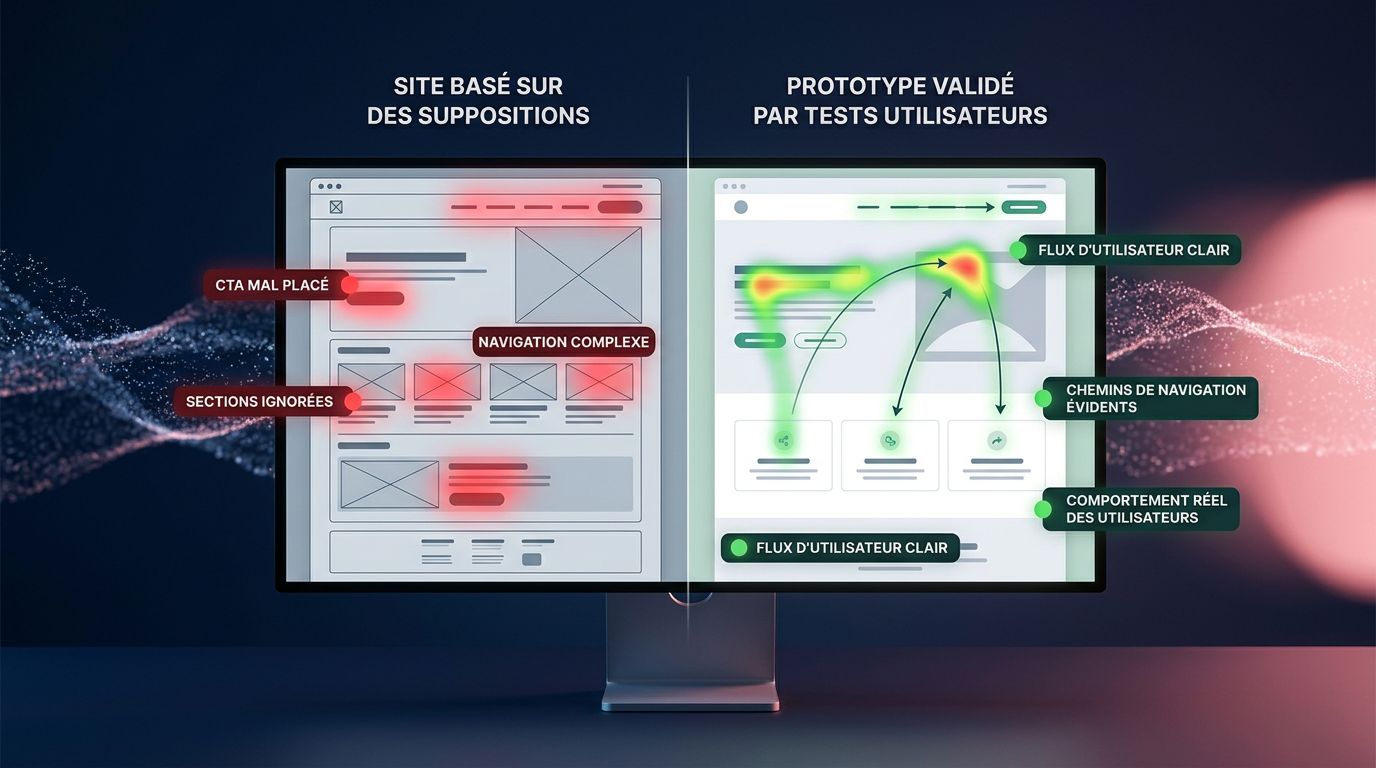
The validation prototype is the one you show your client in a meeting. It looks great, the animations are smooth, everyone nods. This is what I call the complacency prototype — it validates hypotheses with people who do not represent your users.
The honest prototype is different. It is the one you put in the hands of real users, with no guide, no explanation, no “you see here you click on…”. And you watch what actually happens.
What we concretely observe with our clients when we do this exercise:
Users systematically ignore what the client considers a priority. The large hero banner with the corporate tagline? Skimmed in 0.3 seconds. The small “Request a quote” button hidden in the footer? The one everyone is looking for.
Imagined user journeys do not exist. We design logical navigation funnels. Users, however, land on the product page via Google, jump to the FAQ, go back, abandon, return two days later. The logic is theirs, not ours.
The words we use are not the words they search for. “HR support solutions” vs “help managing my employees” — same service, two entirely different worlds in terms of search and comprehension.
These revelations cannot be invented by an AI. It needs us to provide them.
Why AI needs your user data to produce something useful
Here is how a website creation workflow with AI agents concretely works in 2026: you define the specs, you provide the context, the agent generates the architecture, the code, the structural content.
The quality of the result is directly proportional to the quality of what you give it.
This is the garbage in, garbage out principle — but applied at the speed of an agent that codes 10 pages in 2 hours.
In our workflow at GDM-Pixel, we have industrialised production with Claude Code and MCP servers. We deliver sites in 3 to 7 days instead of 3 to 4 weeks. But this speed gain only has value because we invest the time saved in better scoping the project upfront.
Concretely, what AI needs to know to generate a truly effective site:
The real friction points of your users
Not what you think their problems are. What you have observed during tests. Where they hesitate. Where they drop off. What question they ask first when they call you.
The exact words they use
Not your industry terminology. Their words. The ones they type into Google. The ones they use when they describe their problem to you on the phone.
Real usage contexts
On mobile in transit? On desktop at the office with 12 tabs open? In an emergency situation? Context changes everything about information hierarchy.

How to run honest prototypes — even on an SME budget
I can already hear you: “That’s all well and good, but user testing is for large companies with dedicated UX teams.”
No. And this may be the biggest myth in the sector.
5 users are enough. This is the conclusion from Jakob Nielsen’s research — a global authority on web ergonomics — showing that 5 tests reveal 85% of major usability problems. No need for a panel of 200 people.
Your current clients are your best resource. Call the last 3 clients who bought from you. Ask them to browse your current site for 15 minutes while explaining what they are doing. Record the session with a tool like Hotjar or Microsoft Clarity (free). Watch without intervening.
What you discover will probably surprise you.
For a window installation company in Bayeux that we worked with, this 45-minute test revealed that all users first looked for examples of completed projects with prices — information absent from the site. Result: a gallery with price ranges on the homepage, and +40% quote requests within 3 months.
No AI needed for this diagnosis. Just 5 phone calls and open eyes.
“In practice, with our clients, the most valuable insights always come from the first 10 minutes of watching a real user on the site.”
Turning your observations into a usable AI brief
Once you have your real data — observed behaviours, user verbatims, identified friction points — you have something precious.
You have the raw material to effectively brief an AI agent.
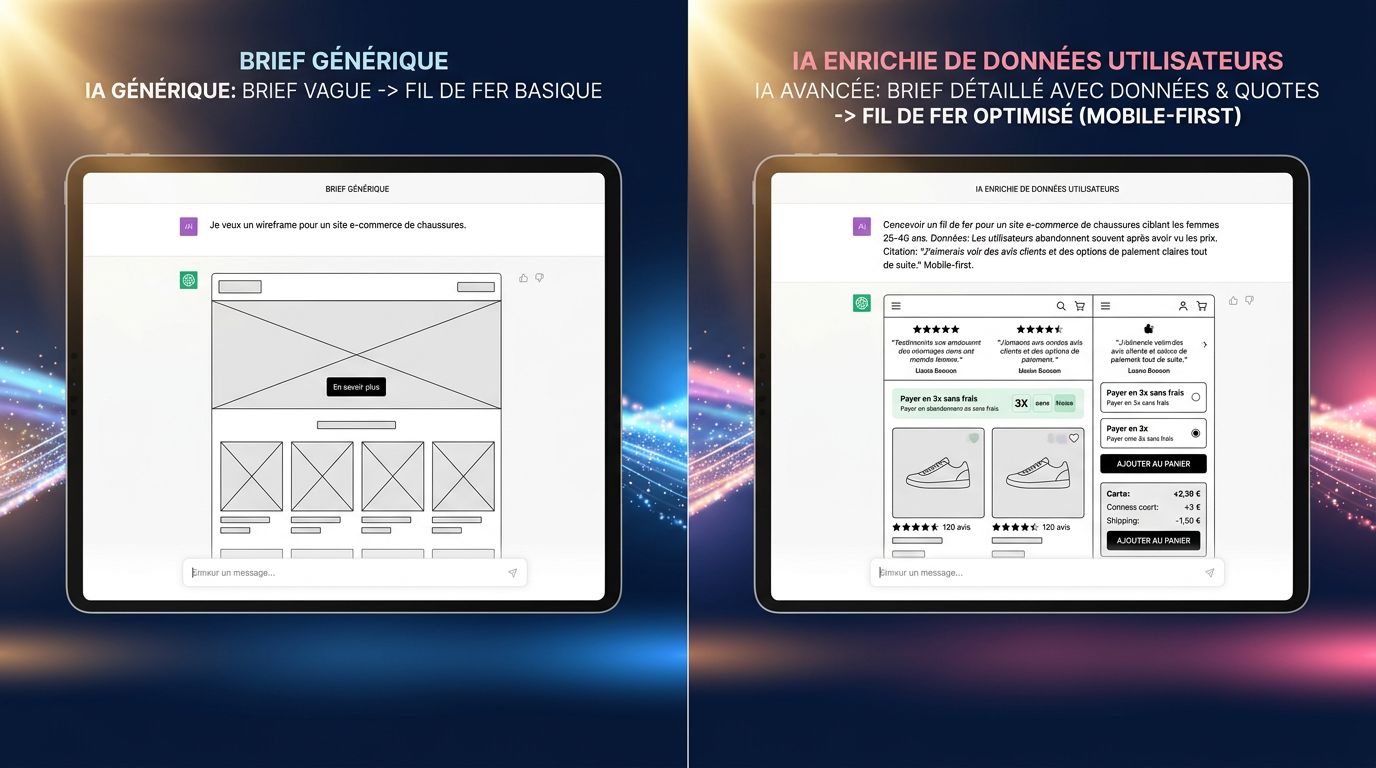
Here is the concrete difference in brief quality:
Brief without user data: “Create a showcase website for a plumbing SME with homepage, services, contact.”
The AI will generate something generic and functional. Like thousands of other plumbers’ sites — the kind of site that generates no clients.
Brief with real user data: “Create a site for a plumber in Caen. Users arrive mainly in emergencies (leaks, breakdowns) from mobile. Their first question is ‘can he come today?’. The phone number and availability must be visible immediately, before any scrolling. Quote requests for planned work arrive mostly in the evening — include a simple form accessible in a maximum of 2 clicks.”
The AI will generate a radically different architecture, centred on what truly matters for this specific user, in this precise context.
It is your field knowledge that makes the difference. Not the AI.
What this changes for your digital strategy in 2026 and beyond
Let us flip the situation for a moment.
If AI democratises site creation to the point where any competitor can generate one in a day, the technical barrier disappears entirely. What differentiates your site from theirs is solely the depth of your understanding of your users.
The businesses that will win in this context will not be those that master AI tools — everyone will master them. They will be those that have invested in knowing their customers.
Direct observation. Regular testing. Collected verbatims. Documented behaviours.
This is a strategic asset your competitors cannot copy overnight with an AI agent.
In Normandy as everywhere in France, SMEs that perform online are not necessarily those with the biggest budget. They are those whose site precisely answers what their local customer is looking for, at the moment they search, with the words they use. This is precisely the approach we apply to every website creation.
This knowledge is built by talking to your clients. By observing them. By testing, measuring, adjusting.
AI accelerates execution. It does not replace understanding.
Three concrete actions to start this week
1. Install Microsoft Clarity on your site today. Free, GDPR-compatible, it records your visitor sessions and automatically generates heatmaps. In one week, you will have real data on your users’ behaviour. No excuse not to do it.
2. Call 3 recent clients and watch them navigate. 15 minutes per call, with screen sharing. Ask them to find specific information on your site without guiding them. Record (with their agreement). Say nothing. Watch. Take notes on what blocks them.
3. Document the 5 questions your clients ask most often. By email, by phone, in meetings. These questions are the clearest signals of what is missing from your site. If everyone asks “do you work in [city X]?”, that information should be on the homepage, not buried in your terms and conditions.
These three actions cost nothing. They take a few hours. And they give you exactly what you need to brief effectively — whether that is a human developer or an AI agent.
Conclusion: the competitive advantage that resists automation
AI-driven website creation will transform our sector faster than most people anticipate. Technical barriers will crumble. Timelines will compress further. Production costs will fall.
But one thing cannot be automated: the trust relationship with your users, built over years of observation, listening, and adjustment.
At GDM-Pixel, we have industrialised our production. We deliver 5x faster than before. But the time we have freed up, we invest upfront — in understanding the real challenges of our clients, in observing user behaviours, in building briefs that guide the AI toward what truly matters.
AI works for us. But it is we who tell it where to go.
Does your current site truly reflect what your users are looking for — or what you think they are looking for? If you are not certain of the answer, now is the time to find out. Contact us for a user journey audit — we will tell you what is blocking, without trying to sell you a redesign if it is not necessary.
 Social networks
 Analyze with AI